


Trends in the Treatment of Anemia Using Recombinant Human Erythropoietin in Patients with HIV Infection
Supporting Files
Public Domain

-
Dec 29 2011
-
Details
-
Alternative Title:Open AIDS J
-
Personal Author:
-
Description:Background:
Treating anemia with erythropoietin (EPO) to hemoglobin (Hb) endpoints >11 g/dL may increase risk of serious adverse cardiovascular events.
Methods:
We used medical records data (1996-2003 from the Adolescent Spectrum of HIV Disease Project [ASD] and 1996-2006 from the HIV Outpatient Study [HOPS]) to describe EPO prescription patterns for mildly, moderately, or severely anemic HIV-infected patients. We calculated proportions prescribed EPO and treated to Hb>12 g/dL, and tested for trends over time. We calculated median hemoglobin at first EPO prescription, and described temporal changes using linear regression.
Results:
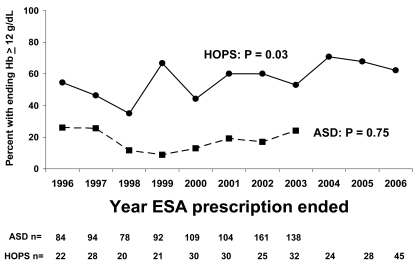
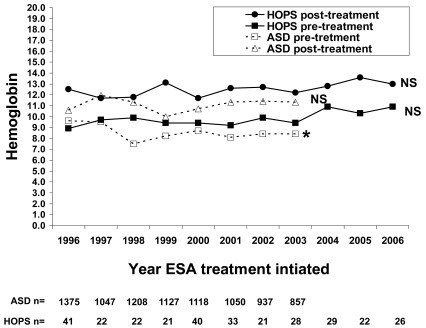
Among 37,395 patients in ASD and 7,005 patients in HOPS, EPO prescription increased over time for moderately anemic patients; for patients with severe anemia, EPO prescription increased only among ASD patients. Hb at EPO prescription decreased over time in ASD patients (median=8.5 g/dL), but not in HOPS patients (median 9.5 g/dL). Percentage of EPO-treated patients with post-treatment Hb>12 g/dL was 18.3% in ASD and stable, and was 56.7% in HOPS and increased over time (p = 0.03).
Conclusions:
Through 2006, EPO prescription increased over time for patients with moderate or severe anemia. Many patients treated with EPO had post-treatment Hb>12 g/dL. Based on 2011 FDA recommendations, changes in previous prescription practices will be needed.
-
Subjects:
-
Source:Open AIDS J. 2011; 5:113-118.
-
Document Type:
-
Volume:5
-
Collection(s):
-
Main Document Checksum:urn:sha256:28c386ad8583b40b887c198df88ae4602e9e451c37772122b8bfed318c4f2b2c
-
Download URL:
-
File Type:
 [PDF
- 1.45 MB
]
[PDF
- 1.45 MB
]
Supporting Files


ON THIS PAGE




CDC STACKS serves as an archival repository of CDC-published products including
scientific findings,
journal articles, guidelines, recommendations, or other public health information authored or
co-authored by CDC or funded partners.
As a repository, CDC STACKS retains documents in their original published format to ensure public access to scientific information.
As a repository, CDC STACKS retains documents in their original published format to ensure public access to scientific information.
You May Also Like
COLLECTION
CDC Public Access