


Assessing the Suitability of Multiple Dispersion and Land Use Regression Models for Urban Traffic-Related Ultrafine Particles
Supporting Files

-
1 03 2017
-
File Language:
English
Details
-
Alternative Title:Environ Sci Technol
-
Personal Author:
-
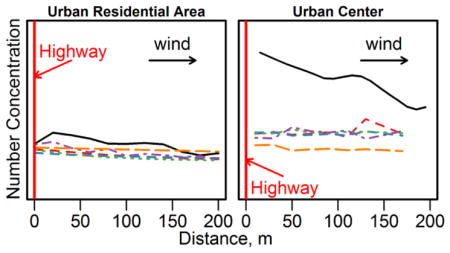
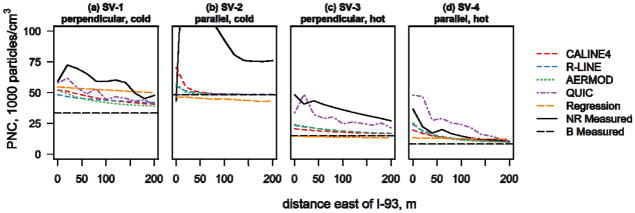
Description:Comparative evaluations are needed to assess the suitability of near-road air pollution models for traffic-related ultrafine particle number concentration (PNC). Our goal was to evaluate the ability of dispersion (CALINE4, AERMOD, R-LINE, and QUIC) and regression models to predict PNC in a residential neighborhood (Somerville) and an urban center (Chinatown) near highways in and near Boston, Massachusetts. PNC was measured in each area, and models were compared to each other and measurements for hot (>18 °C) and cold (<10 °C) hours with wind directions parallel to and perpendicular downwind from highways. In Somerville, correlation and error statistics were typically acceptable, and all models predicted concentration gradients extending ∼100 m from the highway. In contrast, in Chinatown, PNC trends differed among models, and predictions were poorly correlated with measurements likely due to effects of street canyons and nonhighway particle sources. Our results demonstrate the importance of selecting PNC models that align with study area characteristics (e.g., dominant sources and building geometry). We applied widely available models to typical urban study areas; therefore, our results should be generalizable to models of hourly averaged PNC in similar urban areas.
-
Subjects:
-
Source:Environ Sci Technol. 51(1):384-392
-
Pubmed ID:27966909
-
Pubmed Central ID:PMC5209293
-
Document Type:
-
Funding:
-
Volume:51
-
Issue:1
-
Collection(s):
-
Main Document Checksum:urn:sha256:85c06c1ef32e06a5b921744be7266721e567bc97d788b05ab75398dac0503fd8
-
Download URL:
-
File Type:
 [PDF
- 708.58 KB
]
[PDF
- 708.58 KB
]
Supporting Files


File Language:
English
ON THIS PAGE



CDC STACKS serves as an archival repository of CDC-published products including
scientific findings,
journal articles, guidelines, recommendations, or other public health information authored or
co-authored by CDC or funded partners.
As a repository, CDC STACKS retains documents in their original published format to ensure public access to scientific information.
As a repository, CDC STACKS retains documents in their original published format to ensure public access to scientific information.
You May Also Like
COLLECTION
CDC Public Access