


False-Positive Human Immunodeficiency Virus Enzyme Immunoassay Results in Pregnant Women
Supporting Files
Public Domain

-
Jan 27 2011
-
File Language:
English
Details
-
Alternative Title:PLoS One
-
Personal Author:
-
Description:Objective
Examine whether false-positive HIV enzyme immunoassay (EIA) test results occur more frequently among pregnant women than among women who are not pregnant and men (others).
Design
To obtain a large number of pregnant women and others tested for HIV, we identified specimens tested at a national laboratory using Genetic Systems HIV-1/HIV-2 Plus O EIA from July 2007 to June 2008.
Methods
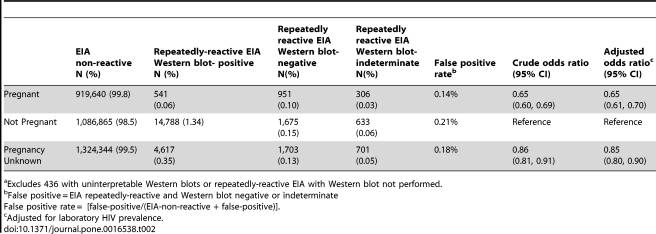
Specimens with EIA repeatedly reactive and Western blot-negative or indeterminate results were considered EIA false-positive. We compared the false-positive rate among uninfected pregnant women and others, adjusting for HIV prevalence. Among all reactive EIAs, we evaluated the proportion of false-positives, positive predictive value (PPV), and Western blot bands among indeterminates, by pregnancy status.
Results
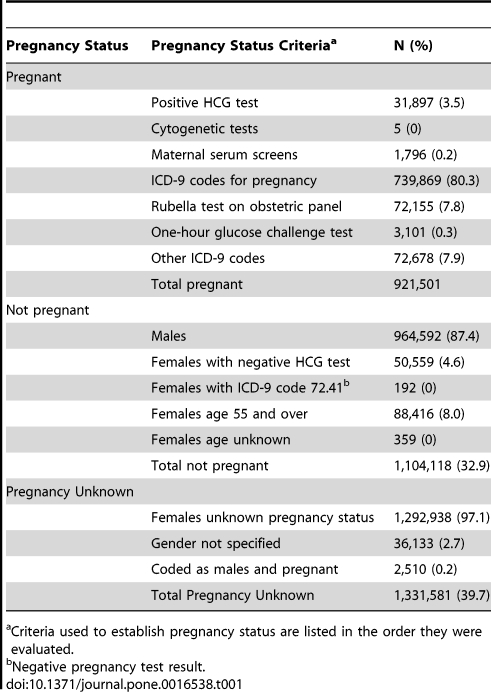
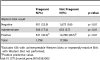
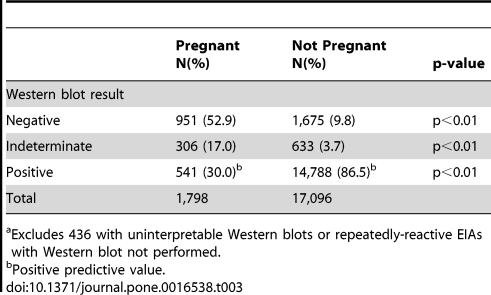
HIV prevalence was 0.06% among 921,438 pregnant women and 1.34% among 1,103,961 others. The false-positive rate was lower for pregnant women than others (0.14% vs. 0.21%, odds ratio 0.65 [95% confidence interval 0.61, 0.70]). Pregnant women with reactive EIAs were more likely than others (p<0.01) to have Western blot-negative (52.9% vs. 9.8%) and indeterminate results (17.0% vs. 3.7%) and lower PPV (30% vs. 87%). The p24 band was detected more often among pregnant women (p<0.01).
Conclusions
False-positive HIV EIA results were rare and occurred less frequently among pregnant women than others. Pregnant women with reactive EIAs were more likely to have negative and indeterminate Western blot results due to lower HIV prevalence and higher p24 reactivity, respectively. Indeterminate results may complicate clinical management during pregnancy. Alternative methods are needed to rule out infection in persons with reactive EIAs from low prevalence populations.
-
Subjects:
-
Source:PLoS One. 6(1).
-
Document Type:
-
Volume:6
-
Issue:1
-
Collection(s):
-
Main Document Checksum:urn:sha-512:3438bc555b6d1016b465b2f17f3664af80029ca6e599e0c11e54857f6ae7e5ff1db99d68f2a347960573990cf325cc642702667e2c8a911d04d9b035f4a03ff2
-
Download URL:
-
File Type:
 [PDF
- 96.49 KB
]
[PDF
- 96.49 KB
]
Supporting Files


File Language:
English
ON THIS PAGE

CDC STACKS serves as an archival repository of CDC-published products including
scientific findings,
journal articles, guidelines, recommendations, or other public health information authored or
co-authored by CDC or funded partners.
As a repository, CDC STACKS retains documents in their original published format to ensure public access to scientific information.
As a repository, CDC STACKS retains documents in their original published format to ensure public access to scientific information.
You May Also Like
COLLECTION
CDC Public Access