


Pertussis-Associated Pneumonia in Infants and Children From Low- and Middle-Income Countries Participating in the PERCH Study
Supporting Files

-
Dec 01 2016
File Language:
English
Details
-
Alternative Title:Clin Infect Dis
-
Personal Author:Barger-Kamate, Breanna ; Deloria Knoll, Maria ; Kagucia, E. Wangeci ; Prosperi, Christine ; Baggett, Henry C. ; Brooks, W. Abdullah ; Feikin, Daniel R. ; Hammitt, Laura L. ; Howie, Stephen R. C. ; Levine, Orin S. ; Madhi, Shabir A. ; Scott, J. Anthony G. ; Thea, Donald M. ; Amornintapichet, Tussanee ; Anderson, Trevor P. ; Awori, Juliet O. ; Baillie, Vicky L. ; Chipeta, James ; DeLuca, Andrea N. ; Driscoll, Amanda J. ; Goswami, Doli ; Higdon, Melissa M. ; Hossain, Lokman ; Karron, Ruth A. ; Maloney, Susan ; Moore, David P. ; Morpeth, Susan C. ; Mwananyanda, Lawrence ; Ofordile, Ogochukwu ; Olutunde, Emmanuel ; Park, Daniel E. ; Sow, Samba O. ; Tapia, Milagritos D. ; Murdoch, David R. ; O'Brien, Katherine L. ; Kotloff, Karen L.
-
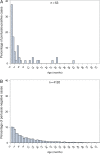
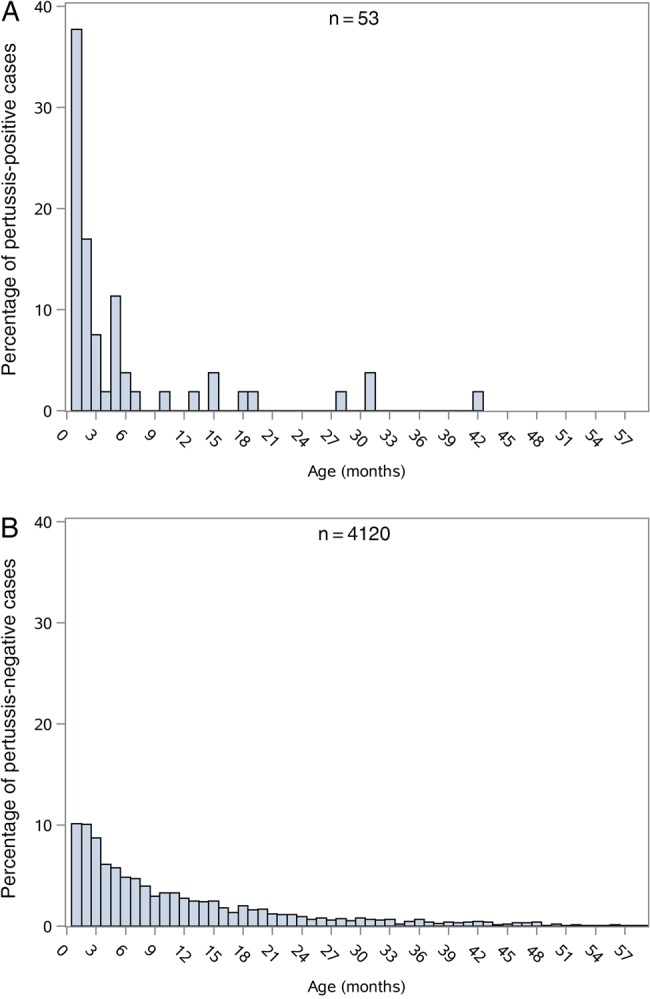
Description:Few data exist describing pertussis epidemiology among infants and children in low- and middle-income countries to guide preventive strategies.| Children 1-59 months of age hospitalized with World Health Organization-defined severe or very severe pneumonia in 7 African and Asian countries and similarly aged community controls were enrolled in the Pneumonia Etiology Research for Child Health study. They underwent a standardized clinical evaluation and provided nasopharyngeal and oropharyngeal swabs and induced sputum (cases only) for Bordetella pertussis polymerase chain reaction. Risk factors and pertussis-associated clinical findings were identified.| Bordetella pertussis was detected in 53 of 4200 (1.3%) cases and 11 of 5196 (0.2%) controls. In the age stratum 1-5 months, 40 (2.3% of 1721) cases were positive, all from African sites, as were 8 (0.5% of 1617) controls. Pertussis-positive African cases 1-5 months old, compared to controls, were more often human immunodeficiency virus (HIV) uninfected-exposed (adjusted odds ratio [aOR], 2.2), unvaccinated (aOR, 3.7), underweight (aOR, 6.3), and too young to be immunized (aOR, 16.1) (all P ≤ .05). Compared with pertussis-negative African cases in this age group, pertussis-positive cases were younger, more likely to vomit (aOR, 2.6), to cough ≥14 days (aOR, 6.3), to have leukocyte counts >20 000 cells/µL (aOR, 4.6), and to have lymphocyte counts >10 000 cells/µL (aOR, 7.2) (all P ≤ .05). The case fatality ratio of pertussis-infected pneumonia cases 1-5 months of age was 12.5% (95% confidence interval, 4.2%-26.8%; 5/40); pertussis was identified in 3.7% of 137 in-hospital deaths among African cases in this age group.| In the postneonatal period, pertussis causes a small fraction of hospitalized pneumonia cases and deaths; however, case fatality is substantial. The propensity to infect unvaccinated infants and those at risk for insufficient immunity (too young to be vaccinated, premature, HIV-infected/exposed) suggests that the role for maternal vaccination should be considered along with efforts to reduce exposure to risk factors and to optimize childhood pertussis vaccination coverage.
-
Subjects:
-
Source:Clin Infect Dis. 2016; 63(Suppl 4):S187-S196
-
Pubmed ID:27838672
-
Pubmed Central ID:PMC5106621
-
Document Type:
-
Funding:MC_UP_A900_1124/Medical Research Council/United Kingdom ; MC_U190074190/Medical Research Council/United Kingdom ; MC_UP_A900_1116/Medical Research Council/United Kingdom ; R24 TW007988/TW/FIC NIH HHS/United States ; MC_UP_A900_1122/Medical Research Council/United Kingdom ; MC_U190081991/Medical Research Council/United Kingdom ; MC_U190088478/Medical Research Council/United Kingdom ; Wellcome Trust/United Kingdom
-
Volume:63
-
Collection(s):
-
Main Document Checksum:urn:sha256:bdad87a37c39ce423268798a94510eead41484c7edd5af44083ddcad29450245
-
Download URL:
-
File Type:
 [PDF
- 275.40 KB
]
[PDF
- 275.40 KB
]
Supporting Files
-
html


File Language:
English
ON THIS PAGE

CDC STACKS serves as an archival repository of CDC-published products including
scientific findings,
journal articles, guidelines, recommendations, or other public health information authored or
co-authored by CDC or funded partners.
As a repository, CDC STACKS retains documents in their original published format to ensure public access to scientific information.
As a repository, CDC STACKS retains documents in their original published format to ensure public access to scientific information.
You May Also Like
COLLECTION
CDC Public Access