



Myofibroblasts and Lung Fibrosis Induced by Carbon Nanotube Exposure
Supporting Files
Public Domain
Peer Reviewed

-
2016/11/04
-
Available in CDC Stacks on 2016-11-04T00:00:00Z
File Language:
English
Details
-
Journal Article:Particle and Fibre Toxicology
-
Personal Author:
-
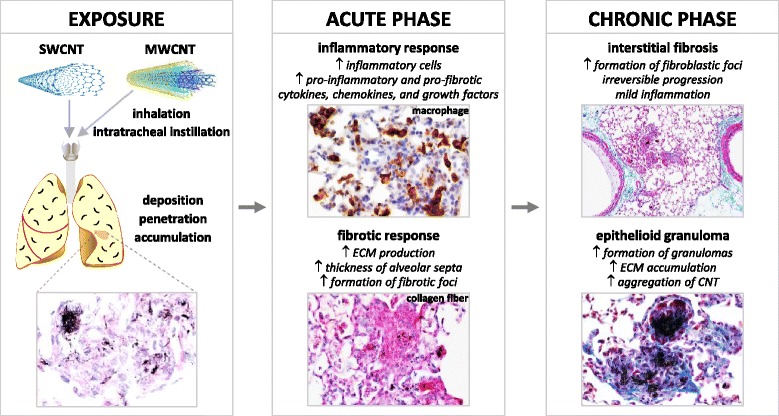
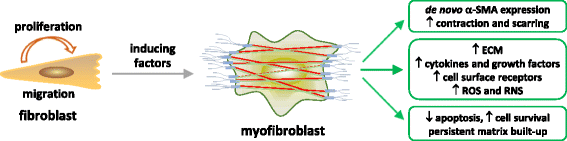
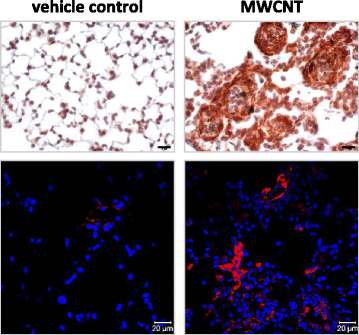
Description:Carbon nanotubes (CNTs) are newly developed materials with unique properties and a range of industrial and commercial applications. A rapid expansion in the production of CNT materials may increase the risk of human exposure to CNTs. Studies in rodents have shown that certain forms of CNTs are potent fibrogenic inducers in the lungs to cause interstitial, bronchial, and pleural fibrosis characterized by the excessive deposition of collagen fibers and the scarring of involved tissues. The cellular and molecular basis underlying the fibrotic response to CNT exposure remains poorly understood. Myofibroblasts are a major type of effector cells in organ fibrosis that secrete copious amounts of extracellular matrix proteins and signaling molecules to drive fibrosis. Myofibroblasts also mediate the mechano-regulation of fibrotic matrix remodeling via contraction of their stress fibers. Recent studies reveal that exposure to CNTs induces the differentiation of myofibroblasts from fibroblasts in vitro and stimulates pulmonary accumulation and activation of myofibroblasts in vivo. Moreover, mechanistic analyses provide insights into the molecular underpinnings of myofibroblast differentiation and function induced by CNTs in the lungs. In view of the apparent fibrogenic activity of CNTs and the emerging role of myofibroblasts in the development of organ fibrosis, we discuss recent findings on CNT-induced lung fibrosis with emphasis on the role of myofibroblasts in the pathologic development of lung fibrosis. Particular attention is given to the formation and activation of myofibroblasts upon CNT exposure and the possible mechanisms by which CNTs regulate the function and dynamics of myofibroblasts in the lungs. It is evident that a fundamental understanding of the myofibroblast and its function and regulation in lung fibrosis will have a major influence on the future research on the pulmonary response to nano exposure, particle and fiber-induced pneumoconiosis, and other human lung fibrosing diseases. Description provided by NIOSH
-
Subjects:
-
Keywords:
- Carbon nanotubes; Exposure levels; Risk factors; Animal studies; Animals; Laboratory animals; Fibrosis; Lung; Lung fibrosis; Cell function; Cellular function; Proteins; Molecular biology; Fibrosis;
- Author Keywords: Carbon nanotube; Myofibroblast; Lung fibrosis; Animal model; Mechanism; Extracellular matrix
-
Source:Part Fibre Toxicol 2016 Nov; 13:60
-
ISSN:1743-8977
-
Pubmed ID:27814727
-
Pubmed Central ID:PMC5097370
-
Document Type:
-
Genre:
-
Place as Subject:
-
CIO:
-
Division:
-
Topic:
-
Location:
-
Pages in Document:22 pdf pages
-
Volume:13
-
NIOSHTIC Number:nn:20048963
-
Contact Point Address:Qiang Ma, Health Effects Laboratory Division, National Institute for Occupational Safety and Health, Centers for Disease Control and Prevention, 1095 Willowdale Road, Morgantown, WV 26506
-
Email:qam1@cdc.gov
-
Federal Fiscal Year:2017
-
NORA Priority Area:
-
Peer Reviewed:True
-
Download URL:
-
File Type:
 [PDF - 1.94 MB]
 -
Collection(s):
-
Main Document Checksum:urn:sha-512:fcf60b19a0b29ed1869e6eedc5e348290d2b162e011c2aa21cbd9468c0bc426a59ec195790033152645faf9a7ba878d809ec709a2bd122d2f81d8a3ad55e229d
Supporting Files


File Language:
English
 Was this page helpful?
 Found an issue?



CDC STACKS serves as an archival repository of CDC-published products including
scientific findings, journal articles, guidelines, recommendations, or other public health information authored or
co-authored by CDC or funded partners.
As a repository, CDC STACKS retains documents in their original published format to ensure public access to scientific information.
As a repository, CDC STACKS retains documents in their original published format to ensure public access to scientific information.
You May Also Like