


Intermittent Preventive Treatment in Infants for the Prevention of Malaria in Rural Western Kenya: A Randomized, Double-Blind Placebo-Controlled Trial
Supporting Files
Public Domain

-
Apr 02 2010
-
File Language:
English
Details
-
Alternative Title:PLoS One
-
Personal Author:
-
Description:Background
Intermittent preventive treatment in infants (IPTi) with sulphadoxine-pyrimethamine (SP) for the prevention of malaria has shown promising results in six trials. However, resistance to SP is rising and alternative drug combinations need to be evaluated to better understand the role of treatment versus prophylactic effects.
Methods
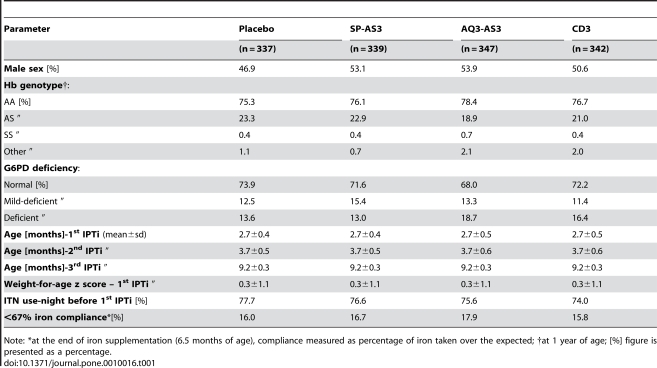
Between March 2004 and March 2008, in an area of western Kenya with year round malaria transmission with high seasonal intensity and high usage of insecticide-treated nets, we conducted a randomized, double-blind placebo-controlled trial with SP plus 3 days of artesunate (SP-AS3), 3 days of amodiaquine-artesunate (AQ3-AS3), or 3 days of short-acting chlorproguanil-dapsone (CD3) administered at routine expanded programme of immunization visits (10 weeks, 14 weeks and 9 months).
Principal Findings
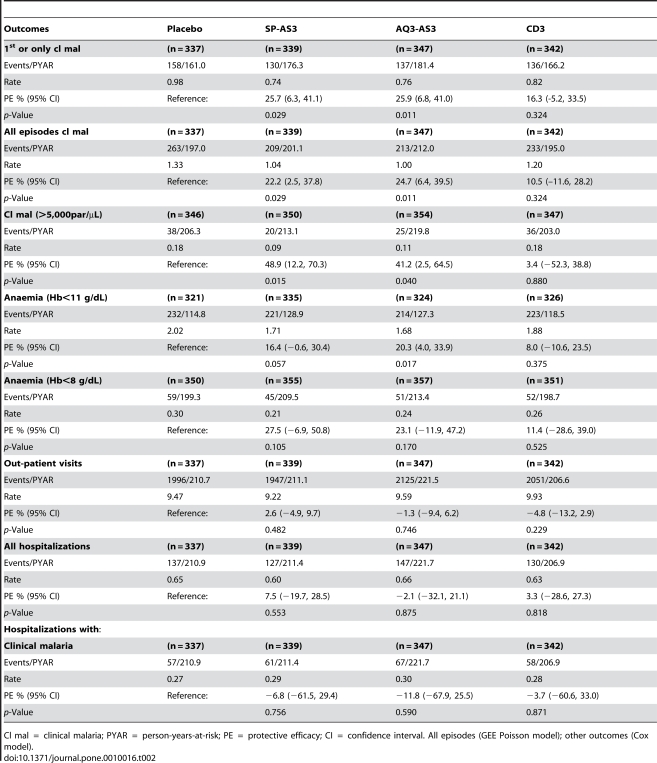
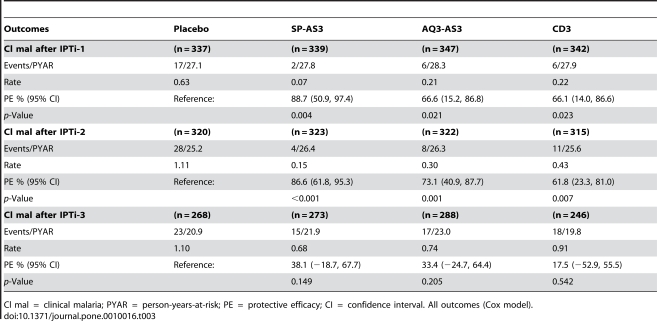
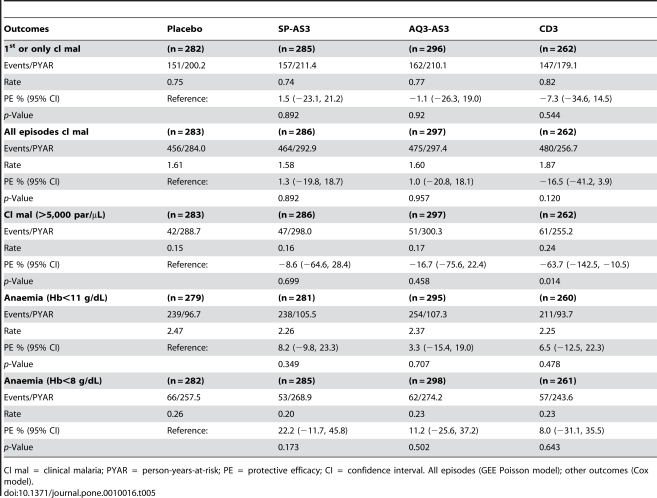
1,365 subjects were included in the analysis. The incidence of first or only episode of clinical malaria during the first year of life (primary endpoint) was 0.98 episodes/person-year in the placebo group, 0.74 in the SP-AS3 group, 0.76 in the AQ3-AS3 group, and 0.82 in the CD3 group. The protective efficacy (PE) and 95% confidence intervals against the primary endpoint were: 25.7% (6.3, 41.1); 25.9% (6.8, 41.0); and 16.3% (−5.2, 33.5) in the SP-AS3, AQ3-AS3, and CD3 groups, respectively. The PEs for moderate-to-severe anaemia were: 27.5% (−6.9, 50.8); 23.1% (−11.9, 47.2); and 11.4% (−28.6, 39.0). The duration of the protective effect remained significant for up to 5 to 8 weeks for SP-AS3 and AQ3-AS3. There was no evidence for a sustained beneficial or rebound effect in the second year of life. All regimens were well tolerated.
Conclusions
These results support the view that IPTi with long-acting regimens provide protection against clinical malaria for up to 8 weeks even in the presence of high ITN coverage, and that the prophylactic rather than the treatment effect of IPTi appears central to its protective efficacy.
Trial Registration
ClinicalTrials.gov NCT00111163
-
Subjects:
-
Source:PLoS One. 5(4).
-
Document Type:
-
Place as Subject:
-
Volume:5
-
Issue:4
-
Collection(s):
-
Main Document Checksum:urn:sha-512:263da1eca413e061ba43ed44e40f46ae595444a0bcf607e879f13f3064de084058747897fc3ef4604c6150c75c3b9448cffc8fee06a5ad0bdcb4baba1e02275c
-
Download URL:
-
File Type:
 [PDF
- 140.01 KB
]
[PDF
- 140.01 KB
]
Supporting Files


File Language:
English
ON THIS PAGE





CDC STACKS serves as an archival repository of CDC-published products including
scientific findings,
journal articles, guidelines, recommendations, or other public health information authored or
co-authored by CDC or funded partners.
As a repository, CDC STACKS retains documents in their original published format to ensure public access to scientific information.
As a repository, CDC STACKS retains documents in their original published format to ensure public access to scientific information.
You May Also Like
COLLECTION
CDC Public Access