


The Contribution of Family Planning towards the Prevention of Vertical HIV Transmission in Uganda
Supporting Files
Public Domain

-
Nov 02 2009
-
File Language:
English
Details
-
Alternative Title:PLoS One
-
Personal Author:
-
Description:Background
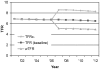
Uganda has one of the highest total fertility rates (TFR) worldwide. We compared the effects of antiretroviral (ARV) prophylaxis for the prevention of mother-to-child HIV transmission (PMTCT) to that of existing family planning (FP) use and estimated the burden of pediatric HIV disease due to unwanted fertility.
Methodology/Principal Findings
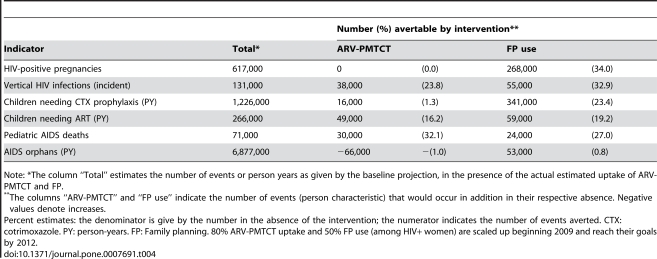
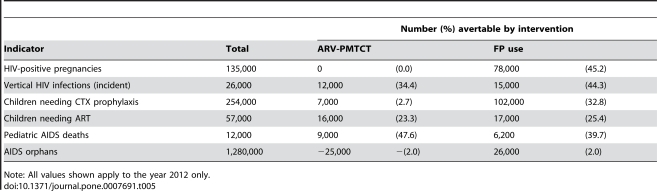
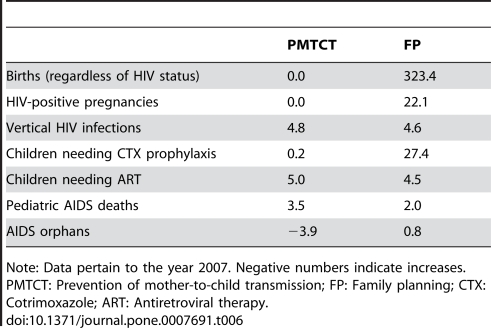
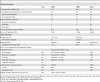
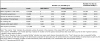
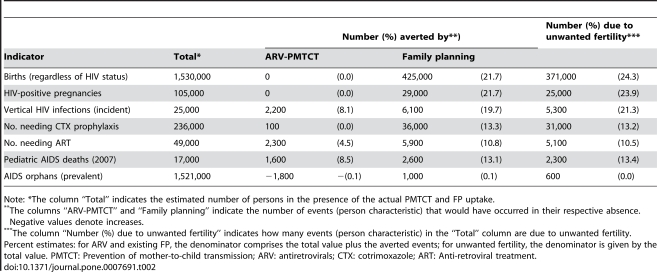
Using the demographic software Spectrum, a baseline mathematical projection to estimate the current pediatric HIV burden in Uganda was compared to three hypothetical projections: 1) without ARV-PMTCT (to estimate the effect of ARV-PMTCT), 2) without contraception (effect of existing FP use), 3) without unwanted fertility (effect of unmet FP needs). Key input parameters included HIV prevalence, ARV-PMTCT uptake, MTCT probabilities, and TFR. We estimate that in 2007, an estimated 25,000 vertical infections and 17,000 pediatric AIDS deaths occurred (baseline projection). Existing ARV-PMTCT likely averted 8.1% of infections and 8.5% of deaths. FP use likely averted 19.7% of infections and 13.1% of deaths. Unwanted fertility accounted for 21.3% of infections and 13.4% of deaths. During 2008–2012, an estimated 131,000 vertical infections and 71,000 pediatric AIDS deaths will occur. The projected scale up of ARV-PMTCT (from 39%–57%) may avert 18.1% of infections and 24.5% of deaths. Projected FP use may avert 21.6% of infections and 18.5% of deaths. Unwanted fertility will account for 24.5% of infections and 19.8% of deaths.
Conclusions
Existing FP use contributes as much or more than ARV-PMTCT in mitigating pediatric HIV in Uganda. Expanding FP services can substantially contribute towards PMTCT.
-
Subjects:
-
Source:PLoS One. 4(11).
-
Pubmed ID:19888347
-
Pubmed Central ID:PMC2766039
-
Document Type:
-
Place as Subject:
-
Volume:4
-
Issue:11
-
Collection(s):
-
Main Document Checksum:urn:sha-512:3a25d7d0a6997858f5a2042697f76967a4b5bb715b72adf0ae05625d23e6487b0bdf1dcae94f0fc190a4a31a2e7ceac633fee661965a3cf26f16f9ed6ffbbe06
-
Download URL:
-
File Type:
 [PDF
- 121.68 KB
]
[PDF
- 121.68 KB
]
Supporting Files


File Language:
English
ON THIS PAGE




CDC STACKS serves as an archival repository of CDC-published products including
scientific findings,
journal articles, guidelines, recommendations, or other public health information authored or
co-authored by CDC or funded partners.
As a repository, CDC STACKS retains documents in their original published format to ensure public access to scientific information.
As a repository, CDC STACKS retains documents in their original published format to ensure public access to scientific information.
You May Also Like
COLLECTION
CDC Public Access