



Generation, Characterization and Epitope Mapping of Two Neutralizing and Protective Human Recombinant Antibodies against Influenza A H5N1 Viruses
Supporting Files
Public Domain

-
5 7 2009
File Language:
English
Details
-
Alternative Title:PLoS One
-
Personal Author:Sun, Lina ; Lu, Xiuhua ; Li, Chuan ; Wang, Min ; Liu, Qinzhi ; Li, Zi ; Hu, Xiaofen ; Li, Jiandong ; Liu, Feng ; Li, Qun ; Belser, Jessica A. ; Hancock, Kathy ; Shu, Yuelong ; Katz, Jacqueline M. ; Liang, Mifang ; Li, Dexin
-
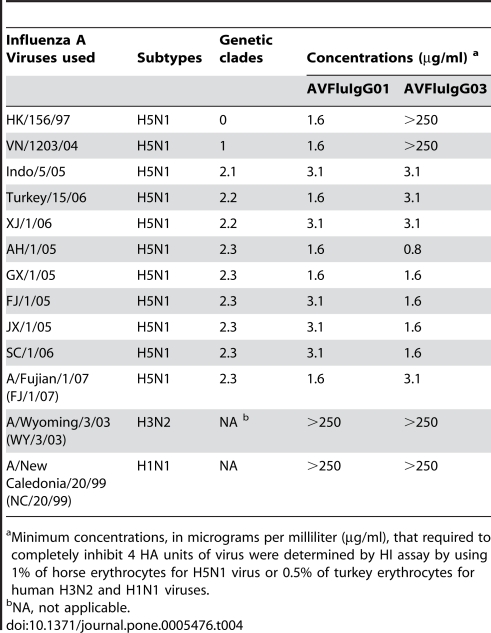
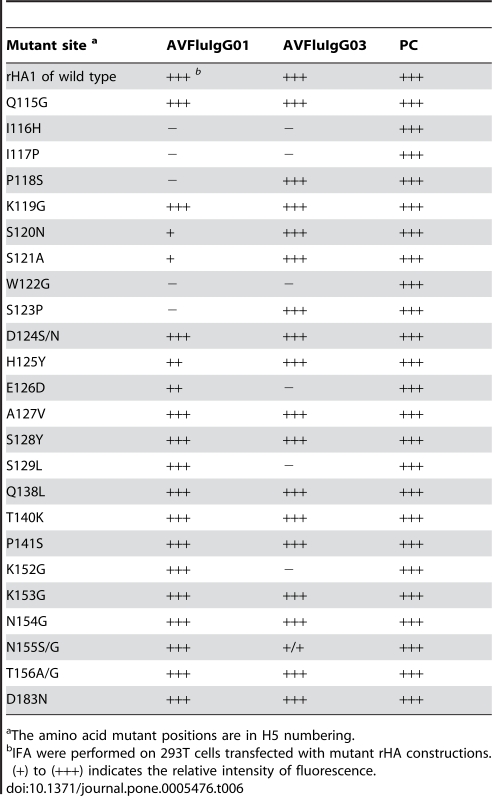
Description:Background ; The development of new therapeutic targets and strategies to control highly pathogenic avian influenza (HPAI) H5N1 virus infection in humans is urgently needed. Broadly cross-neutralizing recombinant human antibodies obtained from the survivors of H5N1 avian influenza provide an important role in immunotherapy for human H5N1 virus infection and definition of the critical epitopes for vaccine development. ; Methodology/Principal Findings ; We have characterized two recombinant baculovirus-expressed human antibodies (rhAbs), AVFluIgG01 and AVFluIgG03, generated by screening a Fab antibody phage library derived from a patient recovered from infection with a highly pathogenic avian influenza A H5N1 clade 2.3 virus. AVFluIgG01 cross-neutralized the most of clade 0, clade 1, and clade 2 viruses tested, in contrast, AVFluIgG03 only neutralized clade 2 viruses. Passive immunization of mice with either AVFluIgG01 or AVFluIgG03 antibody resulted in protection from a lethal H5N1 clade 2.3 virus infection. Furthermore, through epitope mapping, we identify two distinct epitopes on H5 HA molecule recognized by these rhAbs and demonstrate their potential to protect against a lethal H5N1 virus infection in a mouse model. ; Conclusions/Significance ; Importantly, localization of the epitopes recognized by these two neutralizing and protective antibodies has provided, for the first time, insight into the human antibody responses to H5N1 viruses which contribute to the H5 immunity in the recovered patient. These results highlight the potential of a rhAbs treatment strategy for human H5N1 virus infection and provide new insight for the development of effective H5N1 pandemic vaccines.
-
Subjects:
- Research Article
- Virology
- Adult
- Amino Acid Sequence
- Amino Acid Substitution
- Animals
- Antibodies, Viral
- Blotting, Western
- Enzyme-Linked Immunosorbent Assay
- Epitope Mapping
- Female
- Fluorescent Antibody Technique
- Humans
- Immunization
- Influenza A Virus, H5N1 Subtype
- Mice
- Mice, Inbred BALB C
- Molecular Sequence Data
- Mutagenesis, Site-Directed
- Neutralization Tests
- Peptide Fragments
- Peptide Library
- Recombinant Proteins
-
Source:PLoS One. 2009; 4(5)
-
Pubmed ID:19421326
-
Pubmed Central ID:PMC2674214
-
Document Type:
-
Volume:4
-
Issue:5
-
Download URL:
-
File Type:
 [PDF - 476.63 KB]
 -
Collection(s):
-
Main Document Checksum:urn:sha-512:9bab3d4cfba59c3502b21d543cbe3ae31bd89ebc02f19a4ee3895d554e8afe0d85cc1f0976defc0438ddb5efd22c4f5d411e6c1d4b04488578e79c0238eddce4
Supporting Files


File Language:
English
 Was this page helpful?
 Found an issue?










CDC STACKS serves as an archival repository of CDC-published products including
scientific findings, journal articles, guidelines, recommendations, or other public health information authored or
co-authored by CDC or funded partners.
As a repository, CDC STACKS retains documents in their original published format to ensure public access to scientific information.
As a repository, CDC STACKS retains documents in their original published format to ensure public access to scientific information.
You May Also Like
COLLECTION
CDC Public Access