


Directly Observed Therapy and Improved Tuberculosis Treatment Outcomes in Thailand
Supporting Files
Public Domain

-
Aug 28 2008
File Language:
English
Details
-
Alternative Title:PLoS ONE
-
Personal Author:
-
Description:Background
The World Health Organization (WHO) recommends that tuberculosis (TB) patients receive directly observed therapy (DOT). Randomized controlled trials have not consistently shown that this practice improves TB treatment success rates. In Thailand, one of 22 WHO-designated high burden TB countries, patients may have TB treatment observed by a health care worker (HCW), family member, or no one. We studied whether DOT improved TB treatment outcomes in a prospective, observational cohort.
Methods and Findings
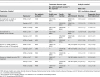
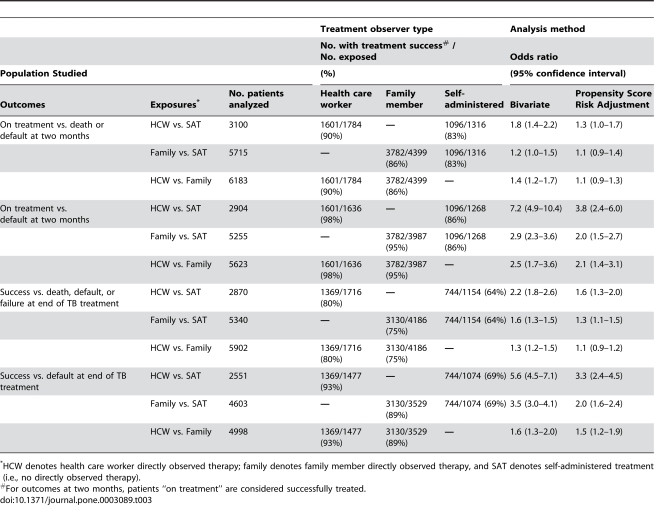
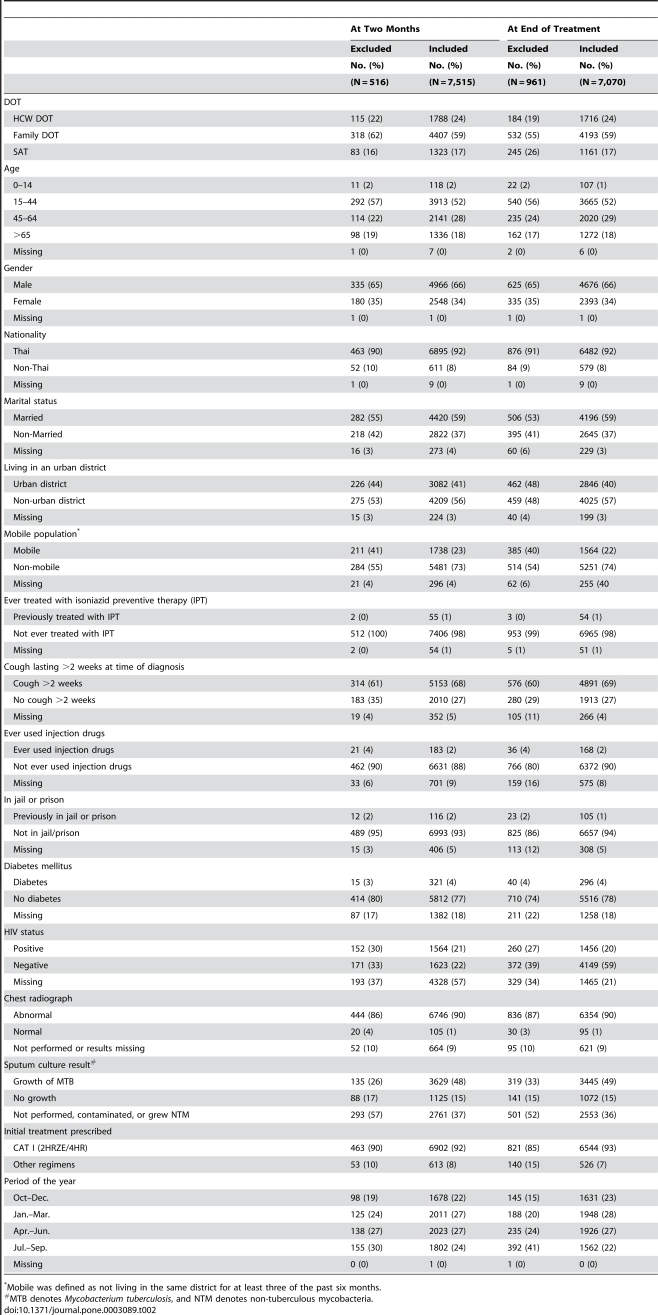
We prospectively collected epidemiologic data about TB patients treated at public and private facilities in four provinces in Thailand and the national infectious diseases hospital from 2004–2006. Public health staff recorded the type of observed therapy that patients received during the first two months of TB treatment. We limited our analysis to pulmonary TB patients never previously treated for TB and not known to have multidrug-resistant TB. We analyzed the proportion of patients still on treatment at the end of two months and with treatment success at the end of treatment according to DOT type. We used propensity score analysis to control for factors associated with DOT and treatment outcome. Of 8,031 patients eligible for analysis, 24% received HCW DOT, 59% family DOT, and 18% self-administered therapy (SAT). Smear-positive TB was diagnosed in 63%, and 21% were HIV-infected. Of patients either on treatment or that defaulted at two months, 1601/1636 (98%) patients that received HCW DOT remained on treatment at two months compared with 1096/1268 (86%) patients that received SAT (adjusted OR [aOR] 3.8; 95% confidence interval [CI] 2.4–6.0) and 3782/3987 (95%) patients that received family DOT (aOR 2.1; CI, 1.4–3.1). Of patients that had treatment success or that defaulted at the end of treatment, 1369/1477 (93%) patients that received HCW DOT completed treatment compared with 744/1074 (69%) patients that received SAT (aOR 3.3; CI, 2.4–4.5) and 3130/3529 (89%) patients that received family DOT (aOR 1.5; 1.2–1.9). The benefit of HCW DOT compared with SAT was similar, but smaller, when comparing patients with treatment success to those with death, default, or failure.
Conclusions
In Thailand, two months of DOT was associated with lower odds of default during treatment. The magnitude of benefit was greater for DOT provided by a HCW compared with a family member. Thailand should consider increasing its use of HCW DOT during TB treatment.
-
Subjects:
-
Source:PLoS ONE. 2008; 3(8).
-
Document Type:
-
Place as Subject:
-
Volume:3
-
Issue:8
-
Collection(s):
-
Main Document Checksum:urn:sha-512:2e4af024253c70199941dce2e587b9e84810961a46e271cb95382addd202fd7b18057d3858b4f8962e0bbf8d9a5bfe942ac0a4f19bbce9cce067ec85944ebdf2
-
Download URL:
-
File Type:
 [PDF
- 151.86 KB
]
[PDF
- 151.86 KB
]
Supporting Files


File Language:
English
ON THIS PAGE



CDC STACKS serves as an archival repository of CDC-published products including
scientific findings,
journal articles, guidelines, recommendations, or other public health information authored or
co-authored by CDC or funded partners.
As a repository, CDC STACKS retains documents in their original published format to ensure public access to scientific information.
As a repository, CDC STACKS retains documents in their original published format to ensure public access to scientific information.
You May Also Like
COLLECTION
CDC Public Access