



Simple PCR Assays Improve the Sensitivity of HIV-1 Subtype B Drug Resistance Testing and Allow Linking of Resistance Mutations
Supporting Files
Public Domain

-
Jul 25 2007
File Language:
English
Details
-
Alternative Title:PLoS ONE
-
Personal Author:
-
Description:Background
The success of antiretroviral therapy is known to be compromised by drug-resistant HIV-1 at frequencies detectable by conventional bulk sequencing. Currently, there is a need to assess the clinical consequences of low-frequency drug resistant variants occurring below the detection limit of conventional genotyping. Sensitive detection of drug-resistant subpopulations, however, requires simple and practical methods for routine testing.
Methodology
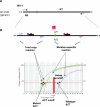
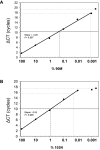
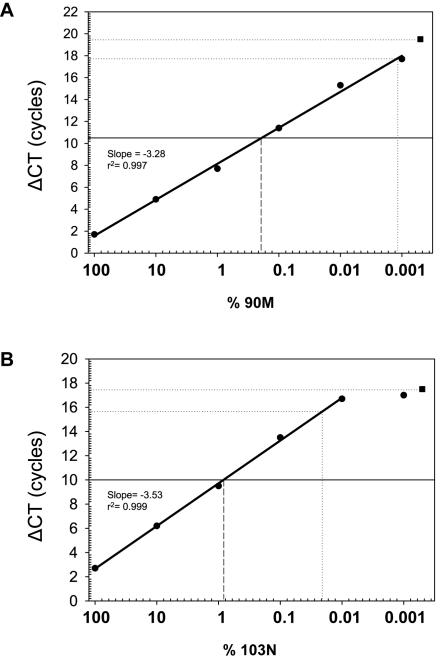
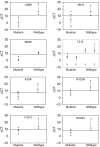
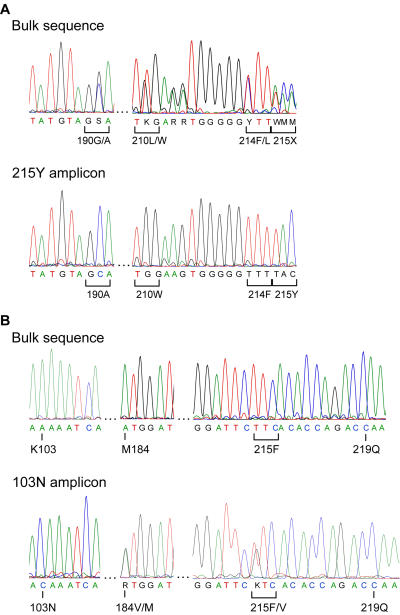
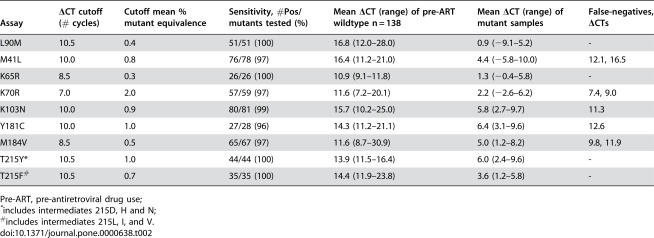
We developed highly-sensitive and simple real-time PCR assays for nine key drug resistance mutations and show that these tests overcome substantial sequence heterogeneity in HIV-1 clinical specimens. We specifically used early wildtype virus samples from the pre-antiretroviral drug era to measure background reactivity and were able to define highly-specific screening cut-offs that are up to 67-fold more sensitive than conventional genotyping. We also demonstrate that sequencing the mutation-specific PCR products provided a direct and novel strategy to further detect and link associated resistance mutations, allowing easy identification of multi-drug-resistant variants. Resistance mutation associations revealed in mutation-specific amplicon sequences were verified by clonal sequencing.
Significance
Combined, sensitive real-time PCR testing and mutation-specific amplicon sequencing provides a powerful and simple approach that allows for improved detection and evaluation of HIV-1 drug resistance mutations. -
Subjects:
-
Source:PLoS ONE. 2007; 2(7).
-
Document Type:
-
Volume:2
-
Issue:7
-
Download URL:
-
File Type:
 [PDF - 321.52 KB]
 -
Collection(s):
-
Main Document Checksum:urn:sha-512:b40c833d047ccb39ee875cd15c03cf68d29fb277781c274d07498b6663dc24bd8956351b5a739fdddbd35cc936b0dcdb4db19d2ff4c4b0495e34f80c9a929a6f
Supporting Files


File Language:
English
 Was this page helpful?
 Found an issue?





CDC STACKS serves as an archival repository of CDC-published products including
scientific findings, journal articles, guidelines, recommendations, or other public health information authored or
co-authored by CDC or funded partners.
As a repository, CDC STACKS retains documents in their original published format to ensure public access to scientific information.
As a repository, CDC STACKS retains documents in their original published format to ensure public access to scientific information.
You May Also Like
COLLECTION
CDC Public Access