


Spirochete flagella hook protein self-catalyze a lysinoalanine covalent cross-link for motility
Supporting Files

-
8 08 2016
-
File Language:
English
Details
-
Alternative Title:Nat Microbiol
-
Personal Author:
-
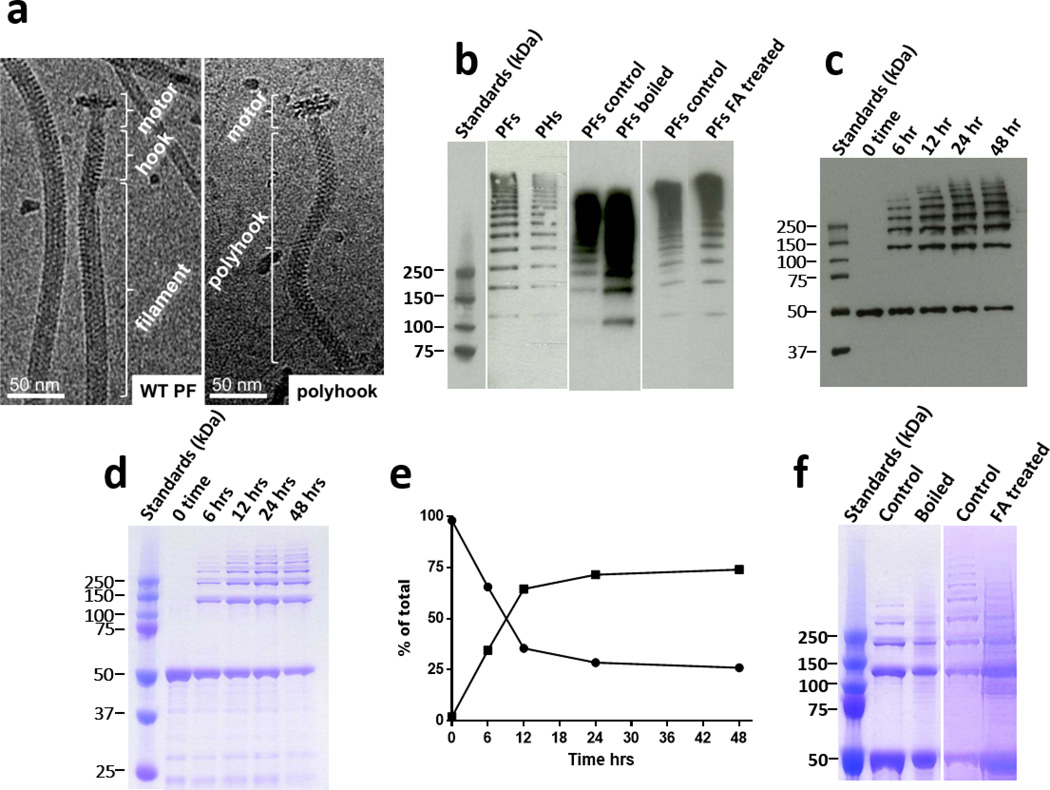
Description:Spirochaetes are bacteria responsible for several serious diseases, including Lyme disease (Borrelia burgdorferi), syphilis (Treponema pallidum) and leptospirosis (Leptospira interrogans), and contribute to periodontal diseases (Treponema denticola)(1). These spirochaetes employ an unusual form of flagella-based motility necessary for pathogenicity; indeed, spirochaete flagella (periplasmic flagella) reside and rotate within the periplasmic space(2-11). The universal joint or hook that links the rotary motor to the filament is composed of ∼120-130 FlgE proteins, which in spirochaetes form an unusually stable, high-molecular-weight complex(9,12-17). In other bacteria, the hook can be readily dissociated by treatments such as heat(18). In contrast, spirochaete hooks are resistant to these treatments, and several lines of evidence indicate that the high-molecular-weight complex is the consequence of covalent crosslinking(12,13,17). Here, we show that T. denticola FlgE self-catalyses an interpeptide crosslinking reaction between conserved lysine and cysteine, resulting in the formation of an unusual lysinoalanine adduct that polymerizes the hook subunits. Lysinoalanine crosslinks are not needed for flagellar assembly, but they are required for cell motility and hence infection. The self-catalytic nature of FlgE crosslinking has important implications for protein engineering, and its sensitivity to chemical inhibitors provides a new avenue for the development of antimicrobials targeting spirochaetes.
-
Keywords:
-
Source:Nat Microbiol. 1(10):16134
-
Pubmed ID:27670115
-
Pubmed Central ID:PMC5077173
-
Document Type:
-
Funding:R21 DE023432/DE/NIDCR NIH HHSUnited States/ ; R01 GM064664/GM/NIGMS NIH HHSUnited States/ ; R01 AI087946/AI/NIAID NIH HHSUnited States/ ; R01 DE023080/DE/NIDCR NIH HHSUnited States/ ; R01 AI078958/AI/NIAID NIH HHSUnited States/ ; R01 DE023431/DE/NIDCR NIH HHSUnited States/ ; S10 OD017992/OD/NIH HHSUnited States/ ; P41 GM103485/GM/NIGMS NIH HHSUnited States/ ; S10 RR025449/RR/NCRR NIH HHSUnited States/ ; T32 DE023526/DE/NIDCR NIH HHSUnited States/ ; CC999999/ImCDC/Intramural CDC HHSUnited States/
-
Volume:1
-
Issue:10
-
Collection(s):
-
Main Document Checksum:urn:sha256:defaaec36bf1ff613036c280db3e59d23365818b96295f04dccdb980dd5d9a1a
-
Download URL:
-
File Type:
 [PDF
- 1.80 MB
]
[PDF
- 1.80 MB
]
Supporting Files


File Language:
English
ON THIS PAGE





CDC STACKS serves as an archival repository of CDC-published products including
scientific findings,
journal articles, guidelines, recommendations, or other public health information authored or
co-authored by CDC or funded partners.
As a repository, CDC STACKS retains documents in their original published format to ensure public access to scientific information.
As a repository, CDC STACKS retains documents in their original published format to ensure public access to scientific information.
You May Also Like
COLLECTION
CDC Public Access