


Communication Barriers and the Clinical Recognition of Diabetic Peripheral Neuropathy in a Diverse Cohort of Adults: The DISTANCE Study
Supporting Files

-
Apr 26 2016
-
File Language:
English
Details
-
Alternative Title:J Health Commun
-
Personal Author:
-
Description:Objective
The purpose of this study was to explore communication barriers as independent predictors and potential mediators of variation in clinical recognition of diabetic peripheral neuropathy (DPN).
Methods
In this cross-sectional analysis, we estimated the likelihood of having a DPN diagnosis among 4,436 patients with DPN symptoms. We controlled for symptom frequency, demographic and clinical characteristics, and visit frequency using a modified Poisson regression model. We then evaluated 4 communication barriers as independent predictors of clinical documentation and as possible mediators of racial/ethnic differences: difficulty speaking English, not talking to one’s doctor about pain, limited health literacy, and reports of suboptimal patient-provider communication.
Results
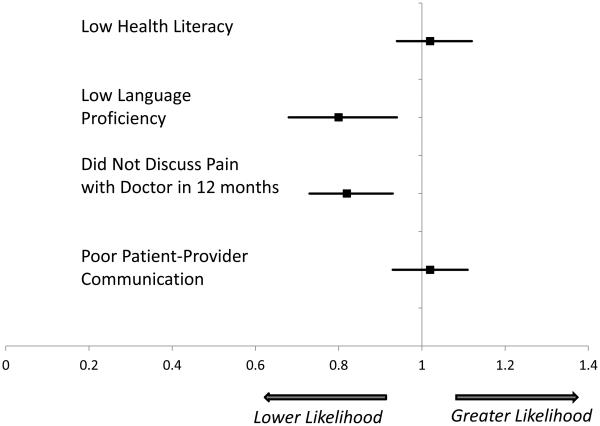
Difficulty speaking English and not talking with one’s doctor about pain were independently associated with not having a diagnosis, though limited health literacy and suboptimal patient-provider communication were not. Limited English proficiency partially attenuated, but did not fully explain, racial/ethnic differences in clinical documentation among Chinese, Latino and Filipino patients.
Conclusions
Providers should be encouraged to talk with their patients about DPN symptoms, and health systems should consider enhancing strategies to improve timely clinical recognition of DPN among patients who have difficult speaking English. More work is needed to understand persistent race/ethnic differences in diagnosis.
-
Subjects:
-
Source:J Health Commun. 21(5):544-553.
-
Pubmed ID:27116591
-
Pubmed Central ID:PMC4920056
-
Document Type:
-
Funding:U58 DP002641/DP/NCCDPHP CDC HHS/United States ; R01 DK065664/DK/NIDDK NIH HHS/United States ; RC1 DK086178/DK/NIDDK NIH HHS/United States ; R01 DK080726/DK/NIDDK NIH HHS/United States ; P30 DK092924/DK/NIDDK NIH HHS/United States ; P30 DK020572/DK/NIDDK NIH HHS/United States ; R01 DK081796/DK/NIDDK NIH HHS/United States
-
Volume:21
-
Issue:5
-
Collection(s):
-
Main Document Checksum:urn:sha256:6104755d8b4c257ebd1f09e2920c5a36a81c7b239d4a7eb4ce7bd665a40a968b
-
Download URL:
-
File Type:
 [PDF
- 374.22 KB
]
[PDF
- 374.22 KB
]
Supporting Files


File Language:
English
ON THIS PAGE



CDC STACKS serves as an archival repository of CDC-published products including
scientific findings,
journal articles, guidelines, recommendations, or other public health information authored or
co-authored by CDC or funded partners.
As a repository, CDC STACKS retains documents in their original published format to ensure public access to scientific information.
As a repository, CDC STACKS retains documents in their original published format to ensure public access to scientific information.
You May Also Like
COLLECTION
CDC Public Access