



Association of Graduated Driver Licensing With Driver, Non-Driver, and Total Fatalities Among Adolescents
Supporting Files

-
Apr 05 2016
-
Available in CDC Stacks on 2017-07-01T00:00:00Z
File Language:
English
Details
-
Alternative Title:Am J Prev Med
-
Personal Author:
-
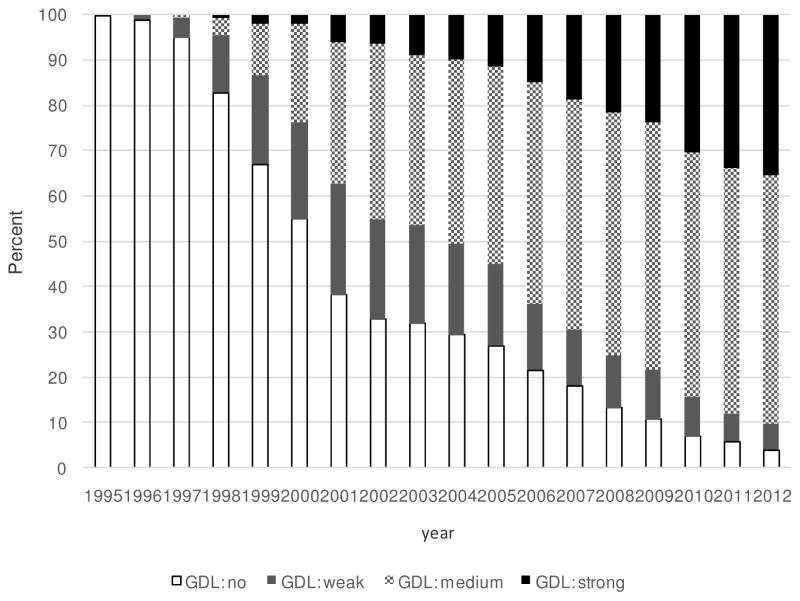
Description:Introduction ; Graduated driver licensing systems typically require an extended learner permit phase, and create night-time driving or passenger restrictions for adolescent drivers. Restricted driving might increase the use of alternative transportation to replace driving and consequently increase crashes and injuries for passengers, bus riders, pedestrians, and bicyclists. This study examined whether graduated driver licensing increases non-driver fatalities among adolescents, and whether it reduces total traffic fatalities combining drivers and non-drivers. ; Methods ; Longitudinal analyses were conducted using data from the 1995–2012 U.S. Fatality Analysis Reporting System. Adjusted rate ratios were estimated for being fatally injured in a crash according to: (1) presence/absence of a graduated driver licensing system; and (2) four levels of graduated driver licensing systems (absent, weak, medium, strong). Analyses were conducted in 2015. ; Results ; Among adolescents aged 16 years, graduated driver licensing was not associated with increased passenger fatalities (adjusted rate ratio, 0.96; 95% CI=0.90, 1.03) or pedestrian and bicyclist fatalities (adjusted rate ratio, 1.09; 95% CI=0.85, 1.39), but was associated with an 11% reduction in total traffic fatalities. Among those aged 17 years, graduated driver licensing was not associated with increased fatalities as passengers, pedestrians, or bicyclists, and was not associated with reduced total traffic fatalities. ; Conclusions ; In general, graduated driver licensing systems were not associated with increased fatalities as passengers, pedestrians, bicyclists, and bus riders. Graduated driver licensing systems were associated with reduced total fatalities of adolescents aged 16 years.
-
Subjects:
-
Source:Am J Prev Med. 51(1):63-70.
-
Pubmed ID:27067034
-
Pubmed Central ID:PMC4914472
-
Document Type:
-
Funding:
-
Place as Subject:
-
Volume:51
-
Issue:1
-
Download URL:
-
File Type:
 [PDF - 151.32 KB]
 -
Collection(s):
-
Main Document Checksum:urn:sha256:0394070f35748a01a0b2876db207a471a5f36c6167f35ca74a01f6e8e086a7fb
Supporting Files


File Language:
English
 Was this page helpful?
 Found an issue?


CDC STACKS serves as an archival repository of CDC-published products including
scientific findings, journal articles, guidelines, recommendations, or other public health information authored or
co-authored by CDC or funded partners.
As a repository, CDC STACKS retains documents in their original published format to ensure public access to scientific information.
As a repository, CDC STACKS retains documents in their original published format to ensure public access to scientific information.
You May Also Like
COLLECTION
CDC Public Access