



Decentralization Does Not Assure Optimal Delivery of PMTCT and HIV-Exposed Infant Services in a Low Prevalence Setting
Supporting Files

-
12 1 2015 ; 12-1-
-
Available in CDC Stacks on May 04, 2016, 12:00 AM
File Language:
English
Details
-
Alternative Title:J Acquir Immune Defic Syndr
-
Personal Author:
-
Description:Background
The consequences of decentralizing prevention of mother-to-child HIV transmission and HIV-exposed infant services to antenatal care (ANC)/labor and delivery (L&D) sites from dedicated HIV care and treatment (C&T) centers remain unknown, particularly in low prevalence settings.
Methods
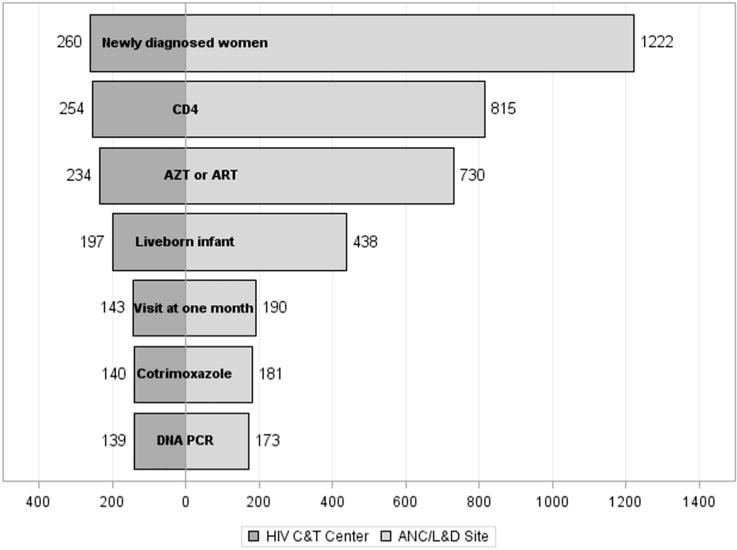
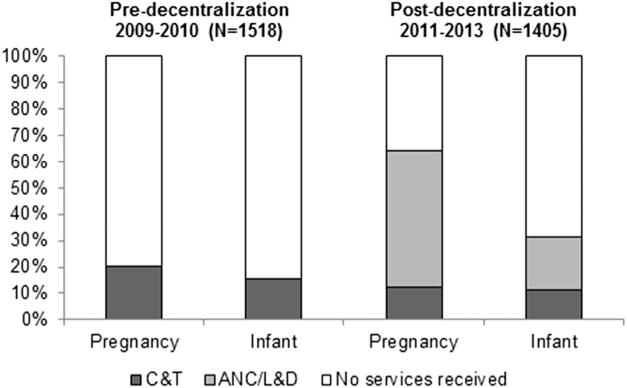
In a cohort of mother–infant pairs, we compared delivery of routine services at ANC/L&D and C&T facilities in Kinshasa, Democratic Republic of Congo from 2010–2013, using methods accounting for competing risks (eg, death). Women could opt to receive interventions at 90 decentralized ANC/L&D sites, or 2 affiliated C&T centers. Additionally, we assessed decentralization’s population-level impacts by comparing proportions of women and infants receiving interventions before (2009–2010) and after (2011–2013) decentralization.
Results
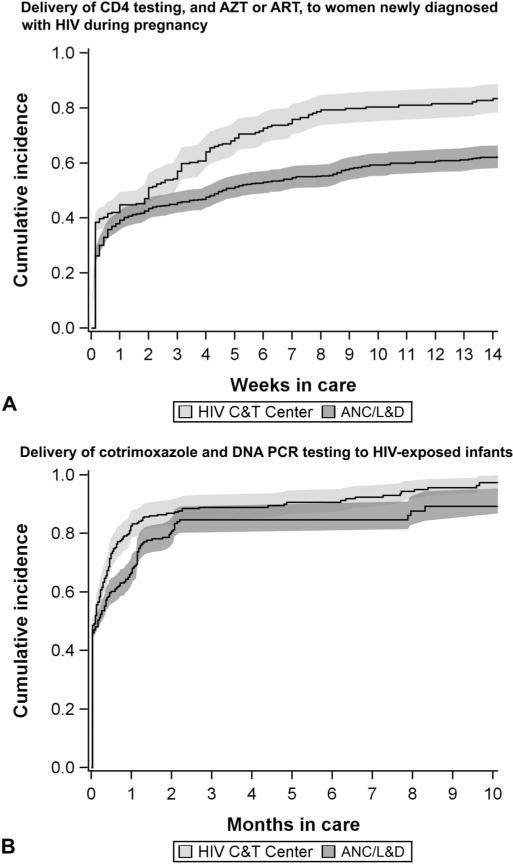
Among newly HIV-diagnosed women (N = 1482), the 14-week cumulative incidence of receiving the package of CD4 testing and zidovudine or antiretroviral therapy was less at ANC/L&D 66%; 95% confidence interval (CI): 63% to 69% than at C&T (88%; 95% CI: 83% to 92%) sites (subdistribution hazard ratio, 0.62; 95% CI: 0.55 to 0.69). Delivery of cotrimoxazole and DNA polymerase chain reaction testing to HIV-exposed infants (N = 1182) was inferior at ANC/L&D sites (subdistribution hazard ratio, 0.84; 95% CI: 0.76 to 0.92); the 10-month cumulative incidence of the package at ANC/L&D sites was 89% (95% CI: 82% to 93%) versus 97% (95% CI: 93% to 99%) at C&T centers. Receipt of the pregnancy (20% of 1518, to 64% of 1405) and infant (16%–31%) packages improved post decentralization.
Conclusions
Services were delivered less efficiently at ANC/L&D sites than C&T centers. Although access improved with decentralization, its potential cannot be realized without sufficient and sustained support. -
Keywords:
- prevention of mother to child transmission
- vertical transmission
- Democratic Republic of Congo
- health services accessibility
- delivery of health care
- prenatal care/utilization
- postnatal care/utilization
- Adolescent
- Adult
- Anti-Retroviral Agents
- Cohort Studies
- Democratic Republic of the Congo
- Female
- HIV Infections
- Health Services Accessibility
- Humans
- Infant
- Infant, Newborn
- Infectious Disease Transmission, Vertical
- Medication Adherence
- Postnatal Care
- Pregnancy
- Pregnancy Complications, Infectious
- Prenatal Care
- Young Adult
-
Source:J Acquir Immune Defic Syndr. 70(4):e130-e139
-
Pubmed ID:26262776
-
Pubmed Central ID:PMC4856046
-
Document Type:
-
Funding:
-
Volume:70
-
Issue:4
-
Download URL:
-
File Type:
 [PDF - 275.04 KB]
 -
Collection(s):
-
Main Document Checksum:urn:sha256:ac5a38d8f3f092f2ceb6a289e0839265e2a8b45e533484ade6134b18f4a7724e
Supporting Files


File Language:
English
 Was this page helpful?
 Found an issue?



CDC STACKS serves as an archival repository of CDC-published products including
scientific findings, journal articles, guidelines, recommendations, or other public health information authored or
co-authored by CDC or funded partners.
As a repository, CDC STACKS retains documents in their original published format to ensure public access to scientific information.
As a repository, CDC STACKS retains documents in their original published format to ensure public access to scientific information.
You May Also Like
COLLECTION
CDC Public Access