


First Pregnancy Characteristics, Postmenopausal Breast Density, and Salivary Sex Hormone Levels in a Population at High Risk for Breast Cancer
Supporting Files

-
Jun 2015
-
Details
-
Alternative Title:BBA Clin
-
Personal Author:
-
Description:Background
It remains unknown if later life breast cancer risk as determined by reproductive history is mediated by postmenopausal breast density and/or sex steroid levels.
Methods
Increased breast density is a strong surrogate for future breast cancer risk. A cross-sectional study with a longitudinal follow up for breast health outcomes evaluated women without breast cancer (n = 1,023; 682 = parous), drawn from a high risk postmenopausal population, with questionnaire reported reproductive histories. The questionnaire was linked to prospective screening mammogram breast density measurements, and saliva biospecimens that were used to assess sex steroid hormone levels.
Results
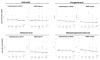
Expected age and postmenopause related declines in salivary estradiol (E), progesterone (P), dehydroepiandrosterone (DHEA) and testosterone (T) levels were observed. This was most pronounced for DHEA and T, which were also the only postmenopausal hormone levels significantly associated with any reproductive characteristics: parity and breast feeding for DHEA, age-at-first birth for T. Postmenopausal breast density was borderline significantly lower with parity and higher body mass index (BMI). After multivariate analysis, T was the only hormone level to retain any association (negative, p<0.05) with breast density.
Conclusions and General Significance
While reproductive characteristics, in particular parity, generally demonstrated independent associations with postmenopausal breast density and E, P and DHEA levels, T levels showed concordant inverse associations with age-at-first birth and breast density. These findings suggest that reproductive effects and later life salivary sex steroid hormone levels may have independent effects on later life breast density and cancer risk.
-
Subjects:
-
Source:BBA Clin. 3:189-195.
-
Pubmed ID:26317068
-
Pubmed Central ID:PMC4547694
-
Document Type:
-
Funding:
-
Volume:3
-
Collection(s):
-
Main Document Checksum:urn:sha256:64877d153583eacd288ca8fbcb061c7a58fdc5b4974760fc3b3e046635b6ac30
-
Download URL:
-
File Type:
 [PDF
- 367.79 KB
]
[PDF
- 367.79 KB
]
Supporting Files


ON THIS PAGE


CDC STACKS serves as an archival repository of CDC-published products including
scientific findings,
journal articles, guidelines, recommendations, or other public health information authored or
co-authored by CDC or funded partners.
As a repository, CDC STACKS retains documents in their original published format to ensure public access to scientific information.
As a repository, CDC STACKS retains documents in their original published format to ensure public access to scientific information.
You May Also Like
COLLECTION
CDC Public Access