



Effects of antenatal care and HIV treatment integration on elements of the PMTCT cascade: Results from the SHAIP cluster-randomized controlled trial in Kenya
Supporting Files

-
Aug 15 2015
File Language:
English
Details
-
Alternative Title:J Acquir Immune Defic Syndr
-
Personal Author:Turan, Janet M. ; Onono, Maricianah ; Steinfeld, Rachel L. ; Shade, Starley B. ; Owuor, Kevin ; Washington, Sierra ; Bukusi, Elizabeth A. ; Ackers, Marta L. ; Kioko, Jackson ; Interis, Evelyn C. ; Cohen, Craig R.
-
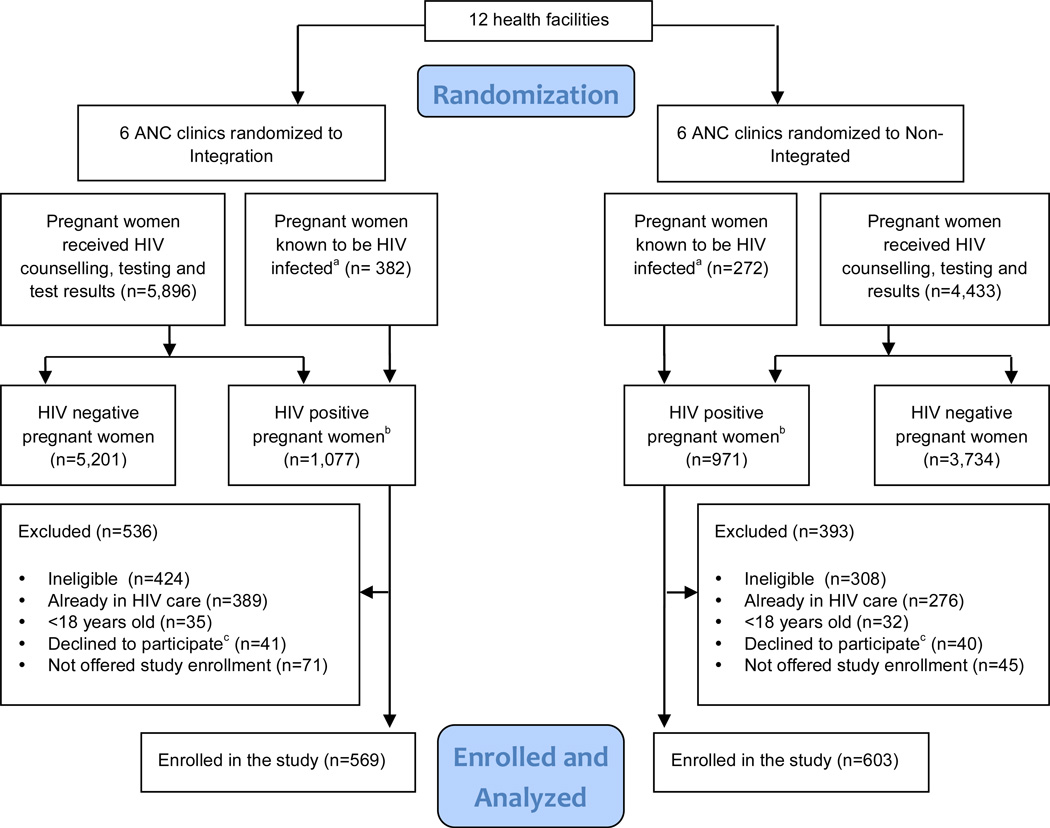
Description:Background ; Integrating antenatal care (ANC) and HIV care may improve uptake and retention in services along the prevention of mother-to-child transmission (PMTCT) cascade. The current study aimed to determine if integration of HIV services into ANC settings improves PMTCT service utilization outcomes. ; Methods ; ANC clinics in rural Kenya were randomized to integrated (6 clinics, 569 women) or non-integrated (6 clinics, 603 women) services. Intervention clinics provided all HIV services, including highly active antiretroviral therapy (HAART), while control clinics provided PMTCT services but referred women to HIV care clinics within the same facility. PMTCT utilization outcomes among HIV-infected women (maternal HIV care enrollment, HAART initiation, and 3-month infant HIV testing uptake) were compared using generalized estimating equations and Cox regression. ; Results ; HIV care enrollment was higher in intervention compared to control clinics (69% versus 36%, Odds Ratio (OR)=3.94, 95% Confidence Interval (CI): 1.14–13.63). Median time to enrollment was significantly shorter among intervention arm women (0 versus 8 days, Hazard Ratio (HR)=2.20, 95% CI: 1.62–3.01). Eligible women in the intervention arm were more likely to initiate HAART (40% versus 17%, OR=3.22, 95% CI: 1.81–5.72). Infant testing was more common in the intervention arm (25% versus 18%), however not statistically different. No significant differences were detected in postnatal service uptake or maternal retention. ; Conclusions ; Service integration increased maternal HIV care enrollment and HAART uptake. However, PMTCT utilization outcomes were still suboptimal, and postnatal service utilization remained poor in both study arms. Further improvements in the PMTCT cascade will require additional research and interventions.
-
Subjects:
- Article
- Adult
- Anti-HIV Agents
- Antiretroviral Therapy, Highly Active
- Cluster Analysis
- Community Health Centers
- Female
- HIV Infections
- Health Plan Implementation
- Humans
- Infant
- Infant, Newborn
- Infectious Disease Transmission, Vertical
- Maternal-Child Health Centers
- Odds Ratio
- Pregnancy
- Prenatal Care
- Risk Factors
- Young Adult
-
Source:J Acquir Immune Defic Syndr. 69(5):e172-e181.
-
Pubmed ID:25967269
-
Pubmed Central ID:PMC4501892
-
Document Type:
-
Funding:
-
Corporate as Subject:
-
Place as Subject:
-
Volume:69
-
Issue:5
-
Download URL:
-
File Type:
 [PDF - 832.38 KB]
 -
Collection(s):
-
Main Document Checksum:urn:sha-512:73e14f16f23ec44aedccd067206dfd4dbef213bf11812c5b4bd1e7e0a4dd08fc5764ab64947c075978b800eb197a87155cf7dab25eb67e02fbedef90295153be
Supporting Files


File Language:
English
 Was this page helpful?
 Found an issue?





CDC STACKS serves as an archival repository of CDC-published products including
scientific findings, journal articles, guidelines, recommendations, or other public health information authored or
co-authored by CDC or funded partners.
As a repository, CDC STACKS retains documents in their original published format to ensure public access to scientific information.
As a repository, CDC STACKS retains documents in their original published format to ensure public access to scientific information.
You May Also Like
COLLECTION
CDC Public Access