


IS WORK-FAMILY CONFLICT A MULTILEVEL STRESSOR LINKING JOB CONDITIONS TO MENTAL HEALTH? EVIDENCE FROM THE WORK, FAMILY AND HEALTH NETWORK
Supporting Files

-
2015
-
File Language:
English
Details
-
Alternative Title:Res Sociol Work
-
Personal Author:
-
Description:Purpose
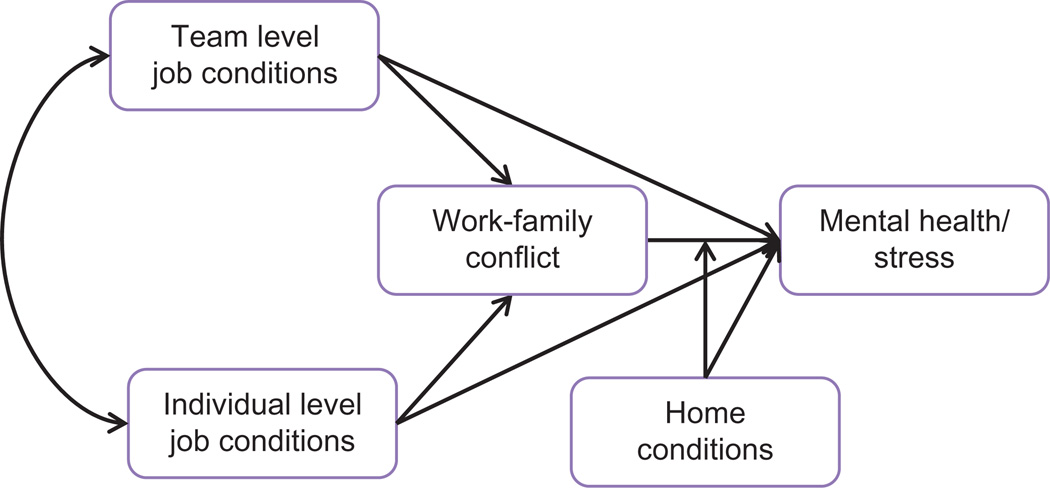
Most research on the work conditions and family responsibilities associated with work-family conflict and other measures of mental health uses the individual employee as the unit of analysis. We argue that work conditions are both individual psychosocial assessments and objective characteristics of the proximal work environment, necessitating multilevel analyses of both individual- and team-level work conditions on mental health.
Methodology/approach
This study uses multilevel data on 748 high-tech professionals in 120 teams to investigate relationships between team- and individual-level job conditions, work-family conflict, and four mental health outcomes (job satisfaction, emotional exhaustion, perceived stress, and psychological distress).
Findings
We find that work-to-family conflict is socially patterned across teams, as are job satisfaction and emotional exhaustion. Team-level job conditions predict team-level outcomes, while individuals’ perceptions of their job conditions are better predictors of individuals’ work-to-family conflict and mental health. Work-to-family conflict operates as a partial mediator between job demands and mental health outcomes.
Practical implications
Our findings suggest that organizational leaders concerned about presenteeism, sickness absences, and productivity would do well to focus on changing job conditions in ways that reduce job demands and work-to-family conflict in order to promote employees’ mental health.
Originality/value of the chapter
We show that both work-to-family conflict and job conditions can be fruitfully framed as team characteristics, shared appraisals held in common by team members. This challenges the framing of work-to-family conflict as a “private trouble” and provides support for work-to-family conflict as a structural mismatch grounded in the social and temporal organization of work.
-
Keywords:
-
Source:Res Sociol Work. 2015; 26:177-217
-
Pubmed ID:25866431
-
Pubmed Central ID:PMC4389766
-
Document Type:
-
Funding:K12 HD055887/HD/NICHD NIH HHSUnited States/ ; R24 HD041023/HD/NICHD NIH HHSUnited States/ ; U01 HD051217/HD/NICHD NIH HHSUnited States/ ; U01 OH008788/OH/NIOSH CDC HHSUnited States/ ; U01 AG027669/AG/NIA NIH HHSUnited States/ ; U01 HD051256/HD/NICHD NIH HHSUnited States/ ; R03 AG046393/AG/NIA NIH HHSUnited States/ ; R01 HL107240/HL/NHLBI NIH HHSUnited States/ ; U01 HD059773/HD/NICHD NIH HHSUnited States/ ; U01 HD051276/HD/NICHD NIH HHSUnited States/ ; U01 HD051218/HD/NICHD NIH HHSUnited States/
-
Volume:26
-
Collection(s):
-
Main Document Checksum:urn:sha256:a9de636203dbf3e1c54a9b4936c273d3f13f5b77a85b67141000fe5d470c8dd4
-
Download URL:
-
File Type:
 [PDF
- 1.14 MB
]
[PDF
- 1.14 MB
]
Supporting Files


File Language:
English
ON THIS PAGE




CDC STACKS serves as an archival repository of CDC-published products including
scientific findings,
journal articles, guidelines, recommendations, or other public health information authored or
co-authored by CDC or funded partners.
As a repository, CDC STACKS retains documents in their original published format to ensure public access to scientific information.
As a repository, CDC STACKS retains documents in their original published format to ensure public access to scientific information.
You May Also Like
COLLECTION
CDC Public Access