


Relation of Chlorhexidine Gluconate Skin Concentration to Microbial Density on Skin of Critically Ill Patients Bathed Daily with Chlorhexidine Gluconate
Supporting Files

-
Jul 23 2012
-
File Language:
English
Details
-
Alternative Title:Infect Control Hosp Epidemiol
-
Personal Author:
-
Description:Introduction
Previous work has shown that daily skin cleansing with chlorhexidine gluconate (CHG) is effective in preventing infection in the medical intensive care unit (MICU).
Methods
A colorimetric, semi-quantitative indicator was used to measure CHG concentration on skin (neck, antecubital fossae, inguinal areas) of patients bathed daily with CHG during MICU stay and after discharge from MICU, when CHG bathing stopped. Skin sites were also cultured quantitatively. The relationship between CHG concentration and microbial density on skin was explored in a mixed effects model using gram-positive colony forming unit (CFU) counts.
Results
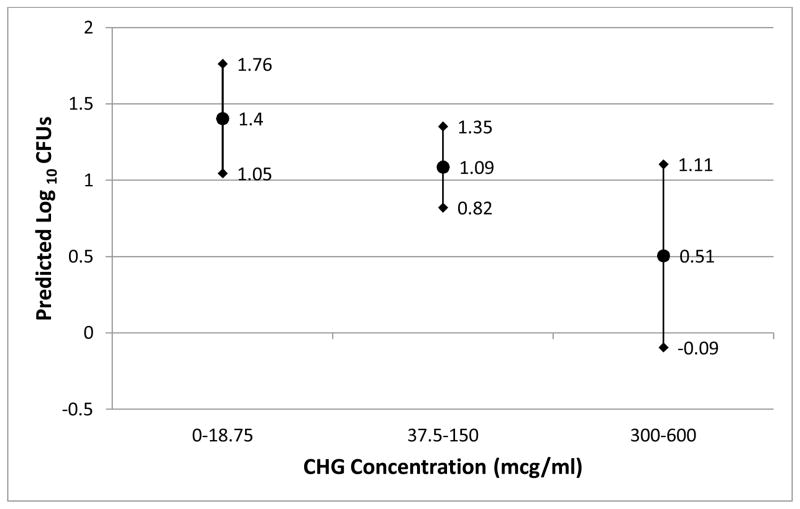
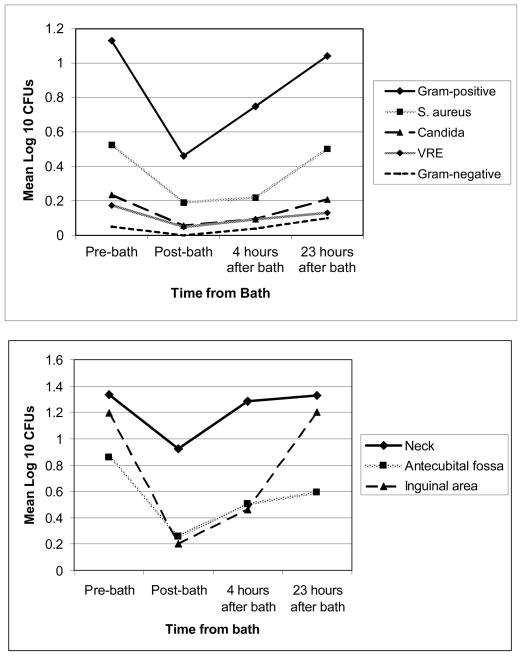
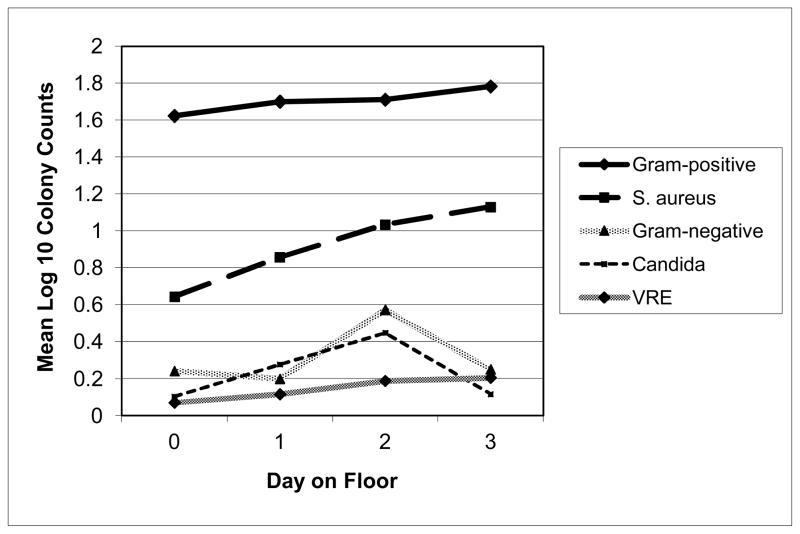
For 20 MICU patients studied (240 measurements), lowest CHG concentrations (0–18.75μg/mL) and highest gram-positive CFUs were on the neck (median 1.07log10CFU, p=0.014). CHG concentration increased post-bath and decreased over 24h(p<0.001). In parallel, median log10CFUs decreased pre- to post-bath (0.78 to 0) and then increased over 24h to baseline of 0.78 (p=0.001). A CHG concentration >18.75μg/mL was associated with decreased gram-positive CFU(p=0.004). In all but 2 instances, CHG was detected on patient skin during entire inter-bath (~24h) period (18/20(90%) patients). In 11 patients studied after MICU discharge (80 measurements), CHG skin concentrations fell below effective levels after 1–3 days.
Conclusion
In MICU patients bathed daily with CHG, CHG concentration was inversely associated with microbial density on skin; residual antimicrobial activity on skin persisted up to 24h. Determination of CHG concentration on patients’ skin may be useful in monitoring adequacy of skin cleansing by healthcare workers.
-
Subjects:
-
Source:Infect Control Hosp Epidemiol. 33(9):889-896.
-
Pubmed ID:22869262
-
Pubmed Central ID:PMC3632447
-
Document Type:
-
Funding:
-
Volume:33
-
Issue:9
-
Collection(s):
-
Main Document Checksum:urn:sha256:f78e1bc799b938665e2bb658fea8add6418d3b1387a6c420140cc50d55d42ef4
-
Download URL:
-
File Type:
 [PDF
- 821.27 KB
]
[PDF
- 821.27 KB
]
Supporting Files


File Language:
English
ON THIS PAGE

CDC STACKS serves as an archival repository of CDC-published products including
scientific findings,
journal articles, guidelines, recommendations, or other public health information authored or
co-authored by CDC or funded partners.
As a repository, CDC STACKS retains documents in their original published format to ensure public access to scientific information.
As a repository, CDC STACKS retains documents in their original published format to ensure public access to scientific information.
You May Also Like
COLLECTION
CDC Public Access