


Early diagnosis of autism spectrum disorder: Stability and change in clinical diagnosis and symptom presentation
Supporting Files

-
May 2013
-
Details
-
Alternative Title:J Child Psychol Psychiatry
-
Personal Author:
-
Description:Background
Although a diagnosis of autism spectrum disorder (ASD) appears to be stable in children as young as age three, few studies have explored stability of a diagnosis in younger children. Predictive value of diagnostic tools for toddlers and patterns of symptom change are important considerations for clinicians making early diagnoses. Most findings come from high-risk samples, but reports on children screened in community settings are also needed.
Methods
Stability of diagnosis and Autism Diagnostic Observation Schedule–Toddler Module (ADOS-T) classifications and scores was examined across two time points in a sample of 82 children identified through the FIRST WORDSR Project. Children received two comprehensive diagnostic evaluations at average ages of 19.39 (SD=2.12) and 36.89 (SD=3.85) months.
Results
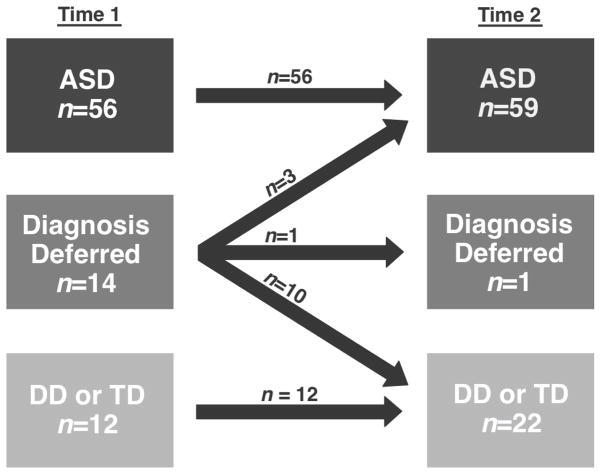
Stability was 100% when confirming and ruling out a diagnosis of ASD based on a comprehensive diagnostic evaluation that included clinic and home observations, although diagnosis was initially deferred for 17% of the sample. Receiver Operating Characteristic curves revealed excellent sensitivity and acceptable specificity for the ADOS-T compared to concurrent diagnosis. Logistic regressions indicated good predictive value of initial ADOS-T scores for follow-up diagnosis. Finally, both ASD and Non-ASD children demonstrated a decrease in Social Affect scores (i.e., improvement), while children with ASD demonstrated an increase in Restricted and Repetitive Behavior scores (i.e., worsening), changes that were accounted for by nonverbal developmental level in mixed model analyses.
Conclusions
Short-term stability was documented for children diagnosed at 19 months on average, although a minority of children initially showed unclear diagnostic presentations. Findings highlight utility of the ADOS-T in making early diagnoses and predicting follow-up diagnoses. Children with ASD demonstrated improvement in social communication behaviors and unfolding of repetitive behaviors, suggesting that certain early patterns of change in symptoms may be characteristic of ASD.
-
Subjects:
-
Source:J Child Psychol Psychiatry. 54(5):582-590.
-
Pubmed ID:23078094
-
Pubmed Central ID:PMC3556369
-
Document Type:
-
Funding:
-
Volume:54
-
Issue:5
-
Collection(s):
-
Main Document Checksum:urn:sha256:eea8d0ee76875c4bad4ac252236df3ecc9cdab32bb68442040d184e57f192c8b
-
Download URL:
-
File Type:
 [PDF
- 187.39 KB
]
[PDF
- 187.39 KB
]
Supporting Files


ON THIS PAGE

CDC STACKS serves as an archival repository of CDC-published products including
scientific findings,
journal articles, guidelines, recommendations, or other public health information authored or
co-authored by CDC or funded partners.
As a repository, CDC STACKS retains documents in their original published format to ensure public access to scientific information.
As a repository, CDC STACKS retains documents in their original published format to ensure public access to scientific information.
You May Also Like
COLLECTION
CDC Public Access