



Maintenance Treatment of Depression in Old Age: A Randomized, Double-blind, Placebo-Controlled Evaluation of the Efficacy and Safety of Donepezil Combined with Antidepressant Pharmacotherapy
Supporting Files

-
1 2011 ; 1-2011
-
Available in CDC Stacks on 2011-04-13T00:00:00Z
File Language:
English
Details
-
Alternative Title:Arch Gen Psychiatry
-
Personal Author:Reynolds, Charles F. ; Butters, Meryl A. ; Lopez, Oscar ; Pollock, Bruce G. ; Dew, Mary Amanda ; Mulsant, Benoit H. ; Lenze, Eric J. ; Holm, Margo ; Rogers, Joan C. ; Mazumdar, Sati ; Houck, Patricia R. ; Begley, Amy ; Anderson, Stewart ; Karp, Jordan F. ; Miller, Mark D. ; Whyte, Ellen M. ; Stack, Jacqueline ; Gildengers, Ariel ; Szanto, Katalin ; Bensasi, Salem ; Kaufer, Daniel I. ; Kamboh, M. Ilyas ; DeKosky, Steven T.
-
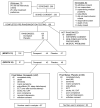
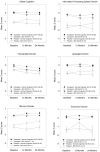
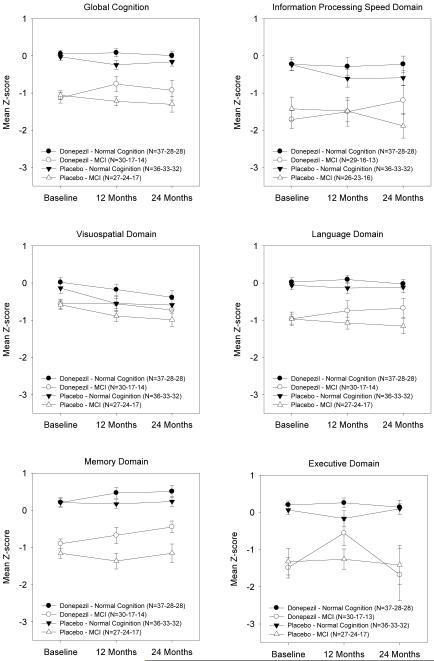
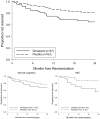
Description:Context ; Cognitive impairment in late-life depression is a core feature of the illness. ; Objective ; to test whether donepezil + antidepressant is superior to placebo + antidepressant in (1) improving cognitive performance and instrumental activities of daily living and (2) reducing recurrences of depression over two years of maintenance treatment. ; Design ; Randomized, double-blind, placebo controlled maintenance trial. ; Setting ; university clinic ; Main Outcome Measures ; global neuropsychological performance, cognitive instrumental ADL, and recurrent depression. ; Results ; Donepezil + antidepressant temporarily improved global cognition (treatment by time interaction F = 3.78, df = 2, 126, p = .03), but effect sizes were small (Cohen’s d = 0.27: group difference at 1 year). A marginal benefit to cognitive instrumental ADL was also observed (treatment by time interaction; F = 2.94; df = 2, 137, p = 0.06). The donepezil group was more likely to experience recurrent major depression: 35% 95% CI: 24%, 46% versus 19% 95% CI: 9%, 29% (log rank chi squared = 3.97, p = .05); hazard ratio = 2.09 95% CI: 1.00, 4.41. Post-hoc subgroup analyses showed that, of 57 participants with mild cognitive impairment, 3/30 on donepezil (10%; 95% CI: 0, 21%) and 9/27 on placebo (33%; 95% CI: 16%, 51%) converted to dementia over two years (Fisher exact p = 0.05). The MCI subgroup had a 44 percent recurrence rate of major depression on donepezil verses 12% on placebo (LR=4.91, p=.03). The subgroup with normal cognition (n = 73) showed no benefit on donepezil or increase in recurrence of major depression. ; Conclusion ; Whether ChEI should be used as augmentation in the maintenance treatment of late-life depression depends upon a careful weighing of risks and benefits in those with MCI. In cognitively intact patients, donepezil appears to have no clear benefit for preventing progression to MCI/dementia or recurrence of depression.
-
Subjects:
- Activities of Daily Living
- Aged
- Aged, 80 and over
- Aging
- Antidepressive Agents
- Cholinesterase Inhibitors
- Cognition
- Depressive Disorder, Major
- Donepezil
- Double-Blind Method
- Drug Therapy, Combination
- Female
- Follow-Up Studies
- Humans
- Indans
- Male
- Nootropic Agents
- Piperidines
- Secondary Prevention
- Treatment Outcome
-
Source:Arch Gen Psychiatry. 68(1):51-60
-
Pubmed ID:21199965
-
Pubmed Central ID:PMC3076045
-
Document Type:
-
Funding:UL1 TR000005/TR/NCATS NIH HHSUnited States/ ; R01 AG022462/AG/NIA NIH HHSUnited States/ ; R01 MH037869-25/MH/NIMH NIH HHSUnited States/ ; R01 MH043823/MH/NIMH NIH HHSUnited States/ ; R01 MH043832-16A1/MH/NIMH NIH HHSUnited States/ ; P30 MH071944/MH/NIMH NIH HHSUnited States/ ; P50 AG005133/AG/NIA NIH HHSUnited States/ ; K01 EB009724/EB/NIBIB NIH HHSUnited States/ ; P50 AG05133/AG/NIA NIH HHSUnited States/ ; R01 AG030653/AG/NIA NIH HHSUnited States/ ; R01 MH037869/MH/NIMH NIH HHSUnited States/ ; P30 MH071944-05/MH/NIMH NIH HHSUnited States/ ; R49 CE001495/CE/NCIPC CDC HHSUnited States/ ; R21 AG033387/AG/NIA NIH HHSUnited States/ ; R01 MH043832/MH/NIMH NIH HHSUnited States/ ; P50 AG005133-24/AG/NIA NIH HHSUnited States/ ; R01 MH083660/MH/NIMH NIH HHSUnited States/ ; R01MH072947/MH/NIMH NIH HHSUnited States/ ; AG030653/AG/NIA NIH HHSUnited States/ ; R01 AG030653-03/AG/NIA NIH HHSUnited States/ ; R01 MH072947-05S1/MH/NIMH NIH HHSUnited States/ ; R01 MH072947/MH/NIMH NIH HHSUnited States/ ; KL2 TR000146/TR/NCATS NIH HHSUnited States/
-
Volume:68
-
Issue:1
-
Download URL:
-
File Type:
 [PDF - 828.42 KB]
 -
Collection(s):
-
Main Document Checksum:urn:sha256:1189011cc35d193ba7869a69b3f341f84eac323dc41c747fe836a847800ca6c2
Supporting Files


File Language:
English
 Was this page helpful?
 Found an issue?



CDC STACKS serves as an archival repository of CDC-published products including
scientific findings, journal articles, guidelines, recommendations, or other public health information authored or
co-authored by CDC or funded partners.
As a repository, CDC STACKS retains documents in their original published format to ensure public access to scientific information.
As a repository, CDC STACKS retains documents in their original published format to ensure public access to scientific information.
You May Also Like
COLLECTION
CDC Public Access