



Risk of renal cell carcinoma following exposure to metalworking fluids among autoworkers
Supporting Files

-
Aug 02 2016
-
File Language:
English
Details
-
Alternative Title:Occup Environ Med
-
Personal Author:
-
Description:Objectives
Metalworking fluids (MWF), used to cool and lubricate metal in occupational settings, are linked to several cancers but data on kidney cancer are limited. We examine how MWF influence the rate of renal cell carcinoma (RCC) in a large prospective study.
Methods
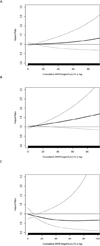
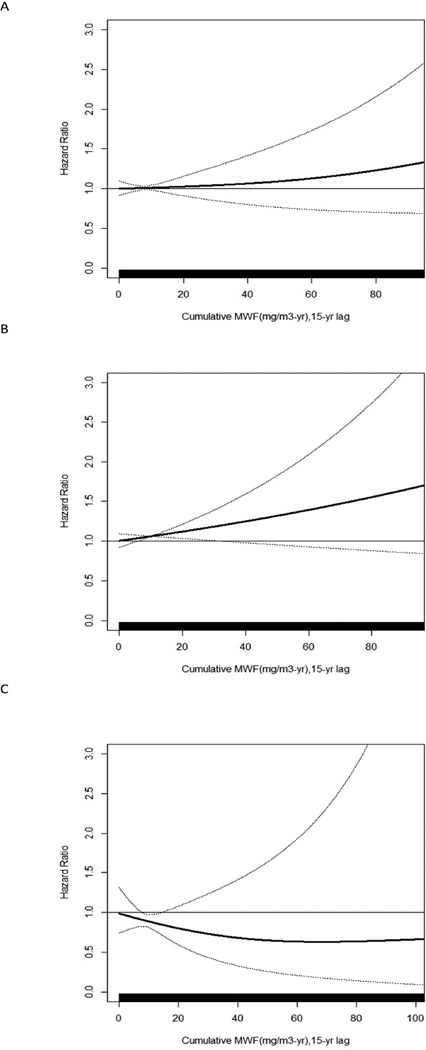
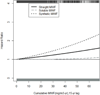
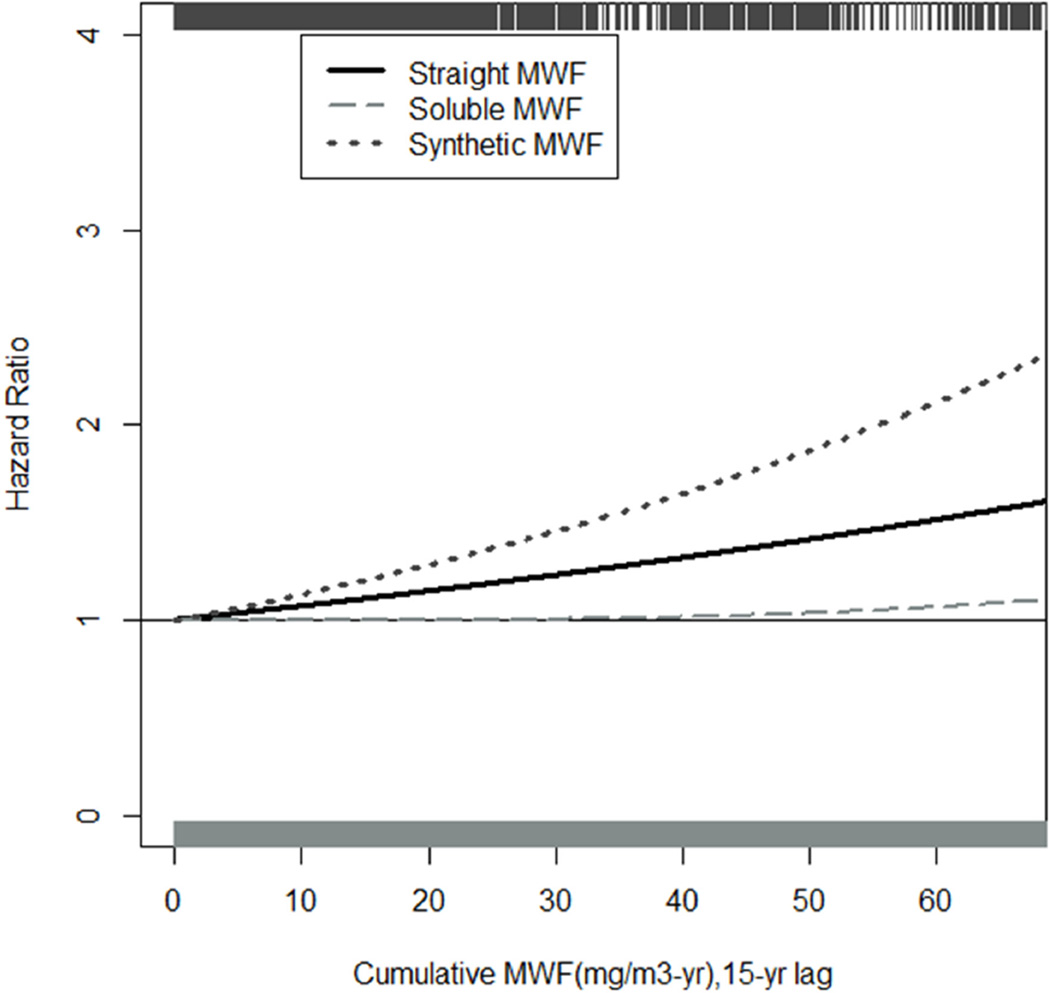
A cohort of Michigan autoworkers consisting of 33,421 individuals was followed 1985 through 2009. The cohort was linked to the Michigan Cancer Registry to identify new cases of RCC. We analyzed RCC in relation to cumulative exposure to each specific type of MWF (straight, soluble and synthetic) and all three types pooled into a single MWF variable, with a 15-year lag. Cox Proportional Hazards Regression with splines were used to estimate Hazard Ratios (HRs) and 95% confidence intervals (95% CIs), controlling for age, gender, race, calendar year, year hired, time since hire, plant, and other MWF types.
Results
There were 135 incident cases. A linear increase in the log-HR was observed for RCC with increasing cumulative exposure to each MWF type and total MWF exposure. At the mean of total MWF exposure (18.80 mg/m3-yr), the estimated HR was 1.11 (95% CI 1.04, 1.19).
Conclusions
Our results provide evidence for a dose-dependent association between MWF exposure and RCC. The influence of components of both oil- and water-based MWF needs further examination.
-
Subjects:
-
Source:Occup Environ Med. 73(10):656-662.
-
Pubmed ID:27484955
-
Pubmed Central ID:PMC5045439
-
Document Type:
-
Funding:
-
Place as Subject:
-
Volume:73
-
Issue:10
-
Collection(s):
-
Main Document Checksum:urn:sha256:da962de6186fb6b2c2dd4ebe885002ff6df89adcf8e056dfbca839ec216b1b0c
-
Download URL:
-
File Type:
 [PDF
- 776.04 KB
]
[PDF
- 776.04 KB
]
Supporting Files


File Language:
English
 Was this page helpful?
 Found an issue?
CDC STACKS serves as an archival repository of CDC-published products including
scientific findings,
journal articles, guidelines, recommendations, or other public health information authored or
co-authored by CDC or funded partners.
As a repository, CDC STACKS retains documents in their original published format to ensure public access to scientific information.
As a repository, CDC STACKS retains documents in their original published format to ensure public access to scientific information.
You May Also Like
COLLECTION
CDC Public Access