



Association between community socioeconomic factors, animal feeding operations, and campylobacteriosis incidence rates: Foodborne Diseases Active Surveillance Network (FoodNet), 2004-2010
Supporting Files
Public Domain

-
-
By Show All

-
File Language:
English
Details
-
Journal Article:BMC Infect Dis
-
Description:Background
Campylobacter is a leading cause of foodborne illness in the United States. Campylobacter infections have been associated with individual risk factors, such as the consumption of poultry and raw milk. Recently, a Maryland-based study identified community socioeconomic and environmental factors that are also associated with campylobacteriosis rates. However, no previous studies have evaluated the association between community risk factors and campylobacteriosis rates across multiple U.S. states.
Methods
We obtained Campylobacter case data (2004-2010; n = 40,768) from the Foodborne Diseases Active Surveillance Network (FoodNet) and socioeconomic and environmental data from the 2010 Census of Population and Housing, the 2011 American Community Survey, and the 2007 U.S. Census of Agriculture. We linked data by zip code and derived incidence rate ratios using negative binomial regression models.
Results
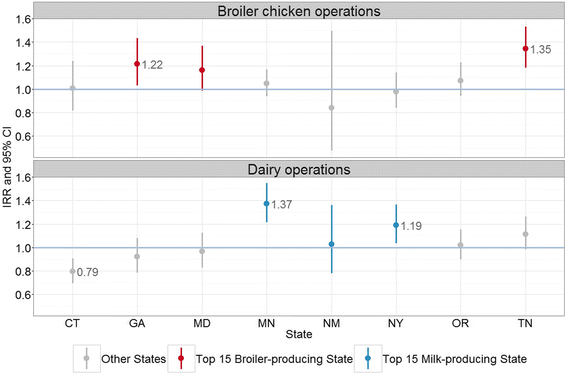
Community socioeconomic and environmental factors were associated with both lower and higher campylobacteriosis rates. Zip codes with higher percentages of African Americans had lower rates of campylobacteriosis (incidence rate ratio [IRR]) = 0.972; 95 % confidence interval (CI) = 0.970,0.974). In Georgia, Maryland, and Tennessee, three leading broiler chicken producing states, zip codes with broiler operations had incidence rates that were 22 % (IRR = 1.22; 95 % CI = 1.03,1.43), 16 % (IRR = 1.16; 95 % CI = 0.99,1.37), and 35 % (IRR = 1.35; 95 % CI = 1.18,1.53) higher, respectively, than those of zip codes without broiler operations. In Minnesota and New York FoodNet counties, two top dairy producing areas, zip codes with dairy operations had significantly higher campylobacteriosis incidence rates (IRR = 1.37; 95 % CI = 1.22, 1.55; IRR = 1.19; 95 % CI = 1.04,1.36).
Conclusions
Community socioeconomic and environmental factors are important to consider when evaluating the relationship between possible risk factors and Campylobacter infection. -
Subjects:
- Adolescent
- Adult
- Aged
- Aged, 80 and over
- Animal Husbandry
- Animals
- Campylobacter Infections
- Chickens
- Child
- Child, Preschool
- Environment
- Female
- Foodborne Diseases
- Health Surveys
- Humans
- Incidence
- Infant
- Infant, Newborn
- Male
- Middle Aged
- Models, Statistical
- Poultry Products
- Public Health Surveillance
- Residence Characteristics
- Risk Factors
- Socioeconomic Factors
- Young Adult
-
DOI:
-
Pubmed ID:27450432
-
Pubmed Central ID:PMC4957341
-
Document Type:
-
Corporate as Subject:
-
Genre:
-
Place as Subject:
-
Volume:16
-
Download URL:
-
File Type:
 [PDF - 769.71 KB]
-
Collection(s):
-
Main Document Checksum:urn:sha-512:adcad90c467e57bf9dd687677565fb689b5d9e0c043bc5cd80dc318a92c10aa946458023057224c0a3fc4cd079b0a52303847f2ba87265ba23c35db4476458af
Supporting Files


File Language:
English
 Was this page helpful?
 Found an issue?



CDC STACKS serves as an archival repository of CDC-published products including
scientific findings, journal articles, guidelines, recommendations, or other public health information authored or
co-authored by CDC or funded partners.
As a repository, CDC STACKS retains documents in their original published format to ensure public access to scientific information.
As a repository, CDC STACKS retains documents in their original published format to ensure public access to scientific information.
You May Also Like
COLLECTION
CDC Public Access