



Cost of Starting Colorectal Cancer Screening Programs: Results From Five Federally Funded Demonstration Programs
Supporting Files
Public Domain

-
Mar 15 2008
File Language:
English
Details
-
Journal Article:Preventing Chronic Disease (PCD)
-
Personal Author:
-
Description:Introduction
In 2005, the Centers for Disease Control and Prevention (CDC) started a 3-year colorectal cancer screening demonstration project and funded five programs to explore the feasibility of a colorectal cancer program for the underserved U.S. population. CDC is evaluating the five programs to estimate implementation cost, identify best practices, and determine the most cost-effective approach. The objectives are to calculate start-up costs and estimate funding requirements for widespread implementation of colorectal cancer screening programs.
Methods
An instrument was developed to collect data on resource use and related costs. Costs were estimated for start-up activities, including program management, database development, creation of partnerships, public education and outreach, quality assurance and professional development, and patient support. Monetary value of in-kind contributions to start-up programs was also estimated.
Results
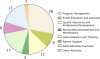
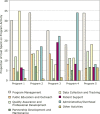
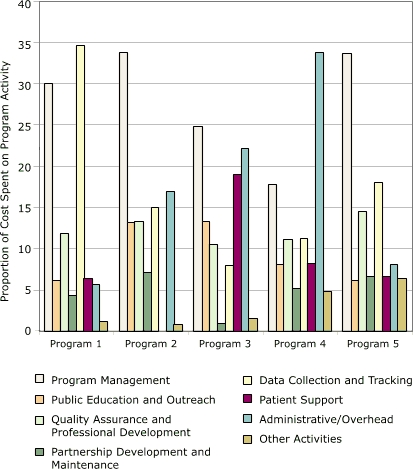
Start-up time ranged from 9 to 11 months for the five programs; costs ranged from $60,602 to $337,715. CDC funding and in-kind contributions were key resources for the program start-up activities. The budget category with the largest expenditure was labor, which on average accounted for 67% of start-up costs. The largest cost categories by activities were management (28%), database development (17%), administrative (17%), and quality assurance (12%). Other significant expenditures included public education and outreach (9%) and patient support (8%).
Conclusion
To our knowledge, no previous reports detail the costs to begin a colorectal cancer screening program for the underserved population. Start-up costs were significant, an important consideration in planning and budgeting. In-kind contributions were also critical in overall program funding. Start-up costs varied by the infrastructure available and the unique design of programs. These findings can inform development of organized colorectal cancer programs. -
Subjects:
-
Source:Prev Chronic Dis. 2008; 5(2).
-
ISSN:1545-1151
-
Pubmed ID:18341782
-
Pubmed Central ID:PMC2396978
-
Document Type:
-
Corporate as Subject:
-
Place as Subject:
-
Location:
-
Volume:5
-
Issue:2
-
Download URL:
-
File Type:
 [PDF - 395.80 KB]
 -
Collection(s):
-
Main Document Checksum:urn:sha-512:050f9c5ef1db7ddaef1735131f1711f956dee33beafe93ccd6681bc46b991539806877ab9cd7cbf186bedfbc61beddf9dcd5205a303bde6b6c786c5498c0be38
Supporting Files


File Language:
English
 Was this page helpful?
 Found an issue?



CDC STACKS serves as an archival repository of CDC-published products including
scientific findings, journal articles, guidelines, recommendations, or other public health information authored or
co-authored by CDC or funded partners.
As a repository, CDC STACKS retains documents in their original published format to ensure public access to scientific information.
As a repository, CDC STACKS retains documents in their original published format to ensure public access to scientific information.
You May Also Like
COLLECTION
Preventing Chronic Disease