



Efficacy of a Universal Brief Intervention for Violence Among Urban Emergency Department Youth
Supporting Files

-
9 2016 ; 9-2016
-
Available in CDC Stacks on 2017-09-07T00:00:00Z
File Language:
English
Details
-
Alternative Title:Acad Emerg Med
-
Personal Author:
-
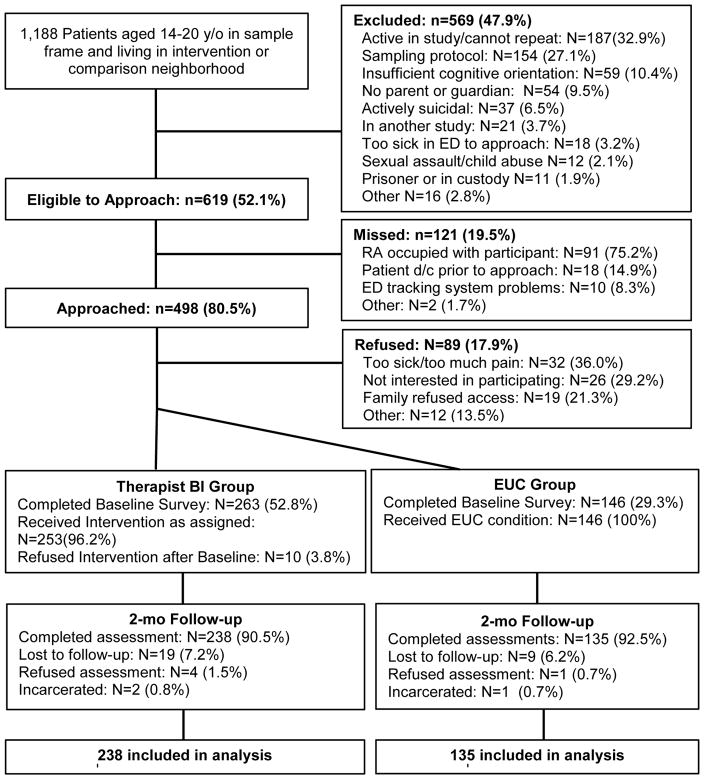
Description:Background ; Violent injury is the leading cause of death among urban youth. Emergency department (ED) visits represent an opportunity to deliver a brief intervention (BI) to reduce violence among youth seeking medical care in high-risk communities. ; Objective ; To determine the efficacy of a universally applied Brief Intervention (BI) addressing violence behaviors among youth presenting to an urban ED. ; Methods ; ED youth (14-to-20 years-old) seeking medical or injury- related care in a Level-1 ED (October 2011–March 2015) and screening positive for a home address within the intervention or comparison neighborhood of a larger youth violence project were enrolled in this quasi-experimental study. Based on home address, participants were assigned to receive either the 30-min therapist-delivered BI (Project Sync) or a resource brochure (enhanced usual care EUC condition). The Project Sync BI combined motivational interviewing and cognitive skills training, including a review of participant goals, tailored feedback, decisional balance exercises, role-playing exercises, and linkage to community resources. Participants completed validated survey measures at baseline and a 2-month follow-up assessment. Main outcome measures included self-report of physical victimization, aggression, and self-efficacy to avoid fighting. Poisson and Zero-inflated Poisson regression analyses analyzed the effects of the BI, as compared to the EUC condition on primary outcomes. ; Results ; 409 eligible youth (82% participation) were enrolled and assigned to either receive the BI (n=263) or the EUC condition (n=146). Two-month follow-up was 91% (n=373). There were no significant baseline differences between study conditions. Among the entire sample, mean age was 17.7 y/o (SD 1.9), 60% were female, 93% were African-American, and 79% reported receipt of public assistance. Of participants, 9% presented for a violent injury, 9% reported recent firearm carriage, 20% reported recent alcohol use, and 39% reported recent marijuana use. Compared with the EUC group, participants in the therapist BI group showed self-reported reductions in frequency of violent aggression (therapist, −46.8%; EUC, −36.9%; Incident rate ratio IRR, 0.87; 95% confidence interval CI, 0.76–0.99) and increased self-efficacy for avoiding fighting (therapist, +7.2%; EUC, −1.3%; IRR, 1.09; 95% CI, 1.02–1.15). No significant changes were noted for victimization. ; Conclusions ; Among youth seeking ED care in a high-risk community, a brief, universally applied BI shows promise in increased self-efficacy for avoiding fighting and a decrease in the frequency of violent aggression. ; Trial Registration ; Clinicaltrials.gov identifier – NCT02586766
-
Subjects:
-
Keywords:
-
Source:Acad Emerg Med. 23(9):1061-1070
-
Pubmed ID:27265097
-
Pubmed Central ID:PMC5018914
-
Document Type:
-
Funding:
-
Volume:23
-
Issue:9
-
Download URL:
-
File Type:
 [PDF - 714.75 KB]
 -
Collection(s):
-
Main Document Checksum:urn:sha256:bb441cee97cb35201bea14e53915bcbba09d093c12274058324baaaccaa36ac9
Supporting Files


File Language:
English
 Was this page helpful?
 Found an issue?

CDC STACKS serves as an archival repository of CDC-published products including
scientific findings, journal articles, guidelines, recommendations, or other public health information authored or
co-authored by CDC or funded partners.
As a repository, CDC STACKS retains documents in their original published format to ensure public access to scientific information.
As a repository, CDC STACKS retains documents in their original published format to ensure public access to scientific information.
You May Also Like
COLLECTION
CDC Public Access