



Can States Simultaneously Improve Health Outcomes and Reduce Health Outcome Disparities?
Supporting Files
Public Domain

-
Aug 25 2016
File Language:
English
Details
-
Journal Article:Preventing Chronic Disease (PCD)
-
Personal Author:
-
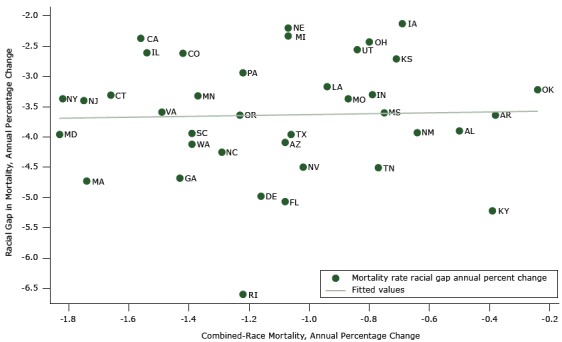
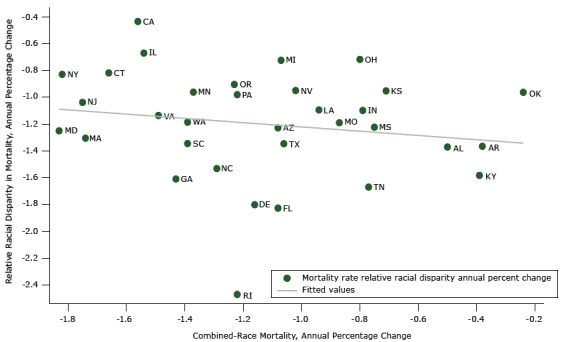
Description:Introduction ; Reducing racial health disparities is often stated as a population health goal, but specific targets for such improvement are seldom set. It is often assumed that improving overall health outcomes will be linked to disparity reduction, but this is not necessarily the case. ; Methods ; We compared the annual change from 1999 through 2013 in combined-race (black and white) mortality with the annual change in absolute and relative racial mortality disparities for US states. ; Results ; Median annual improvement in combined-race mortality was 1.08% per year. Annual overall mortality rate reductions ranged from 0.24% per year in Oklahoma to 1.83% per year in Maryland. For disparities, the median for the black–white absolute gap was 3.60% per year, and the median for the relative black-to-white ratio was 1.19% per year. There was no significant correlation between the combined-race measure and either the absolute (0.03) or relative disparity measure reductions (−0.17). ; Conclusion ; For mortality in US states over a recent period, improvement in the population mean and disparity reduction do not usually occur together. The disparity reduction rates observed may provide realistic guidance for public and private policy makers in setting goals for reducing population health disparity and creating investment priorities. As a starting point for discussion, the observed national median annual percentage improvement of 1.1 per year combined, 3.6% per year absolute gap reduction, and 1.2% per year relative gap reduction would be modest and reasonable goals.
-
Subjects:
-
Source:Prev Chronic Dis. 13.
-
DOI:
-
ISSN:1545-1151
-
Pubmed ID:27560720
-
Pubmed Central ID:PMC5003539
-
Document Type:
-
Place as Subject:
-
Volume:13
-
Download URL:
-
File Type:
 [PDF - 249.50 KB]
 -
Collection(s):
-
Main Document Checksum:urn:sha-512:bc041778323d07a82b44bd79d277ba887cd20a708f6c5aa24456a07bdcdb1614c0b700c69b17cf90010bcda43c0604fd6821f3d15169f3fbf90decb9b762717e
Supporting Files


File Language:
English
 Was this page helpful?
 Found an issue?


CDC STACKS serves as an archival repository of CDC-published products including
scientific findings, journal articles, guidelines, recommendations, or other public health information authored or
co-authored by CDC or funded partners.
As a repository, CDC STACKS retains documents in their original published format to ensure public access to scientific information.
As a repository, CDC STACKS retains documents in their original published format to ensure public access to scientific information.
You May Also Like
COLLECTION
Preventing Chronic Disease