



Clearing the Air: Smoke-Free Housing Policies, Smoking, and Secondhand Smoke Exposure Among Affordable Housing Residents in Minnesota, 2014–2015
Supporting Files
Public Domain

-
Aug 18 2016
File Language:
English
Details
-
Journal Article:Preventing Chronic Disease (PCD)
-
Personal Author:
-
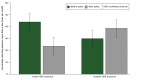
Description:Introduction ; During the past 30 years, local and state tobacco use control laws in the United States have helped reduce smoking prevalence and exposure to secondhand smoke, but progress among low socioeconomic populations has been slow. Implementing smoke-free housing policies in affordable housing may help address this issue. The purpose of our study was to assess how such policies affect smoking rates and exposure to secondhand smoke among residents of affordable housing. ; Methods ; We conducted a pretest–posttest longitudinal study of 180 residents from 8 affordable housing properties in Minnesota. Participating properties agreed to adopt a smoke-free housing policy covering indoor grounds, and 3 of these properties also prohibited smoking on all outdoor grounds. Policies were implemented with assistance from local public health departments and the Statewide Health Improvement Program. Participants completed surveys one month before policy implementation and 6 months postimplementation. Surveys assessed smoking, quit attempts, and indoor and outdoor secondhand smoke exposure. ; Results ; Results indicated a significant reduction in nonsmokers’ indoor exposure to secondhand smoke (F1,144 = 22.69, P < .001) and no change in outdoor exposure to secondhand smoke from Time 1 (pretest) to Time 2 (posttest) (F1,140 = 2.17, P = .14). However, when examining sites that only prohibited smoking indoors, we observed an increase in outdoor secondhand smoke exposure that approached significance (F1,118 = 3.76, P = .055). Results showed no change in quit attempts over time, but 77% of residents who smoked at pretest reported reducing the amount that they smoked at posttest, and an additional 5% reported that they had quit. ; Conclusions ; Smoke-free housing policies may be an effective strategy to reduce exposure to indoor secondhand exposure and promote decreased cigarette smoking among residents of affordable housing.
-
Subjects:
-
Source:Prev Chronic Dis. 13.
-
DOI:
-
ISSN:1545-1151
-
Pubmed ID:27536903
-
Pubmed Central ID:PMC4993114
-
Document Type:
-
Place as Subject:
-
Volume:13
-
Download URL:
-
File Type:
 [PDF - 292.56 KB]
 -
Collection(s):
-
Main Document Checksum:urn:sha-512:4a151ac463fd57895963806f245aab93f89de070e8ed4d607599fdbacdaccf2194bf431b88cd8299fbe594a80d5785dcbdeba7746301d1f9710922f2176798db
Supporting Files


File Language:
English
 Was this page helpful?
 Found an issue?


CDC STACKS serves as an archival repository of CDC-published products including
scientific findings, journal articles, guidelines, recommendations, or other public health information authored or
co-authored by CDC or funded partners.
As a repository, CDC STACKS retains documents in their original published format to ensure public access to scientific information.
As a repository, CDC STACKS retains documents in their original published format to ensure public access to scientific information.
You May Also Like
COLLECTION
Preventing Chronic Disease