



Delivering Prevention Interventions to People Living with HIV in Clinical Care Settings: Results of a Cluster Randomized Trial in Kenya, Namibia, and Tanzania
Supporting Files

-
9 2016
-
Available in CDC Stacks on 2016-09-01T00:00:00Z
File Language:
English
Details
-
Alternative Title:AIDS Behav
-
Personal Author:Bachanas, Pamela ; Kidder, Daniel ; Medley, Amy ; Pals, Sherri L. ; Carpenter, Deborah ; Howard, Andrea ; Antelman, Gretchen ; DeLuca, Nicolas ; Muhenje, Odylia ; Sheriff, Muhsin ; Somi, Geoffrey ; Katuta, Frieda ; Cherutich, Peter ; Moore, Janet
-
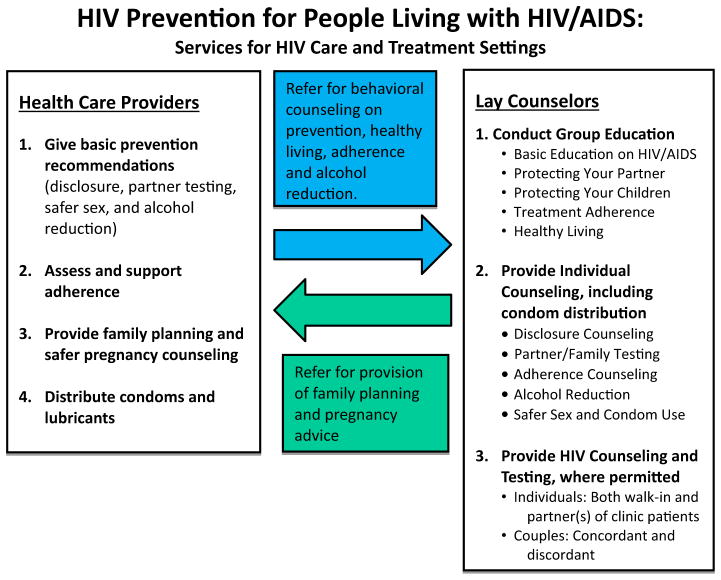
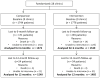
Description:We conducted a group randomized trial to assess the feasibility and effectiveness of a multi-component, clinic-based HIV prevention intervention for HIV-positive patients attending clinical care in Namibia, Kenya, and Tanzania. Eighteen HIV care and treatment clinics (six per country) were randomly assigned to intervention or control arms. Approximately 200 sexually active clients from each clinic were enrolled and interviewed at baseline and 6- and 12-months post-intervention. Mixed model logistic regression with random effects for clinic and participant was used to assess the effectiveness of the intervention. Of 3522 HIV-positive patients enrolled, 3034 (86 %) completed a 12-month follow-up interview. Intervention participants were significantly more likely to report receiving provider-delivered messages on disclosure, partner testing, family planning, alcohol reduction, and consistent condom use compared to participants in comparison clinics. Participants in intervention clinics were less likely to report unprotected sex in the past 2 weeks (OR = 0.56, 95 % CI 0.32, 0.99) compared to participants in comparison clinics. In Tanzania, a higher percentage of participants in intervention clinics (17 %) reported using a highly effective method of contraception compared to participants in comparison clinics (10 %, OR = 2.25, 95 % CI 1.24, 4.10). This effect was not observed in Kenya or Namibia. HIV prevention services are feasible to implement as part of routine care and are associated with a self-reported decrease in unprotected sex. Further operational research is needed to identify strategies to address common operational challenges including staff turnover and large patient volumes.
-
Subjects:
-
Keywords:
-
Source:AIDS Behav. 20(9):2110-2118
-
Pubmed ID:26995678
-
Pubmed Central ID:PMC4996693
-
Document Type:
-
Funding:
-
Place as Subject:
-
Volume:20
-
Issue:9
-
Download URL:
-
File Type:
 [PDF - 369.30 KB]
 -
Collection(s):
-
Main Document Checksum:urn:sha256:dc3959bbfaa8cf55f3c045ca6b33d3c9471c7e6e2dc6898d4973a74577bf7732
Supporting Files


File Language:
English
 Was this page helpful?
 Found an issue?



CDC STACKS serves as an archival repository of CDC-published products including
scientific findings, journal articles, guidelines, recommendations, or other public health information authored or
co-authored by CDC or funded partners.
As a repository, CDC STACKS retains documents in their original published format to ensure public access to scientific information.
As a repository, CDC STACKS retains documents in their original published format to ensure public access to scientific information.
You May Also Like
COLLECTION
CDC Public Access