


Revisiting Nonresidential Environmental Exposures and Childhood Lead Poisoning in the US: Findings from Kansas, 2000–2005
Supporting Files

-
Mar 02 2016
-
File Language:
English
Details
-
Alternative Title:J Environ Public Health
-
Personal Author:
-
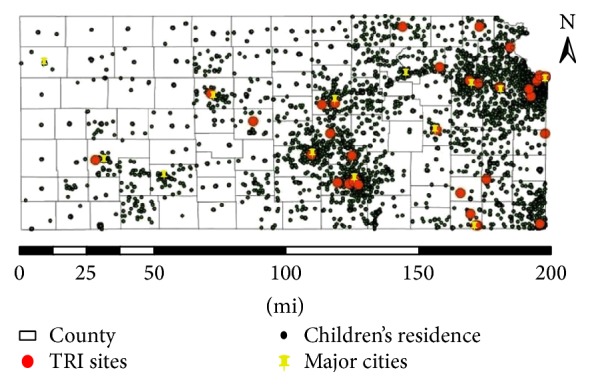
Description:Although blood lead levels (BLLs) in US children have dramatically declined over the past 40 years, there remain pockets of children living in areas with elevated BLLs. While some increases (≥ 10 μg/dL) may be associated with legacy lead paint, ambient air lead may be contributing to the problem. A deidentified dataset of information on over 60,000 Kansas children under 3 years of age who were tested for BLL was provided through the Kansas Environmental Public Health Tracking Network for the period 2000-2005. Using ArcGIS, we calculated distance (in miles) from a lead-emitting industry referred to as a toxic release inventory (TRI) site. The USEPA TRI database tracks the management of certain toxic chemicals that may pose a threat to human health. US facilities in different industry sectors must report annually amount of substances like lead into the environment including their exact location. Distance from a TRI site was inversely related to BLL after controlling for area-level poverty and pre-1950 housing. The results of our evaluation indicate there is a significant relationship between proximity to lead industry and childhood BLLs. Proximity to sources of lead emissions should be evaluated as a possible factor when identifying children for targeted BLL testing.
-
Subjects:
-
Source:J Environ Public Health. 2016; 2016.
-
Pubmed ID:27042184
-
Pubmed Central ID:PMC4793145
-
Document Type:
-
Funding:
-
Place as Subject:
-
Volume:2016
-
Collection(s):
-
Main Document Checksum:urn:sha256:3f115604481e7b56637643306a8c186fefaa0fcfec15c53d71a46c45f1d8ae58
-
Download URL:
-
File Type:
 [PDF
- 1.10 MB
]
[PDF
- 1.10 MB
]
Supporting Files


File Language:
English
ON THIS PAGE

CDC STACKS serves as an archival repository of CDC-published products including
scientific findings,
journal articles, guidelines, recommendations, or other public health information authored or
co-authored by CDC or funded partners.
As a repository, CDC STACKS retains documents in their original published format to ensure public access to scientific information.
As a repository, CDC STACKS retains documents in their original published format to ensure public access to scientific information.
You May Also Like
COLLECTION
CDC Public Access