


Reduced Evolutionary Rate in Reemerged Ebola Virus Transmission Chains
Supporting Files
Public Domain

-
2016/04/29
-
File Language:
English
Details
-
Journal Article:Science Advances
-
Personal Author:Blackley, David J. ; Wiley, Michael R. ; Ladner, Jason T. ; Fallah, Mosoka ; Lo, Terrence ; Gilbert, Merle L. ; Gregory, Christopher ; D'Ambrozio, Jonathan ; Coulter, Stewart ; Mate, Suzanne E. ; Balogun, Zephaniah ; Kugelman, Jeffrey R. ; Nwachukwu, William ; Prieto, Karla ; Yeiah, Adolphus ; Amegashie, Fred ; Kearney, Brian ; Wisniewski, Meagan ; Saindon, John ; Schroth, Gary ; Fakoli, Lawrence ; Diclaro, Joseph W. II ; Kuhn, Jens H. ; Hensley, Lisa E. ; Jahrling, Peter B. ; Ströher, Ute ; Nichol, Stuart T. ; Massaquoi, Moses ; Kateh, Francis N. ; Clement, Peter ; Gasasira, Alex N. ; Bolay, Fatorma ; Monroe, Stephan S. ; Rambaut, Andrew ; Sanchez-Lockhart, Mariano ; Laney, A. Scott ; Nyenswah, Tolbert G. ; Christie, Athalia ; Palacios, Gustavo
-
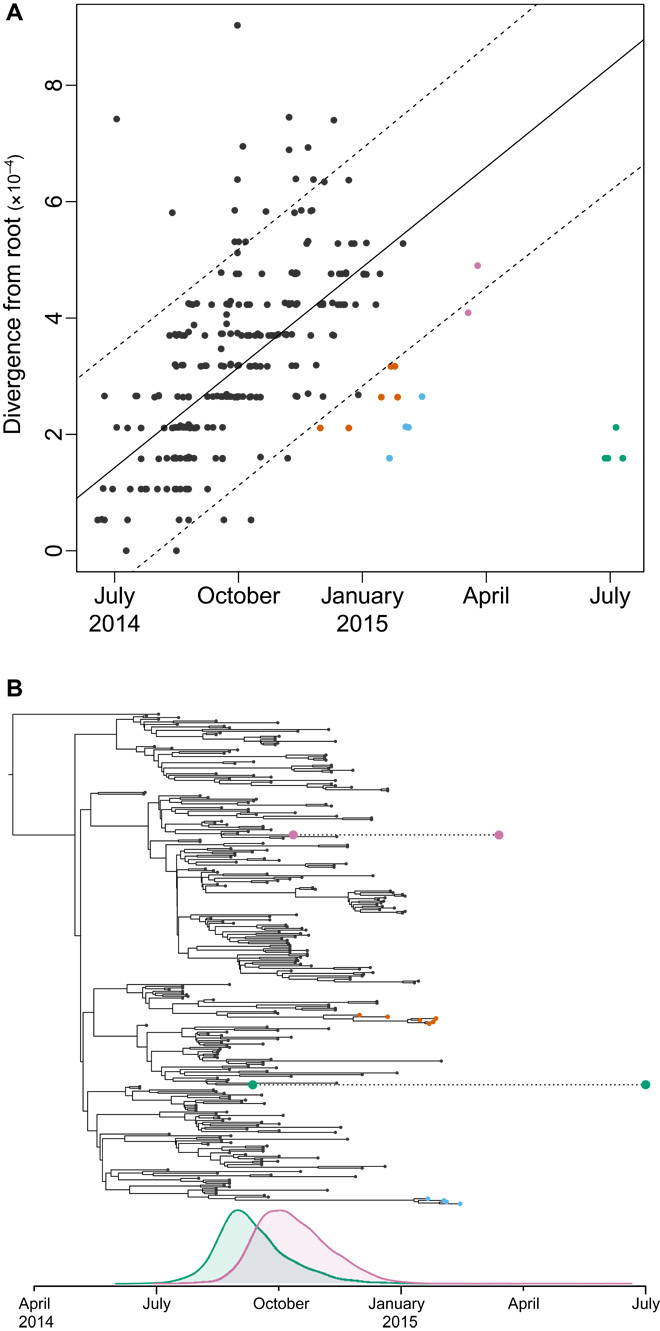
Description:On 29 June 2015, Liberia's respite from Ebola virus disease (EVD) was interrupted for the second time by a renewed outbreak ("flare-up") of seven confirmed cases. We demonstrate that, similar to the March 2015 flare-up associated with sexual transmission, this new flare-up was a reemergence of a Liberian transmission chain originating from a persistently infected source rather than a reintroduction from a reservoir or a neighboring country with active transmission. Although distinct, Ebola virus (EBOV) genomes from both flare-ups exhibit significantly low genetic divergence, indicating a reduced rate of EBOV evolution during persistent infection. Using this rate of change as a signature, we identified two additional EVD clusters that possibly arose from persistently infected sources. These findings highlight the risk of EVD flare-ups even after an outbreak is declared over. [Description provided by NIOSH]
-
Subjects:
-
Keywords:Author Keywords: Ebola Virus; Reemerged; Transmission Chain; Reduced Evolutionary Rate; Liberia; Ebola Virus Disease; Western Africa; Flare-up; Persistent Infection Ebola Virus Disease; Epidemiology; Disease Incidence; Infectious Diseases; Infectious Agents; Disease Transmission; Global Health; Genomics; Viral Diseases; Viral Infections; Disease Control; Infection Control; Humans; Sampling; Surveillance; Ribonucleic Acids; RNA;
-
Source:Sci Adv 2016 Apr; 2(4):e1600378
-
ISSN:2375-2548
-
Pubmed ID:27386513
-
Pubmed Central ID:PMC4928956
-
Document Type:
-
Genre:
-
Place as Subject:
-
CIO:
-
Division:
-
Topic:
-
Location:
-
Pages in Document:6 pdf pages
-
Volume:2
-
Issue:4
-
NIOSHTIC Number:nn:20048360
-
Contact Point Address:Gustavo Palacios, U.S. Army Medical Research Institute of Infectious Diseases, Fort Detrick, Frederick, MD 21702, USA
-
Email:gustavo.f.palacios.ctr@mail.mil
-
Federal Fiscal Year:2016
-
Peer Reviewed:True
-
Collection(s):
-
Main Document Checksum:urn:sha-512:011b820f82c58dd9137ef5aea960d3bc970837f3165a2bce8f5f46d6012a597524d1c8ca602b356c7b4e3f12273a3de81a56af34036ba0985efbd62157c00270
-
Download URL:
-
File Type:
 [PDF
- 804.36 KB
]
[PDF
- 804.36 KB
]
Supporting Files


File Language:
English
ON THIS PAGE

CDC STACKS serves as an archival repository of CDC-published products including
scientific findings,
journal articles, guidelines, recommendations, or other public health information authored or
co-authored by CDC or funded partners.
As a repository, CDC STACKS retains documents in their original published format to ensure public access to scientific information.
As a repository, CDC STACKS retains documents in their original published format to ensure public access to scientific information.
You May Also Like