



Compression or expansion of disability among two birth cohorts of US adults with diabetes during the past 20 years?
Supporting Files

-
Jun 10 2016
-
Available in CDC Stacks on 2017-08-01T00:00:00Z
File Language:
English
Details
-
Alternative Title:Lancet Diabetes Endocrinol
-
Personal Author:
-
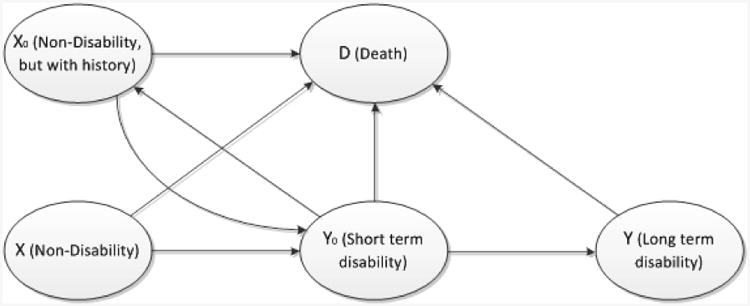
Description:Background ; The life expectancy of the average American with diabetes has increased, but the level of health and functioning of those extra years are not known. ; Methods ; Comparing adults aged 50 to 70 with (n=3,027) and without diabetes (n=9,750), we assessed incident disability, remission from disability, and mortality between population-based Cohort 1 (born 1931-1941, followed 1992 to 2002) and Cohort 2 (born 1942-1947, followed 2002 to 2012), from the Health and Retirement Study. Disability was defined by mobility loss, some difficulty with ≥1 instrumental activities of daily living (IADL), and some difficulty with ≥1 activities of daily living (ADL). Age-specific probabilities representing the two birth cohorts in the U.S. were entered into a five-state Markov model to estimate the number of years of disabled and disability-free life by age 70. ; Findings ; Among persons with diabetes, compared with Cohort 1(n=1,071), Cohort 2 (n=300) experienced more disability-free and total years of life, later onset of disability, and fewer disabled years lost. Solutions to the simulations of the Markov models suggest that among 50 year old diabetic men this amounted to a 0.8 to 2.3 year delay in disability across the 3 metrics (mobility p=0.01, IADL p=0.24, ADL p=0.01), while living 0.7 to 1.3 years longer (mobility p<0.0001, IADL p=0.001, ADL p<0.0001); results were similar for women. Parallel improvements in disabled life were gained across cohorts of non-diabetic adults (cohort 1 n=9,218; cohort 2 n=2,727), although non-diabetic adults in both cohort 1 and cohort 2 had significantly more disability-free years (e.g., cohort 1: non-diabetic men from age 50: 17.0 vs diabetic men: 13.0; cohort 2: non-diabetic men from age 50: 17.9 vs diabetic men: 14.8) and fewer life years lost (e.g., cohort 1: non-diabetic men from age 50: 1.2 vs diabetic men: 2.8; cohort 2: non-diabetic men from age 50: 0.6 vs diabetic men: 1.5) than diabetic adults within the two cohorts (p< 0.0001). ; Interpretation ; Regardless of diabetes status, adults experienced compression of disability and gains in disability-free life years. ; Funding ; None
-
Subjects:
-
Source:Lancet Diabetes Endocrinol. 4(8):686-694.
-
Pubmed ID:27298181
-
Pubmed Central ID:PMC4959005
-
Document Type:
-
Funding:
-
Place as Subject:
-
Volume:4
-
Issue:8
-
Download URL:
-
File Type:
 [PDF - 152.68 KB]
 -
Collection(s):
-
Main Document Checksum:urn:sha256:44d353c28d872662d5e7060c6c6b9b76ff867f77e51470b4a5471a0ca177786c
Supporting Files


File Language:
English
 Was this page helpful?
 Found an issue?


CDC STACKS serves as an archival repository of CDC-published products including
scientific findings, journal articles, guidelines, recommendations, or other public health information authored or
co-authored by CDC or funded partners.
As a repository, CDC STACKS retains documents in their original published format to ensure public access to scientific information.
As a repository, CDC STACKS retains documents in their original published format to ensure public access to scientific information.
You May Also Like
COLLECTION
CDC Public Access