



Putative microcircuit-level substrates for attention are disrupted in mouse models of autism
Supporting Files

-
Apr 28 2015
-
Available in CDC Stacks on 2017-04-15T00:00:00Z
Details
-
Alternative Title:Biol Psychiatry
-
Personal Author:
-
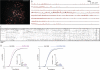
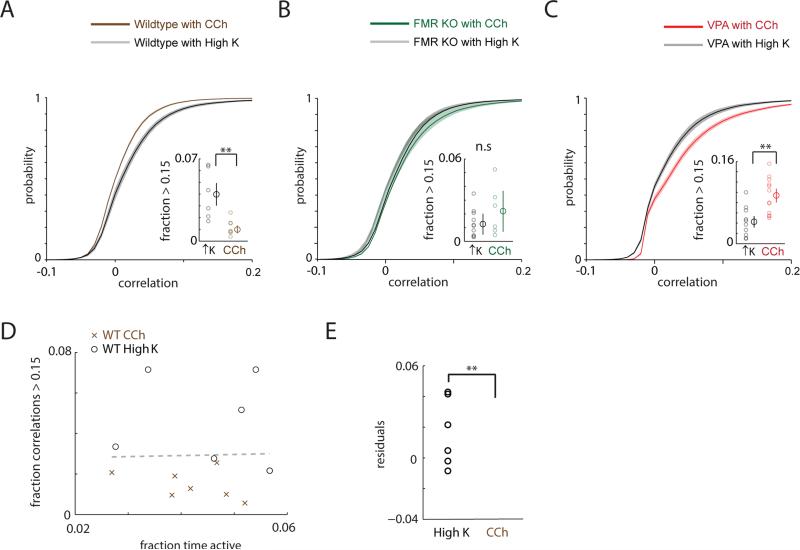
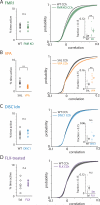
Description:BACKGROUND ; Deep layer excitatory circuits in the prefrontal cortex represent the strongest locus for genetic convergence in autism, but specific abnormalities within these circuits that mediate key features of autism, such cognitive or attentional deficits, remain unknown. Attention normally increases the sensitivity of neural populations to incoming signals by decorrelating ongoing cortical circuit activity. Here we investigated whether mechanisms underlying this phenomenon might be disrupted within deep layer prefrontal circuits in mouse models of autism. ; METHODS ; We isolated deep layer prefrontal circuits in brain slices then used single-photon GCaMP imaging to record activity from many (50-100) neurons simultaneously, in order to study patterns of spontaneous activity generated by these circuits under normal conditions and in two etiologically distinct models of autism: mice exposed to valproic acid (VPA) in utero and FMR1 KO mice. ; RESULTS ; We found that modest doses of the cholinergic agonist carbachol normally decorrelate spontaneous activity generated by deep layer prefrontal networks. This effect was disrupted in both VPA-exposed and FMR1 KO mice, but intact following other manipulations which do not model autism. ; CONCLUSIONS ; Our results suggest that cholinergic modulation may contribute to attention by acting on local cortical microcircuits to decorrelate spontaneous activity. Furthermore, defects in this mechanism represent a microcircuit-level endophenotype that could link diverse genetic and developmental disruptions to attentional deficits in autism. Future studies could elucidate pathways leading from various etiologies to this circuit-level abnormality, or use this abnormality itself as a target, and identify novel therapeutic strategies that restore normal circuit function.
-
Subjects:
- Article
- calcium imaging
- GCaMP
- prefrontal cortex
- Fragile X syndrome
- acetylcholine
- valproic acid
- Action Potentials
- Animals
- Attention
- Autistic Disorder
- Calcium
- Disease Models, Animal
- Fluoxetine
- Fragile X Mental Retardation Protein
- Mice, Inbred C57BL
- Mice, Knockout
- Nerve Tissue Proteins
- Neural Pathways
- Neurons
- Prefrontal Cortex
- Tissue Culture Techniques
- Valproic Acid
- Voltage-Sensitive Dye Imaging
-
Source:Biol Psychiatry. 79(8):667-675.
-
Pubmed ID:26022075
-
Pubmed Central ID:PMC4624609
-
Document Type:
-
Funding:
-
Volume:79
-
Issue:8
-
Download URL:
-
File Type:
 [PDF - 941.44 KB]
 -
Collection(s):
-
Main Document Checksum:urn:sha256:c935f1423c0ffa3c55862f346e0fb8f7ac1db17f6b6646a4be9e071a2c64588e
Supporting Files


 Was this page helpful?
 Found an issue?




CDC STACKS serves as an archival repository of CDC-published products including
scientific findings, journal articles, guidelines, recommendations, or other public health information authored or
co-authored by CDC or funded partners.
As a repository, CDC STACKS retains documents in their original published format to ensure public access to scientific information.
As a repository, CDC STACKS retains documents in their original published format to ensure public access to scientific information.
You May Also Like
COLLECTION
CDC Public Access