



EFFECT OF WEARING AN N95 FILTERING FACEPIECE RESPIRATOR ON SUPEROMEDIAL ORBITAL INFRARED INDIRECT BRAIN TEMPERATURE MEASUREMENTS
Supporting Files

-
January 13 2016
-
Available in CDC Stacks on 2018-02-01T00:00:00Z
File Language:
English
Details
-
Alternative Title:J Clin Monit Comput
-
Personal Author:
-
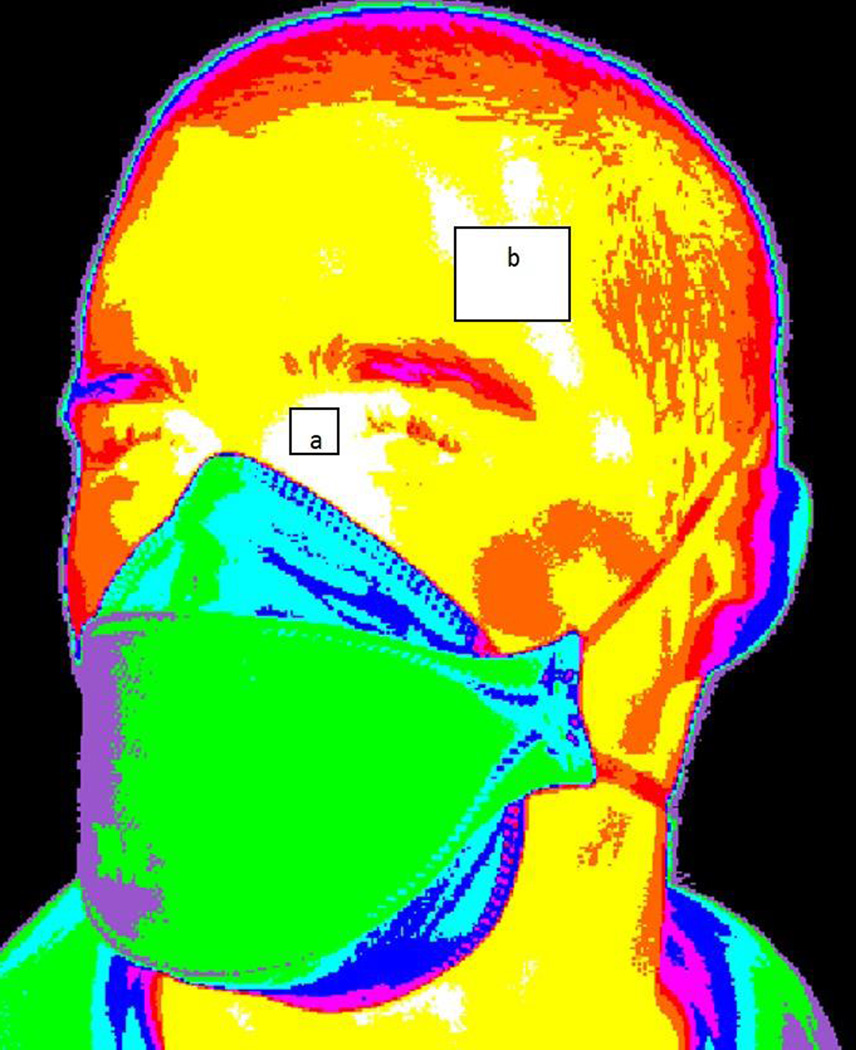
Description:Purpose ; To determine any effect of wearing a filtering facepiece respirator on brain temperature. ; Methods ; Subjects (n=18) wore a filtering facepiece respirator (FFR) for 1h at rest while undergoing infrared thermography measurements of the superomedial periobital region of the eye, a non-invasive indirect method of brain temperature measurements we termed the superomedial orbital infrared indirect brain temperature (SOIIBT) measurement. Temperature of the facial skin covered by the FFR, infrared temperature measurements of the tympanic membrane and superficial temporal artery region were concurrently measured, and subjective impressions of thermal comfort obtained simultaneously. ; Results ; The temperature of the skin under the FFR and subjective impressions of thermal discomfort both increased significantly. The mean tympanic membrane temperature did not increase, and the superficial temporal artery region temperature decreased significantly. The SOIIBT values did not change significantly, but subjects who switched from nasal to oronasal breathing during the study (n=5) experienced a slight increase in the SOIIBT measurements. ; Conclusions ; Wearing a FFR for 1h at rest does not have a significant effect on brain temperatures, as evaluated by the SOIIBT measurements, but a change in the route of breathing may impact these measurements. These findings suggest that subjective impressions of thermal discomfort from wearing a FFR under the study conditions are more likely the result of local dermal sensations rather than brain warming.
-
Subjects:
-
Source:J Clin Monit Comput. 31(1):67-73
-
Pubmed ID:26759336
-
Pubmed Central ID:PMC4942410
-
Document Type:
-
Funding:
-
Volume:31
-
Issue:1
-
Download URL:
-
File Type:
 [PDF - 1.03 MB]
 -
Collection(s):
-
Main Document Checksum:urn:sha256:05f6ad383f161acd83794932727ed853eee3957a09137df2278982fadbf93000
Supporting Files


File Language:
English
 Was this page helpful?
 Found an issue?






CDC STACKS serves as an archival repository of CDC-published products including
scientific findings, journal articles, guidelines, recommendations, or other public health information authored or
co-authored by CDC or funded partners.
As a repository, CDC STACKS retains documents in their original published format to ensure public access to scientific information.
As a repository, CDC STACKS retains documents in their original published format to ensure public access to scientific information.
You May Also Like
COLLECTION
CDC Public Access