


Magnitude and characteristics of acute paraquat- and diquat-related illnesses in the US: 1998–2013
Supporting Files

-
Jan 11 2016
-
File Language:
English
Details
-
Alternative Title:Environ Res
-
Personal Author:
-
Description:Background
Paraquat and diquat are among the most commonly used herbicides in the world.
Objectives
Determine the magnitude, characteristics, and root causes for acute paraquat- and diquat-related illnesses in the US
Methods
Illnesses associated with paraquat or diquat exposure occurring from 1998 through 2011 were identified from the Sentinel Event Notification System for Occupational Risks (SENSOR)-Pesticides Program, the California Department of Pesticide Regulation (CDPR) Pesticide Illness Surveillance Program (PISP), and the Incident Data System (IDS). Cases identified by the National Poison Data System (NPDS) were reviewed for the years 1998–2003 and 2006–2013.
Results
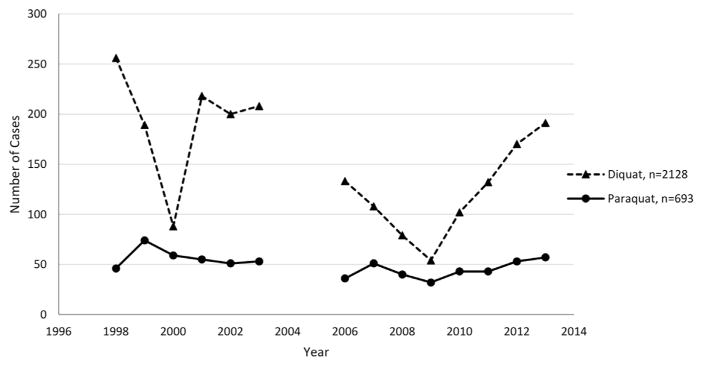
A total of 300 paraquat- and 144 diquat-related acute illnesses were identified by SENSOR, PISP, and IDS. NPDS identified 693 paraquat- and 2128 diquat-related acute illnesses. In SENSOR/PISP/IDS, illnesses were commonly low severity (paraquat=41%; diquat=81%); however, SENSOR/PISP/IDS identified 24 deaths caused by paraquat and 5 deaths associated with diquat. Nineteen paraquat-related deaths were due to ingestion, seven of which were unintentional, often due to improper storage in beverage bottles. In SENSOR/PISP/IDS, paraquat and diquat-related acute illnesses were work-related in 68% (n=203) and 29% (n=42) of cases, respectively. When herbicide application site was known, the vast majority of acute paraquat-related illnesses (81%) arose from agricultural applications. Common root causes of illness were failure to use adequate personal protective equipment (PPE), application equipment failure, and spill/splash of herbicide.
Conclusions
Although the magnitude of acute paraquat/diquat-related illnesses was relatively low, several fatalities were identified. Many illnesses could be prevented through stricter compliance with label requirements (e.g. ensuring proper herbicide storage and PPE use), and through enhanced training of certified applicators.
-
Subjects:
-
Source:Environ Res. 146:191-199.
-
Pubmed ID:26775000
-
Pubmed Central ID:PMC4920265
-
Document Type:
-
Funding:
-
Place as Subject:
-
Volume:146
-
Collection(s):
-
Main Document Checksum:urn:sha256:1b66446dd28fbbe32144c763953f34b90363229013f47a112766ac09932feddb
-
Download URL:
-
File Type:
 [PDF
- 195.78 KB
]
[PDF
- 195.78 KB
]
Supporting Files


File Language:
English
ON THIS PAGE


CDC STACKS serves as an archival repository of CDC-published products including
scientific findings,
journal articles, guidelines, recommendations, or other public health information authored or
co-authored by CDC or funded partners.
As a repository, CDC STACKS retains documents in their original published format to ensure public access to scientific information.
As a repository, CDC STACKS retains documents in their original published format to ensure public access to scientific information.
You May Also Like
COLLECTION
CDC Public Access