


Objective Sepsis Surveillance Using Electronic Clinical Data
Supporting Files

-
Nov 03 2015
-
Details
-
Alternative Title:Infect Control Hosp Epidemiol
-
Personal Author:
-
Description:OBJECTIVE
To compare the accuracy of surveillance of severe sepsis using electronic health record clinical data vs claims and to compare incidence and mortality trends using both methods.
DESIGN
We created an electronic health record–based surveillance definition for severe sepsis using clinical indicators of infection (blood culture and antibiotic orders) and concurrent organ dysfunction (vasopressors, mechanical ventilation, and/or abnormal laboratory values). We reviewed 1,000 randomly selected medical charts to characterize the definition’s accuracy and stability over time compared with a claims-based definition requiring infection and organ dysfunction codes. We compared incidence and mortality trends from 2003–2012 using both methods.
SETTING
Two US academic hospitals.
PATIENTS
Adult inpatients.
RESULTS
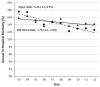
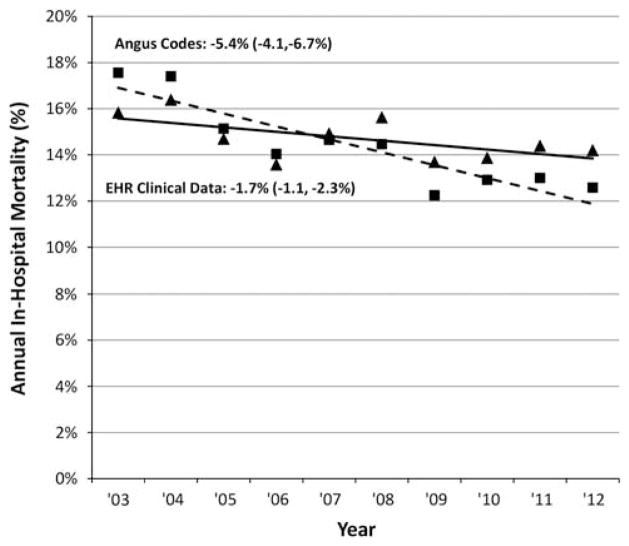
The electronic health record–based clinical surveillance definition had stable and high sensitivity over time (77% in 2003–2009 vs 80% in 2012, P=.58) whereas the sensitivity of claims increased (52% in 2003–2009 vs 67% in 2012, P=.02). Positive predictive values for claims and clinical surveillance definitions were comparable (55% vs 53%, P=.65) and stable over time. From 2003 to 2012, severe sepsis incidence imputed from claims rose by 72% (95% CI, 57%–88%) and absolute mortality declined by 5.4% (95% CI, 4.6%–6.7%). In contrast, incidence using the clinical surveillance definition increased by 7.7% (95% CI, −1.1% to 17%) and mortality declined by 1.7% (95% CI, 1.1%–2.3%).
CONCLUSIONS
Sepsis surveillance using clinical data is more sensitive and more stable over time compared with claims and can be done electronically. This may enable more reliable estimates of sepsis burden and trends.
-
Subjects:
-
Source:Infect Control Hosp Epidemiol. 37(2):163-171.
-
Pubmed ID:26526737
-
Pubmed Central ID:PMC4743875
-
Document Type:
-
Funding:
-
Volume:37
-
Issue:2
-
Collection(s):
-
Main Document Checksum:urn:sha256:6e473ea81178f343b42fddd1ed546a55465099eba4fbb363cb117a74c76ce7dd
-
Download URL:
-
File Type:
 [PDF
- 437.13 KB
]
[PDF
- 437.13 KB
]
Supporting Files


ON THIS PAGE


CDC STACKS serves as an archival repository of CDC-published products including
scientific findings,
journal articles, guidelines, recommendations, or other public health information authored or
co-authored by CDC or funded partners.
As a repository, CDC STACKS retains documents in their original published format to ensure public access to scientific information.
As a repository, CDC STACKS retains documents in their original published format to ensure public access to scientific information.
You May Also Like
COLLECTION
CDC Public Access