


Seasonality of Tuberculosis in the United States, 1993–2008
Supporting Files

-
Apr 03 2012
-
File Language:
English
Details
-
Alternative Title:Clin Infect Dis
-
Personal Author:
-
Description:Background
Although seasonal variation in tuberculosis incidence has been described in several recent studies, the mechanism underlying this seasonality remains unknown. Seasonality of tuberculosis disease may indicate the presence of season-specific risk factors that could potentially be controlled if they were better understood. We conducted this study to determine whether tuberculosis is seasonal in the United States and to describe patterns of seasonality in specific populations.
Methods
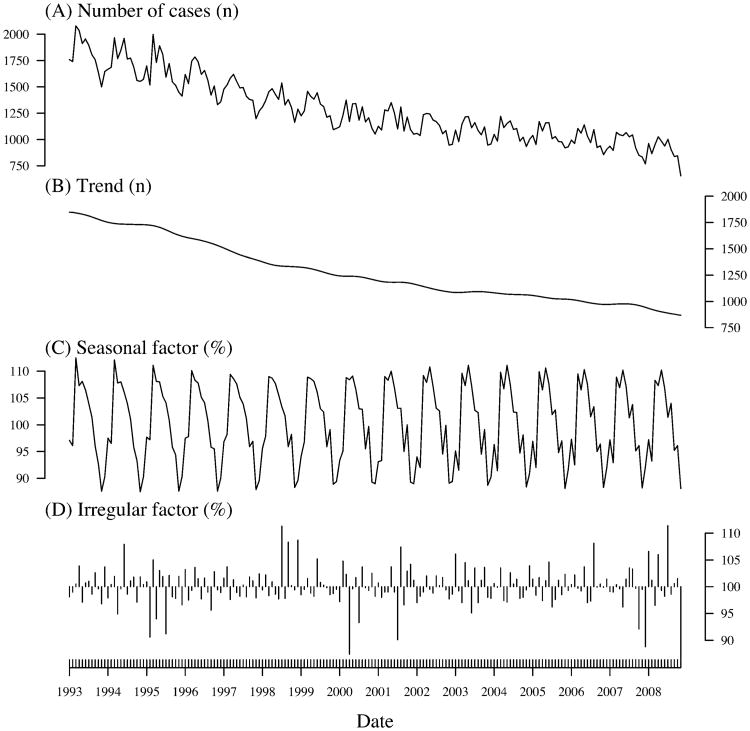
We performed a time series decomposition analysis of tuberculosis cases reported to the Centers for Disease Control and Prevention from 1993 through 2008. Seasonal amplitude of tuberculosis disease (the difference between the months with the highest and lowest mean case counts), was calculated for the population as a whole and for populations with select demographic, clinical, and epidemiologic characteristics.
Results
A total of 243 432 laboratory-confirmed tuberculosis cases were reported over a period of 16 years. A mean of 21.4% more cases were diagnosed in March, the peak month, compared with November, the trough month. The magnitude of seasonality did not vary with latitude. The greatest seasonal amplitude was found among children aged <5 years and in cases associated with disease clusters.
Conclusions
Tuberculosis is a seasonal disease in the United States, with a peak in spring and trough in late fall. The latitude independence of seasonality suggests that reduced winter sunlight exposure may not be a strong contributor to tuberculosis risk. Increased seasonality among young children and clustered cases suggests that disease that is the result of recent transmission is more influenced by season than disease resulting from activation of latent infection.
-
Subjects:
-
Source:Clin Infect Dis. 54(11):1553-1560.
-
Pubmed ID:22474225
-
Pubmed Central ID:PMC4867465
-
Document Type:
-
Funding:
-
Place as Subject:
-
Volume:54
-
Issue:11
-
Collection(s):
-
Main Document Checksum:urn:sha256:741de7b9991aad86d50446ea794fd1073febb315a8fdeb2769d45e3ca4ef9c99
-
Download URL:
-
File Type:
 [PDF
- 343.63 KB
]
[PDF
- 343.63 KB
]
Supporting Files


File Language:
English
ON THIS PAGE


CDC STACKS serves as an archival repository of CDC-published products including
scientific findings,
journal articles, guidelines, recommendations, or other public health information authored or
co-authored by CDC or funded partners.
As a repository, CDC STACKS retains documents in their original published format to ensure public access to scientific information.
As a repository, CDC STACKS retains documents in their original published format to ensure public access to scientific information.
You May Also Like
COLLECTION
CDC Public Access