



Tailoring Care to Vulnerable Populations by Incorporating Social Determinants of Health: the Veterans Health Administration’s “Homeless Patient Aligned Care Team” Program
Supporting Files
Public Domain

-
Mar 31 2016
File Language:
English
Details
-
Journal Article:Preventing Chronic Disease (PCD)
-
Personal Author:
-
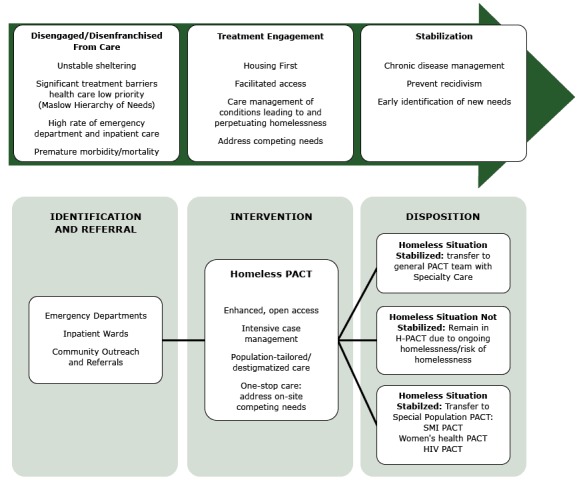
Description:Introduction ; Although the clinical consequences of homelessness are well described, less is known about the role for health care systems in improving clinical and social outcomes for the homeless. We described the national implementation of a “homeless medical home” initiative in the Veterans Health Administration (VHA) and correlated patient health outcomes with characteristics of high-performing sites. ; Methods ; We conducted an observational study of 33 VHA facilities with homeless medical homes and patient- aligned care teams that served more than 14,000 patients. We correlated site-specific health care performance data for the 3,543 homeless veterans enrolled in the program from October 2013 through March 2014, including those receiving ambulatory or acute health care services during the 6 months prior to enrollment in our study and 6 months post-enrollment with corresponding survey data on the Homeless Patient Aligned Care Team (H-PACT) program implementation. We defined high performance as high rates of ambulatory care and reduced use of acute care services. ; Results ; More than 96% of VHA patients enrolled in these programs were concurrently receiving VHA homeless services. Of the 33 sites studied, 82% provided hygiene care (on-site showers, hygiene kits, and laundry), 76% provided transportation, and 55% had an on-site clothes pantry; 42% had a food pantry and provided on-site meals or other food assistance. Six-month patterns of acute-care use pre-enrollment and post-enrollment for 3,543 consecutively enrolled patients showed a 19.0% reduction in emergency department use and a 34.7% reduction in hospitalizations. Three features were significantly associated with high performance: 1) higher staffing ratios than other sites, 1) integration of social supports and social services into clinical care, and 3) outreach to and integration with community agencies. ; Conclusion ; Integrating social determinants of health into clinical care can be effective for high-risk homeless veterans.
-
Subjects:
-
Source:Prev Chronic Dis. 13.
-
DOI:
-
ISSN:1545-1151
-
Pubmed ID:27032987
-
Pubmed Central ID:PMC4825747
-
Document Type:
-
Corporate as Subject:
-
Place as Subject:
-
Location:
-
Volume:13
-
Download URL:
-
File Type:
 [PDF - 381.41 KB]
 -
Collection(s):
-
Main Document Checksum:urn:sha-512:0a33f443f562230f37f07b471148eaf75976e501f1446ed4109d22f2bca65785ba94bf9acbf86e9f5608504aabb53cbec7f272eee6caed7a81edc7dcb4aadc1a
Supporting Files


File Language:
English
 Was this page helpful?
 Found an issue?

CDC STACKS serves as an archival repository of CDC-published products including
scientific findings, journal articles, guidelines, recommendations, or other public health information authored or
co-authored by CDC or funded partners.
As a repository, CDC STACKS retains documents in their original published format to ensure public access to scientific information.
As a repository, CDC STACKS retains documents in their original published format to ensure public access to scientific information.
You May Also Like
COLLECTION
Preventing Chronic Disease