


Changes in the Expression of Calcitonin Gene-Related Peptide After Exposure to Injurious Stretch-Shortening Contractions
Supporting Files

-
Mar 10 2016
-
File Language:
English
Details
-
Alternative Title:Exp Gerontol
-
Personal Author:
-
Description:Methods
Young (3 mo) and old (30 mo) male Fisher 344 × BN F1 rats were anesthetized with isoflurane and the left hind limbs were exposed to 15 sets of 10 SSCs. Control animals were exposed to a single bout of SSCs of equal intensity. Sensitivity to mechanical stimulation was assessed using von Frey filaments prior to beginning the experiment, and on days 2 and 9 following exposure to iSSCs. Rats were euthanized one, 3 or 10 days after the exposure. The ipsilateral DRG were dissected from the L4-5 region of the spine, along with the left tibialis anterior (LTA) muscle.
Results
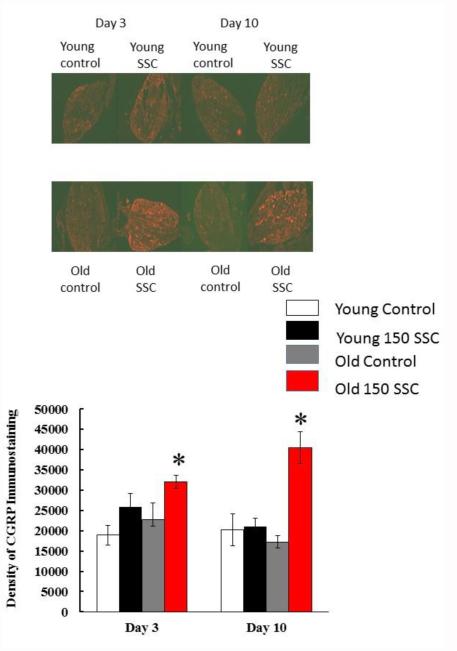
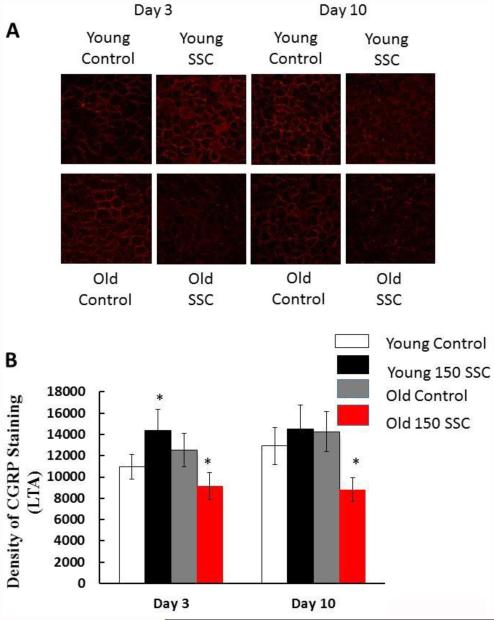
Rats exposed to iSSCs were more sensitive to mechanical stimulation than control rats 2 days after the exposure, and showed a reduction in peak force 3 days after exposure. Changes in sensitivity to pressure were not associated with increases in CGRP labeling in the DRG at 3 days. However, 9 days after exposure to iSSCs, old rats still displayed an increased sensitivity to mechanical stimulation, and this hyperalgesia was associated with an increase in CGRP immunolabeling in the DRG. Young rats exposed to iSSC did not display a change in CGRP immunolabeling and sensitivity to mechanical stimulation returned to control levels at 10 days.
Conclusions
These findings suggest that hyperalgesia seen shortly after exposure to iSSC is not influenced by CGRP levels. However, in cases where recovery from injury may be slower, as it is in older rats, CGRP may contribute to the maintenance of hyperalgesia.
-
Subjects:
-
Source:Exp Gerontol. 79:1-7.
-
Pubmed ID:26972633
-
Pubmed Central ID:PMC4864058
-
Document Type:
-
Funding:
-
Volume:79
-
Collection(s):
-
Main Document Checksum:urn:sha256:53f6efbe7845f75f2921b994dc26476fdd30027a15e25bf6cdfa266a64de0f9c
-
Download URL:
-
File Type:
 [PDF
- 819.04 KB
]
[PDF
- 819.04 KB
]
Supporting Files


File Language:
English
ON THIS PAGE




CDC STACKS serves as an archival repository of CDC-published products including
scientific findings,
journal articles, guidelines, recommendations, or other public health information authored or
co-authored by CDC or funded partners.
As a repository, CDC STACKS retains documents in their original published format to ensure public access to scientific information.
As a repository, CDC STACKS retains documents in their original published format to ensure public access to scientific information.
You May Also Like
COLLECTION
CDC Public Access