



Half-life of polybrominated biphenyl in human sera.
Supporting Files
Public Domain

-
Mar 1995
File Language:
English
Details
-
Alternative Title:Environ Health Perspect
-
Personal Author:
-
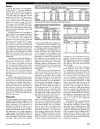
Description:Polybrominated biphenyl (PBB), a flame-retardant material, was introduced into the food chain in Michigan in 1973 due to a manufacturing and distribution mistake. Following public concern about the long-term health effects of PBB in humans, a cohort of PBB-exposed Michigan residents was assembled in 1975. We initiated this study to determine the half-life of PBB in human sera and to understand how continued body burden relates to the possible adverse health consequences of PBB exposure. To determine the half-life, eligible persons were selected from the cohort if they had at least two PBB measurements 1 year apart and had an initial level > or = 20 pbb. There were 163 persons who met the criteria with a median PBB level of 45.5 ppb. The estimated half-life is 10.8 years (95% CI, 9.2-14.7 years). The body burden of PBB in exposed persons will decrease only gradually over time. For persons with an initial level of 45.5 ppb of PBB, it will take more than 60 years for their PBB levels to fall below the current level of detection of 1 ppb.
-
Subjects:
-
Source:Environ Health Perspect. 103(3):272-274.
-
Document Type:
-
Place as Subject:
-
Volume:103
-
Issue:3
-
Download URL:
-
File Type:
 [PDF - 889.29 KB]
 -
Collection(s):
-
Main Document Checksum:urn:sha-512:8c8304550d4e2d666c89f2033900efccb462d2c10fb6400c6e59083a4533f5d0290d433ee565aa463d8354bc1595f9d763fb22c0fe6c0b29a46b0544e81f1e2a
Supporting Files


File Language:
English
 Was this page helpful?
 Found an issue?


CDC STACKS serves as an archival repository of CDC-published products including
scientific findings, journal articles, guidelines, recommendations, or other public health information authored or
co-authored by CDC or funded partners.
As a repository, CDC STACKS retains documents in their original published format to ensure public access to scientific information.
As a repository, CDC STACKS retains documents in their original published format to ensure public access to scientific information.
You May Also Like
COLLECTION
CDC Public Access