



Effects of community-based sales of micronutrient powders on morbidity episodes in preschool children in Western Kenya1,2
Supporting Files

-
3 2016 ; 3-2016
-
Available in CDC Stacks on April 26, 2016, 12:00 AM
File Language:
English
Details
-
Alternative Title:Am J Clin Nutr
-
Personal Author:
-
Description:Background
Although the use of micronutrient powders (MNPs) is considered the preferred approach for childhood anemia control, concerns about iron-related morbidity from clinical trials have challenged programmatic scale-up.
Objective
We aimed to measure the effects of community-based sales of MNPs on diarrhea-, fever-, cough-, and malaria-morbidity episodes in children 6–35 mo of age.
Design
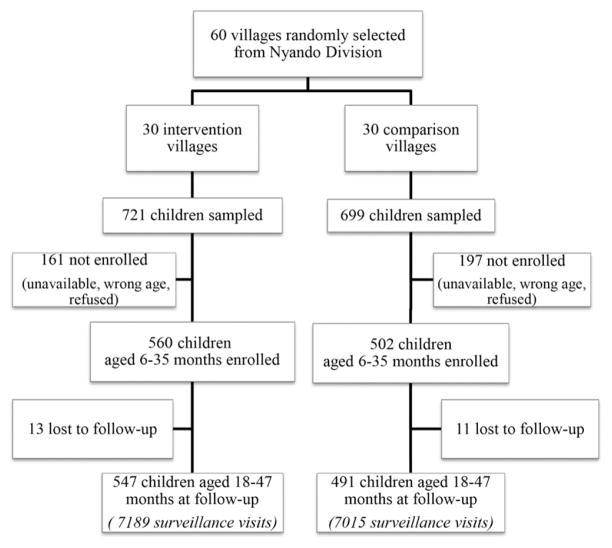
We conducted a cluster-randomized trial in rural Western Kenya where 60 villages were randomly assigned to either intervention or control groups. MNPs (containing iron, vitamin A, zinc, and 11 other micronutrients) and other health products (e.g., insecticide-treated bednets, soap, and water disinfectant) were marketed in 30 intervention villages from June 2007 to March 2008. Household visits every 2 wk were used to monitor self-reported MNP use and morbidity (illness episodes in the previous 24 h and hospitalizations in the previous 2 wk) in both groups. Iron, vitamin A, anemia, malaria, and anthropometric measures were assessed at baseline and at 12 mo of follow-up. Data were analyzed by intent-to-treat analyses.
Results
Of 1062 children enrolled in the study, 1038 children (97.7%) were followed (a total of 14,204 surveillance visits). Mean MNP intake in intervention villages was 0.9 sachets/wk. Children in intervention villages, compared with children in control villages, had ~60% fewer hospitalizations for diarrhea (0.9% compared with 2.4%, respectively; P = 0.03) and 70% fewer hospitalizations for fever (1.8% compared with 5.3%, respectively; P = 0.003) but no significant differences in hospitalizations for respiratory illness (1.1% compared with 2.2%, respectively; P = 0.11) or malaria (3.1% compared with 2.9%, respectively; P = 0.82). There were no differences between groups in the numbers of episodes of diarrhea, cough, or fever.
Conclusions
MNP use in Western Kenya through market-based community sales was not associated with increased infectious morbidity in young children and was associated with decreased hospitalizations for diarrhea and fever. An integrated distribution of MNPs with other health interventions should be explored further in settings with a high child malnutrition and infection burden. This trial was registered at clinicaltrials.gov as NCT01088958. -
Subjects:
-
Keywords:
-
Source:Am J Clin Nutr. 103(3):934-941
-
Pubmed ID:26864367
-
Pubmed Central ID:PMC4845747
-
Document Type:
-
Funding:
-
Volume:103
-
Issue:3
-
Download URL:
-
File Type:
 [PDF - 259.86 KB]
 -
Collection(s):
-
Main Document Checksum:urn:sha256:f8a5e0fc86df1b86387db9c0656738601f230faa418d1f93d933872d43bab7e1
Supporting Files


File Language:
English
 Was this page helpful?
 Found an issue?


CDC STACKS serves as an archival repository of CDC-published products including
scientific findings, journal articles, guidelines, recommendations, or other public health information authored or
co-authored by CDC or funded partners.
As a repository, CDC STACKS retains documents in their original published format to ensure public access to scientific information.
As a repository, CDC STACKS retains documents in their original published format to ensure public access to scientific information.
You May Also Like
COLLECTION
CDC Public Access