



Spatial Temporal Dynamics and Molecular Evolution of Re-Emerging Rabies Virus in Taiwan
Supporting Files
Public Domain

-
Mar 17 2016
File Language:
English
Details
-
Alternative Title:Int J Mol Sci
-
Personal Author:
-
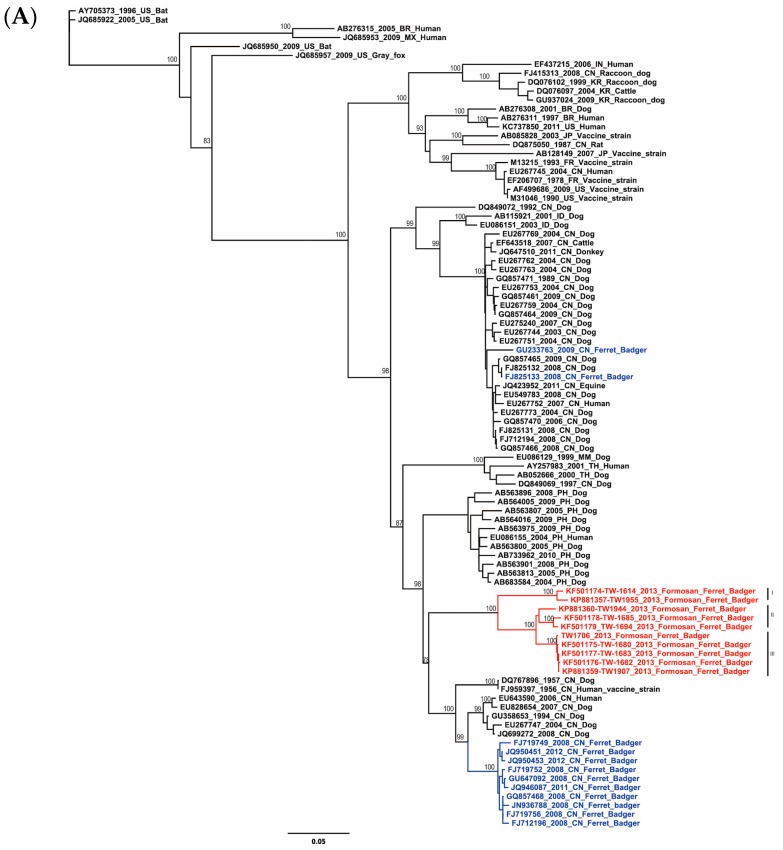
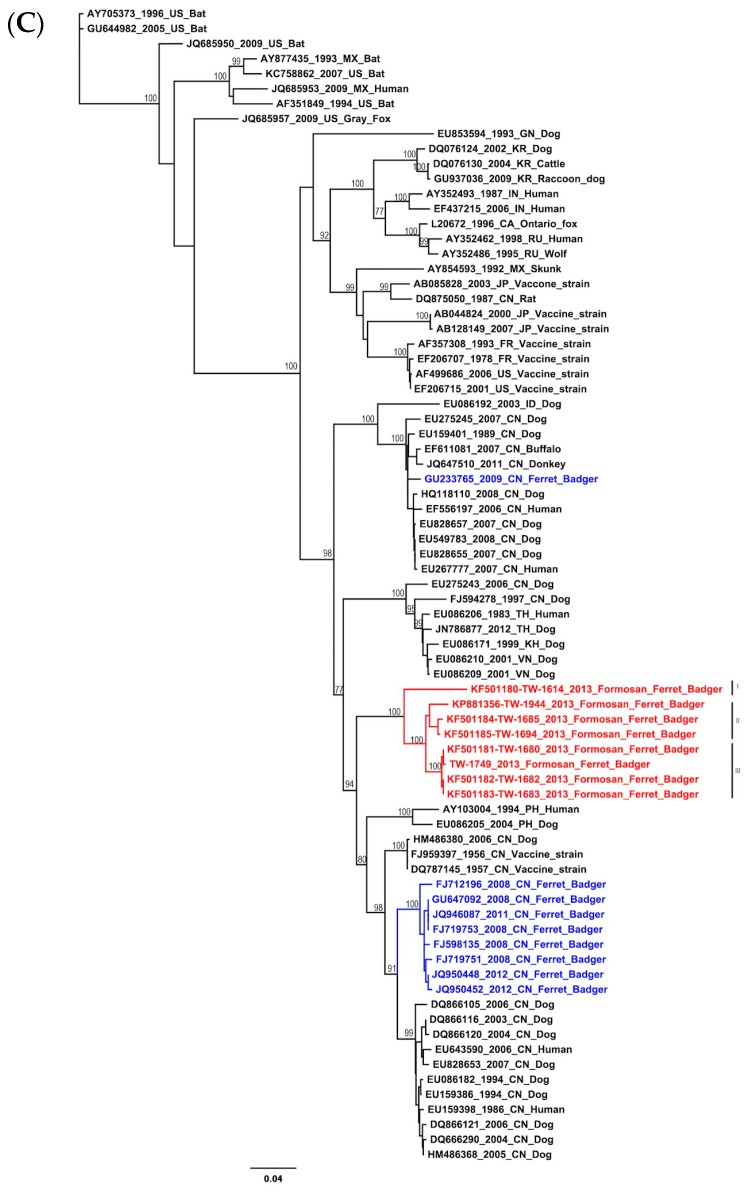
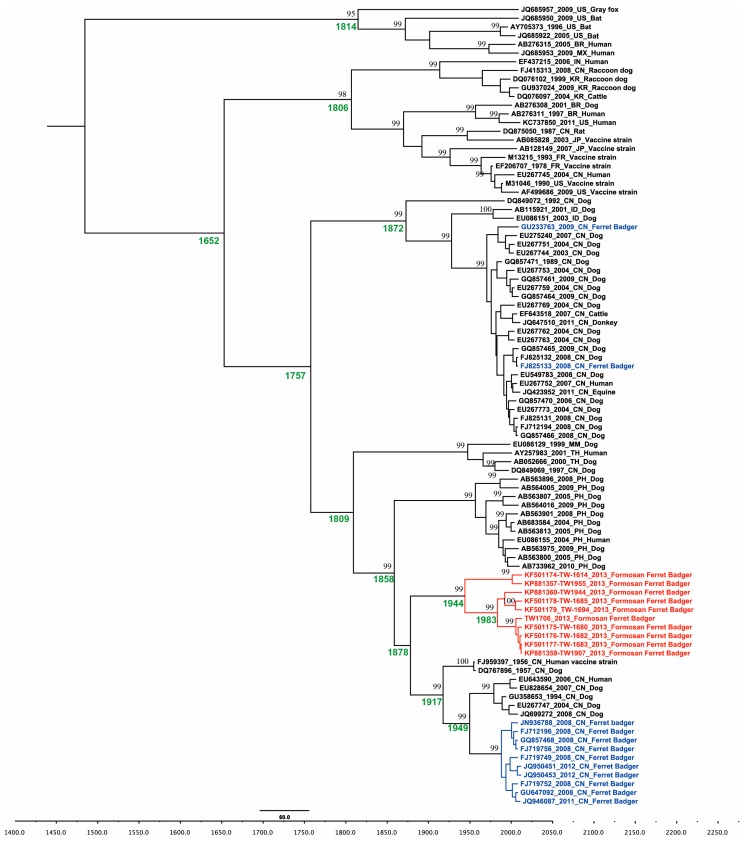
Description:Taiwan has been recognized by the World Organization for Animal Health as rabies-free since 1961. Surprisingly, rabies virus (RABV) was identified in a dead Formosan ferret badger in July 2013. Later, more infected ferret badgers were reported from different geographic regions of Taiwan. In order to know its evolutionary history and spatial temporal dynamics of this virus, phylogeny was reconstructed by maximum likelihood and Bayesian methods based on the full-length of glycoprotein (G), matrix protein (M), and nucleoprotein (N) genes. The evolutionary rates and phylogeographic were determined using Beast and SPREAD software. Phylogenetic trees showed a monophyletic group containing all of RABV isolates from Taiwan and it further separated into three sub-groups. The estimated nucleotide substitution rates of G, M, and N genes were between 2.49 × 10(-4)-4.75 × 10(-4) substitutions/site/year, and the mean ratio of dN/dS was significantly low. The time of the most recent common ancestor was estimated around 75, 89, and 170 years, respectively. Phylogeographic analysis suggested the origin of the epidemic could be in Eastern Taiwan, then the Formosan ferret badger moved across the Central Range of Taiwan to western regions and separated into two branches. In this study, we illustrated the evolution history and phylogeographic of RABV in Formosan ferret badgers.
-
Subjects:
-
Source:Int J Mol Sci. 2016; 17(3).
-
Pubmed ID:26999115
-
Pubmed Central ID:PMC4813248
-
Document Type:
-
Place as Subject:
-
Volume:17
-
Issue:3
-
Download URL:
-
File Type:
 [PDF - 8.31 MB]
 -
Collection(s):
-
Main Document Checksum:urn:sha256:e38de4456c52ec166aab829dc80492c02ca7ccb16842a1005b8d89c2540fd5b3
Supporting Files


File Language:
English
 Was this page helpful?
 Found an issue?






CDC STACKS serves as an archival repository of CDC-published products including
scientific findings, journal articles, guidelines, recommendations, or other public health information authored or
co-authored by CDC or funded partners.
As a repository, CDC STACKS retains documents in their original published format to ensure public access to scientific information.
As a repository, CDC STACKS retains documents in their original published format to ensure public access to scientific information.
You May Also Like
COLLECTION
CDC Public Access