


Combined biomarkers discriminate a low likelihood of bacterial infection among surgical intensive care unit patients with suspected sepsis
Supporting Files

-
January 08 2016
-
File Language:
English
Details
-
Alternative Title:Diagn Microbiol Infect Dis
-
Personal Author:
-
Corporate Authors:
-
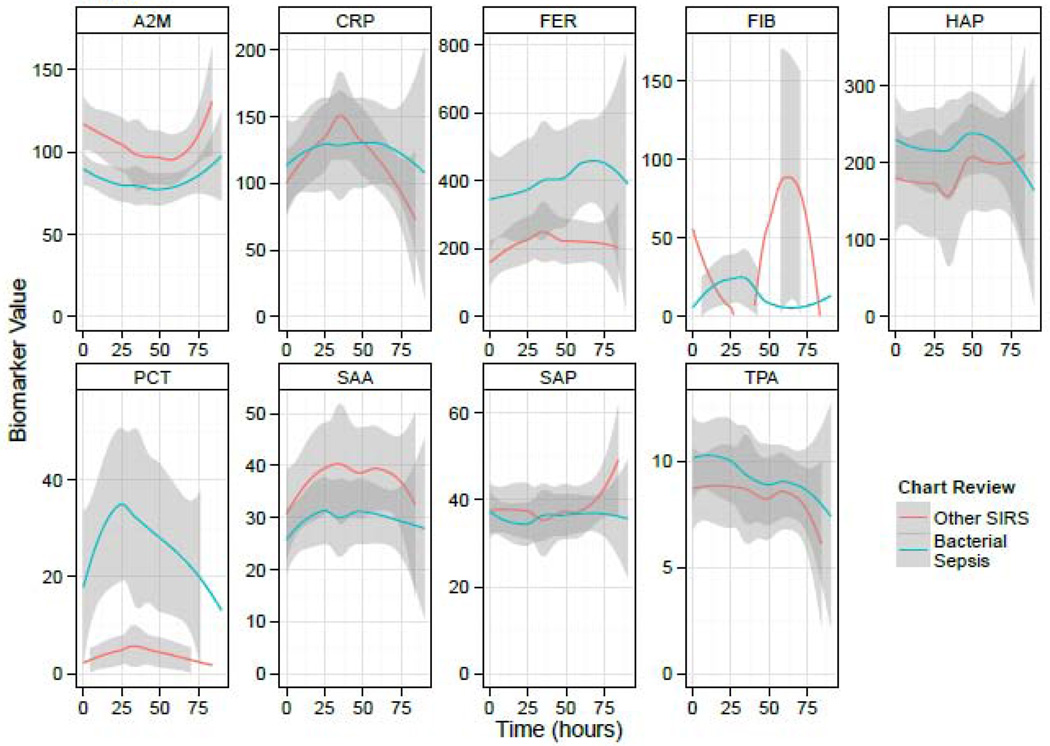
Description:Among surgical intensive care unit (SICU) patients, it is difficult to distinguish bacterial sepsis from other causes of systemic inflammatory response syndrome (SIRS). Biomarkers have proven useful to identify the presence of bacterial infection. We enrolled a prospective cohort of 69 SICU patients with suspected sepsis and assayed the concentrations of 9 biomarkers (α-2 macroglobulin [A2M], C-reactive protein, ferritin, fibrinogen, haptoglobin, procalcitonin [PCT], serum amyloid A, serum amyloid P, and tissue plasminogen activator) at baseline, 24, 48, and 72hours. Forty-two patients (61%) had bacterial sepsis by chart review. A2M concentrations were significantly lower, and PCT concentrations were significantly higher in subjects with bacterial sepsis at 3 of 4 time points. Using optimal cutoff values, the combination of baseline A2M and 72-hour PCT achieved a negative predictive value of 75% (95% confidence interval, 54-96%). The combination of A2M and PCT discriminated bacterial sepsis from other SIRS among SICU patients with suspected sepsis.
-
Subjects:
-
Source:Diagn Microbiol Infect Dis. 85(1):109-115
-
Pubmed ID:26971636
-
Pubmed Central ID:PMC4841711
-
Document Type:
-
Funding:
-
Volume:85
-
Issue:1
-
Collection(s):
-
Main Document Checksum:urn:sha256:f2043c032086e8e3527017d827d97c045c770684a43813367b6d977a33bf60f1
-
Download URL:
-
File Type:
 [PDF
- 1.43 MB
]
[PDF
- 1.43 MB
]
Supporting Files


File Language:
English
ON THIS PAGE



CDC STACKS serves as an archival repository of CDC-published products including
scientific findings,
journal articles, guidelines, recommendations, or other public health information authored or
co-authored by CDC or funded partners.
As a repository, CDC STACKS retains documents in their original published format to ensure public access to scientific information.
As a repository, CDC STACKS retains documents in their original published format to ensure public access to scientific information.
You May Also Like
COLLECTION
CDC Public Access