



Exposure of the U.S. Population to Bisphenol A and 4-tertiary-Octylphenol: 2003–2004
Supporting Files
Public Domain

-
Jan 2008
File Language:
English
Details
-
Alternative Title:Environ Health Perspect
-
Personal Author:
-
Description:Background
Bisphenol A (BPA) and 4-tertiary-octylphenol (tOP) are industrial chemicals used in the manufacture of polycarbonate plastics and epoxy resins (BPA) and nonionic surfactants (tOP). These products are in widespread use in the United States.
Objectives
We aimed to assess exposure to BPA and tOP in the U.S. general population.
Methods
We measured the total (free plus conjugated) urinary concentrations of BPA and tOP in 2,517 participants ≥ 6 years of age in the 2003–2004 National Health and Nutrition Examination Survey using automated solid-phase extraction coupled to isotope dilution–high-performance liquid chromatography–tandem mass spectrometry.
Results
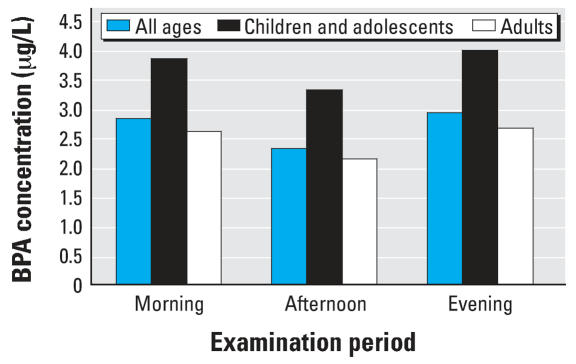
BPA and tOP were detected in 92.6% and 57.4% of the persons, respectively. Least square geometric mean (LSGM) concentrations of BPA were significantly lower in Mexican Americans than in non-Hispanic blacks (p = 0.006) and non-Hispanic whites (p = 0.007); LSGM concentrations for non-Hispanic blacks and non-Hispanic whites were not statistically different (p = 0.21). Females had statistically higher BPA LSGM concentrations than males (p = 0.043). Children had higher concentrations than adolescents (p < 0.001), who in turn had higher concentrations than adults (p = 0.003). LSGM concentrations were lowest for participants in the high household income category (> $45,000/year).
Conclusions
Urine concentrations of total BPA differed by race/ethnicity, age, sex, and household income. These first U.S. population representative concentration data for urinary BPA and tOP should help guide public health research priorities, including studies of exposure pathways, potential health effects, and risk assessment. -
Subjects:
-
Source:Environ Health Perspect. 2008; 116(1):39-44.
-
Document Type:
-
Corporate as Subject:
-
Place as Subject:
-
Volume:116
-
Issue:1
-
Download URL:
-
File Type:
 [PDF - 114.58 KB]
 -
Collection(s):
-
Main Document Checksum:urn:sha-512:c2ccc980fb2f785794b974edca801baf25eafcdd0e9a998f3b5235d0723eafa55532bb4c984767f84ff0284a3b4f6878d688b4a60e95673cfe2b73414741e1b1
Supporting Files


File Language:
English
 Was this page helpful?
 Found an issue?


CDC STACKS serves as an archival repository of CDC-published products including
scientific findings, journal articles, guidelines, recommendations, or other public health information authored or
co-authored by CDC or funded partners.
As a repository, CDC STACKS retains documents in their original published format to ensure public access to scientific information.
As a repository, CDC STACKS retains documents in their original published format to ensure public access to scientific information.
You May Also Like
COLLECTION
CDC Public Access