


On the front line of HIV virological monitoring: barriers and facilitators from a provider perspective in resource-limited settings
Supporting Files

-
1 2016
-
File Language:
English
Details
-
Alternative Title:AIDS Care
-
Personal Author:
-
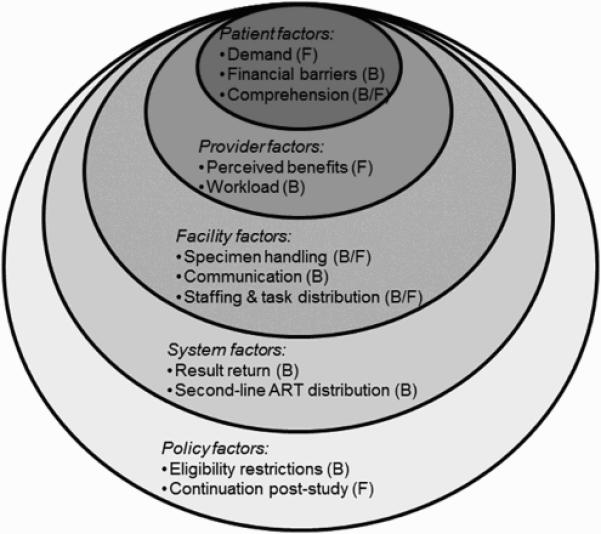
Description:Scale-up of viral load (VL) monitoring for HIV-infected patients on antiretroviral therapy (ART) is a priority in many resource-limited settings, and ART providers are critical to effective program implementation. We explored provider-perceived barriers and facilitators of VL monitoring. We interviewed all providers (n = 17) engaged in a public health evaluation of dried blood spots for VL monitoring at five ART clinics in Malawi. All ART clinics were housed within district hospitals. We grouped themes at patient, provider, facility, system, and policy levels. Providers emphasized their desire for improved ART monitoring strategies, and frustration in response to restrictive policies for determining which patients were eligible to receive VL monitoring. Although many providers pled for expansion of monitoring to include all persons on ART, regardless of time on ART, the most salient provider-perceived barrier to VL monitoring implementation was the pressure of work associated with monitoring activities. The work burden was exacerbated by inefficient data management systems, highlighting a critical interaction between provider-, facility-, and system-level factors. Lack of integration between laboratory and clinical systems complicated the process for alerting providers when results were available, and these communication gaps were intensified by poor facility connectivity. Centralized second-line ART distribution was also noted as a barrier: providers reported that the time and expenses required for patients to collect second-line ART frequently obstructed referral. However, provider empowerment emerged as an unexpected facilitator of VL monitoring. For many providers, this was the first time they used an objective marker of ART response to guide clinical management. Providers' knowledge of a patient's virological status increased confidence in adherence counseling and clinical decision-making. Results from our study provide unique insight into provider perceptions of VL monitoring and indicate the importance of policies responsive to individual and environmental challenges of VL monitoring program implementation. Findings may inform scale-up by helping policy-makers identify strategies to improve feasibility and sustainability of VL monitoring.
-
Subjects:
-
Keywords:
-
Source:AIDS Care. 28(1):1-10
-
Pubmed ID:26278724
-
Pubmed Central ID:PMC4834050
-
Document Type:
-
Funding:MW.10.1433/PHS HHSUnited States/ ; F30 MH098731-01/MH/NIMH NIH HHSUnited States/ ; U2G PS001965/PS/NCHHSTP CDC HHSUnited States/ ; P30AI50410/AI/NIAID NIH HHSUnited States/ ; T32 GM008719/GM/NIGMS NIH HHSUnited States/ ; F30 MH098731/MH/NIMH NIH HHSUnited States/ ; P30 AI050410/AI/NIAID NIH HHSUnited States/
-
Volume:28
-
Issue:1
-
Collection(s):
-
Main Document Checksum:urn:sha256:98975dc8be24f67a24348333c854f58da499097478e160b5d805e966c461269f
-
Download URL:
-
File Type:
 [PDF
- 216.20 KB
]
[PDF
- 216.20 KB
]
Supporting Files


File Language:
English
ON THIS PAGE


CDC STACKS serves as an archival repository of CDC-published products including
scientific findings,
journal articles, guidelines, recommendations, or other public health information authored or
co-authored by CDC or funded partners.
As a repository, CDC STACKS retains documents in their original published format to ensure public access to scientific information.
As a repository, CDC STACKS retains documents in their original published format to ensure public access to scientific information.
You May Also Like
COLLECTION
CDC Public Access