



Prevalence of qacA/B Genes and Mupirocin Resistance Among Methicillin-Resistant Staphylococcus aureus (MRSA) Isolates in the Setting of Chlorhexidine Bathing Without Mupirocin
Supporting Files

-
Feb 02 2016
-
Available in CDC Stacks on 2017-05-01T00:00:00Z
File Language:
English
Details
-
Alternative Title:Infect Control Hosp Epidemiol
-
Personal Author:
-
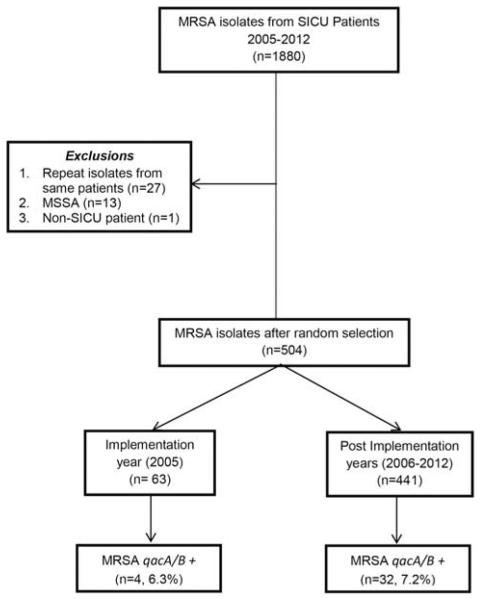
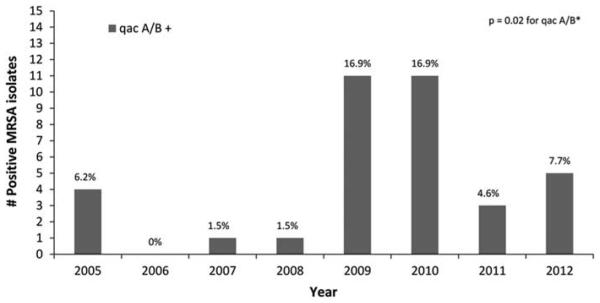
Description:OBJECTIVE ; We aimed to determine the frequency of qacA/B chlorhexidine tolerance genes and high-level mupirocin resistance among MRSA isolates before and after the introduction of a chlorhexidine (CHG) daily bathing intervention in a surgical intensive care unit (SICU). ; DESIGN ; Retrospective cohort study (2005–2012) ; SETTING ; A large tertiary-care center ; PATIENTS ; Patients admitted to SICU who had MRSA surveillance cultures of the anterior nares ; METHODS ; A random sample of banked MRSA anterior nares isolates recovered during (2005) and after (2006–2012) implementation of a daily CHG bathing protocol was examined for qacA/B genes and high-level mupirocin resistance. Staphylococcal cassette chromosome mec (SCCmec) typing was also performed. ; RESULTS ; Of the 504 randomly selected isolates (63 per year), 36 (7.1%) were qacA/B positive ( + ) and 35 (6.9%) were mupirocin resistant. Of these, 184 (36.5%) isolates were SCCmec type IV. There was a significant trend for increasing qacA/B (P= .02; highest prevalence, 16.9% in 2009 and 2010) and SCCmec type IV (P< .001; highest prevalence, 52.4% in 2012) during the study period. qacA/B( + ) MRSA isolates were more likely to be mupirocin resistant (9 of 36 25% qacA/B( + ) vs 26 of 468 5.6% qacA/B(−); P= .003). ; CONCLUSIONS ; A long-term, daily CHG bathing protocol was associated with a change in the frequency of qacA/B genes in MRSA isolates recovered from the anterior nares over an 8-year period. This change in the frequency of qacA/B genes is most likely due to patients in those years being exposed in prior admissions. Future studies need to further evaluate the implications of universal CHG daily bathing on MRSA qacA/B genes among hospitalized patients.
-
Subjects:
- Adult
- Aged
- Anti-Infective Agents, Local
- Bacterial Proteins
- Baths
- Chlorhexidine
- Female
- Humans
- Logistic Models
- Male
- Membrane Transport Proteins
- Methicillin-Resistant Staphylococcus aureus
- Microbial Sensitivity Tests
- Middle Aged
- Nasal Cavity
- Retrospective Studies
- Staphylococcal Infections
- Tertiary Care Centers
-
Source:Infect Control Hosp Epidemiol. 37(5):590-597.
-
Pubmed ID:26828094
-
Pubmed Central ID:PMC4833605
-
Document Type:
-
Funding:
-
Place as Subject:
-
Volume:37
-
Issue:5
-
Download URL:
-
File Type:
 [PDF - 348.19 KB]
 -
Collection(s):
-
Main Document Checksum:urn:sha256:446ea545ab863e804028f9aeab59ce07646bb2f3a977f2ed92983a9a23f035af
Supporting Files


File Language:
English
 Was this page helpful?
 Found an issue?



CDC STACKS serves as an archival repository of CDC-published products including
scientific findings, journal articles, guidelines, recommendations, or other public health information authored or
co-authored by CDC or funded partners.
As a repository, CDC STACKS retains documents in their original published format to ensure public access to scientific information.
As a repository, CDC STACKS retains documents in their original published format to ensure public access to scientific information.
You May Also Like
COLLECTION
CDC Public Access