



Parabens as Urinary Biomarkers of Exposure in Humans
Supporting Files
Public Domain

-
2006/12/01
Details
-
Alternative Title:Environ Health Perspect
-
Personal Author:
-
Description:Background
Parabens appear frequently as antimicrobial preservatives in cosmetic products, in pharmaceuticals, and in food and beverage processing. In vivo and in vitro studies have revealed weak estrogenic activity of some parabens. Widespread use has raised concerns about the potential human health risks associated with paraben exposure.
Objectives
Assessing human exposure to parabens usually involves measuring in urine the conjugated or free species of parabens or their metabolites. In animals, parabens are mostly hydrolyzed to p-hydroxybenzoic acid and excreted in the urine as conjugates. Still, monitoring urinary concentrations of p-hydroxybenzoic acid is not necessarily the best way to assess exposure to parabens. p-Hydroxybenzoic acid is a nonspecific biomarker, and the varying estrogenic bioactivities of parabens require specific biomarkers. Therefore, we evaluated the use of free and conjugated parent parabens as new biomarkers for human exposure to these compounds.
Results
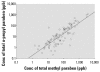
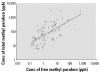
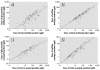
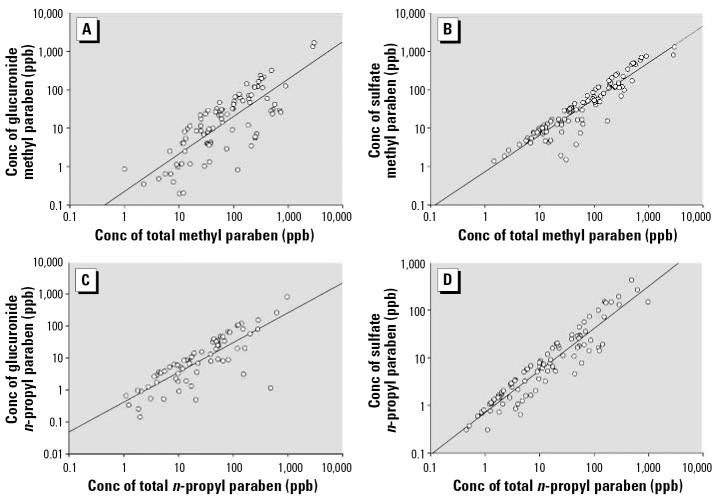
We measured the urinary concentrations of methyl, ethyl, n-propyl, butyl (n- and iso-), and benzyl parabens in a demographically diverse group of 100 anonymous adults. We detected methyl and n-propyl parabens at the highest median concentrations (43.9 ng/mL and 9.05 ng/mL, respectively) in nearly all (> 96%) of the samples. We also detected other parabens in more than half of the samples (ethyl, 58%; butyl, 69%). Most important, however, we found that parabens in urine appear predominantly in their conjugated forms.
Conclusions
The results, demonstrating the presence of urinary conjugates of parabens in humans, suggest that such conjugated parabens could be used as exposure biomarkers. Additionally, the fact that conjugates appear to be the main urinary products of parabens may be important for risk assessment. -
Subjects:
-
Source:Environ Health Perspect. 2006; 114(12):1843-1846.
-
Document Type:
-
Genre:
-
Volume:114
-
Issue:12
-
Download URL:
-
File Type:
 [PDF - 537.84 KB]
 -
Collection(s):
-
Main Document Checksum:urn:sha-512:e4981ac90f3ea5943fd47112d1dd20cb02aeacb9ce39ae82315e3bff49f8ff486e912571b9e11bcd832d957acdd4b2dd7406ad5a32fa0d3eccdef74168c5f1fe
Supporting Files


 Was this page helpful?
 Found an issue?



CDC STACKS serves as an archival repository of CDC-published products including
scientific findings, journal articles, guidelines, recommendations, or other public health information authored or
co-authored by CDC or funded partners.
As a repository, CDC STACKS retains documents in their original published format to ensure public access to scientific information.
As a repository, CDC STACKS retains documents in their original published format to ensure public access to scientific information.
You May Also Like
COLLECTION
CDC Public Access