


Blood Lead Levels and Death from All Causes, Cardiovascular Disease, and Cancer: Results from the NHANES III Mortality Study
Supporting Files
Public Domain

-
Oct 2006
-
File Language:
English
Details
-
Alternative Title:Environ Health Perspect
-
Personal Author:
-
Description:Background
Analyses of mortality data for participants examined in 1976–1980 in the second National Health and Nutrition Examination Survey (NHANES II) suggested an increased risk of mortality at blood lead levels > 20 μg/dL. Blood lead levels have decreased markedly since the late 1970s. In NHANES III, conducted during 1988–1994, few adults had levels > 20 μg/dL.
Objective
Our objective in this study was to determine the risk of mortality in relation to lower blood lead levels observed for adult participants of NHANES III.
Methods
We analyzed mortality information for 9,757 participants who had a blood lead measurement and who were ≥ 40 years of age at the baseline examination. Using blood lead levels categorized as < 5, 5 to < 10, and ≥ 10 μg/dL, we determined the relative risk of mortality from all causes, cancer, and cardiovascular disease through Cox proportional hazard regression analysis.
Results
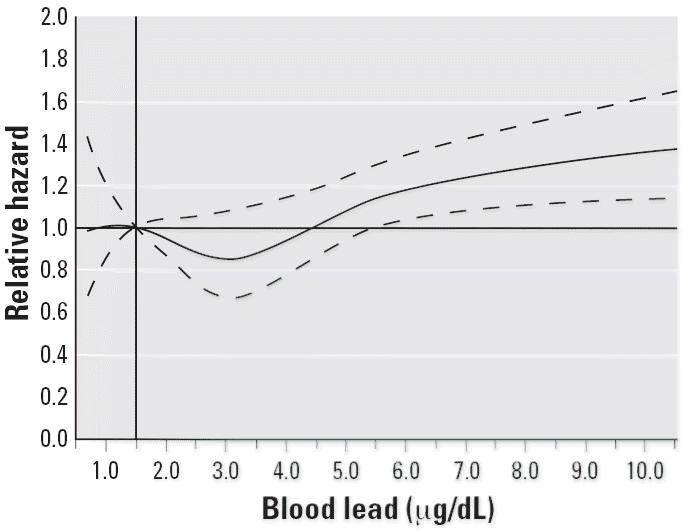
Using blood lead levels < 5 μg/dL as the referent, we determined that the relative risk of mortality from all causes was 1.24 [95% confidence interval (CI), 1.05–1.48] for those with blood levels of 5–9 μg/dL and 1.59 (95% CI, 1.28–1.98) for those with blood levels ≥ 10 μg/dL (p for trend < 0.001). The magnitude of risk was similar for deaths due to cardiovascular disease and cancer, and tests for trend were statistically significant (p < 0.01) for both causes of death.
Conclusion
In a nationally representative sample of the U.S. population, blood lead levels as low as 5–9 μg/dL were associated with an increased risk of death from all causes, cardiovascular disease, and cancer.
-
Subjects:
-
Source:Environ Health Perspect. 2006; 114(10):1538-1541.
-
Document Type:
-
Name as Subject:
-
Place as Subject:
-
Volume:114
-
Issue:10
-
Collection(s):
-
Main Document Checksum:urn:sha-512:6355b2f200e517f898c27065c7e430877e3c1fbab61e4803718cbe20de38c4636d7a2bc4c77159bf6a9f34981af600e2bf73ea7187d992555ae8ebce89c698e6
-
Download URL:
-
File Type:
 [PDF
- 122.39 KB
]
[PDF
- 122.39 KB
]
Supporting Files


File Language:
English
ON THIS PAGE

CDC STACKS serves as an archival repository of CDC-published products including
scientific findings,
journal articles, guidelines, recommendations, or other public health information authored or
co-authored by CDC or funded partners.
As a repository, CDC STACKS retains documents in their original published format to ensure public access to scientific information.
As a repository, CDC STACKS retains documents in their original published format to ensure public access to scientific information.
You May Also Like
COLLECTION
CDC Public Access