



THE EMERGENCE OF PARAPNEUMONIC EMPYEMA IN THE UNITED STATES
Supporting Files

-
May 26 2011
-
Available in CDC Stacks on 2016-04-04T00:00:00Z
File Language:
English
Details
-
Alternative Title:Thorax
-
Personal Author:
-
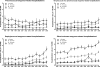
Description:BACKGROUND ; Although recent reports suggest the incidence of parapneumonic empyema increased in several regions of the United States, national trends in disease burden are unknown. We examined national trends in the incidence of parapneumonic empyema hospitalizations and changes in empyema by associated pathogens. ; METHODS ; National hospitalization data(1996–2008) were analyzed and rates estimated using Census estimates as denominators. Incidence rate ratios (IRR) compared 2008 with 1996 rates. Discharge diagnosis codes were used to characterize pathogens associated with empyema hospitalizations. ; RESULTS ; Overall, national parapneumonic empyema-related hospitalization rates increased from 3.04 per 100,000 in 1996 to 5.98 per 100,000 in 2008, a 2.0-fold increase (95% CI: 1.8–2.1). The increases were observed among children (IRR: 1.9 95% CI: 1.4–2.7) and adults aged 18–39, 40–64 and ≥65 years (IRRs: 1.8 95% CI: 1.5–2.1, 2.0 95% CI: 1.6–3.1 and 1.7 95% CI: 1.5–2.0, respectively). Overall pneumococcal empyema rates remained relatively stable in all age groups, whereas streptococcal (non-pneumococcal) and staphylococcal-related empyema rates increased 1.9 and 3.3-fold, respectively, with consistent increases across age groups. The overall in-hospital case fatality ratio for parapneumonic empyema-related hospitalizations was 8.0% (95% CI: 6.4–9.5) in 1996 and 7.2% (95% CI: 6.3–8.1) in 2008 (p=0.395). Of the empyemas where study pathogens were listed (37.6%), Staphylococcal-related empyema had the largest absolute increases across age groups and was associated with longer hospital stay and higher in-hospital mortality than other empyemas. ; CONCLUSIONS ; Although parapneumonic empyema-related hospitalizations remained relatively rare, they increased substantially during the study period. A number of pathogens, especially staphylococcus, contributed to this increase.
-
Subjects:
-
Source:Thorax. 66(8):663-668.
-
Pubmed ID:21617169
-
Pubmed Central ID:PMC4820002
-
Document Type:
-
Funding:
-
Place as Subject:
-
Volume:66
-
Issue:8
-
Download URL:
-
File Type:
 [PDF - 306.54 KB]
 -
Collection(s):
-
Main Document Checksum:urn:sha256:b8b16bd30c88250c4084a1c62b730a7c3e1c7355ab73793df0748b104e4b6a87
Supporting Files


File Language:
English
 Was this page helpful?
 Found an issue?



CDC STACKS serves as an archival repository of CDC-published products including
scientific findings, journal articles, guidelines, recommendations, or other public health information authored or
co-authored by CDC or funded partners.
As a repository, CDC STACKS retains documents in their original published format to ensure public access to scientific information.
As a repository, CDC STACKS retains documents in their original published format to ensure public access to scientific information.
You May Also Like
COLLECTION
CDC Public Access