


Urine sodium excretion increased slightly among U.S. adults between 1988–2010123
Supporting Files

-
5 2014
-
File Language:
English
Details
-
Alternative Title:J Nutr
-
Personal Author:
-
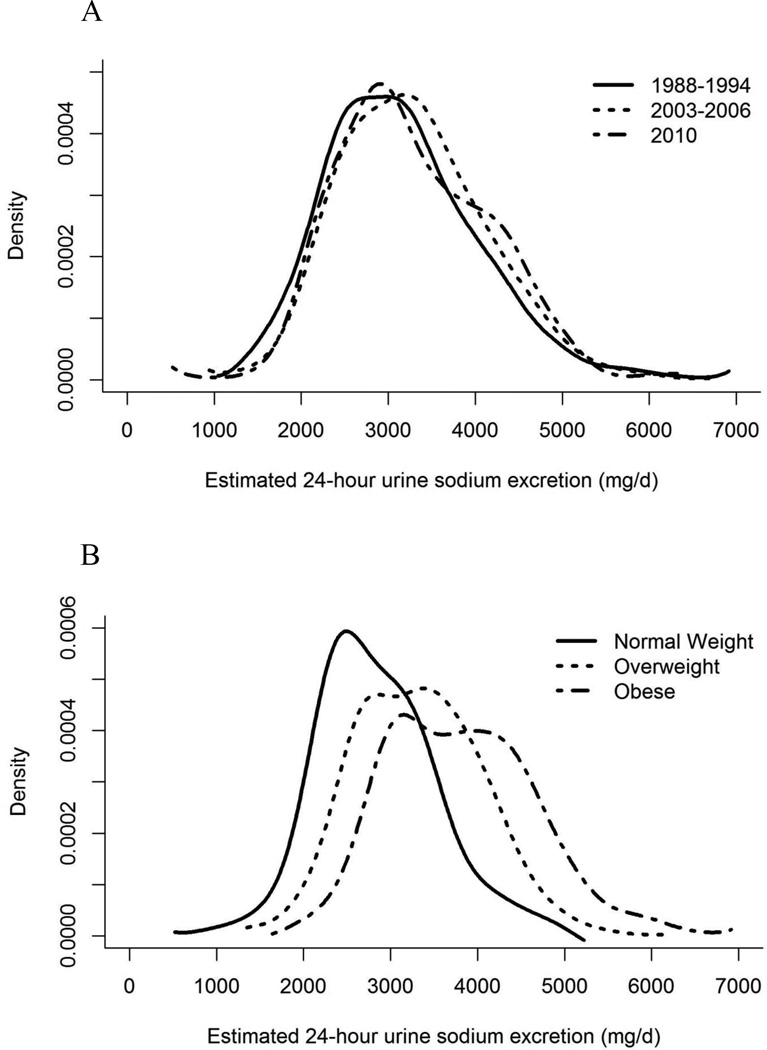
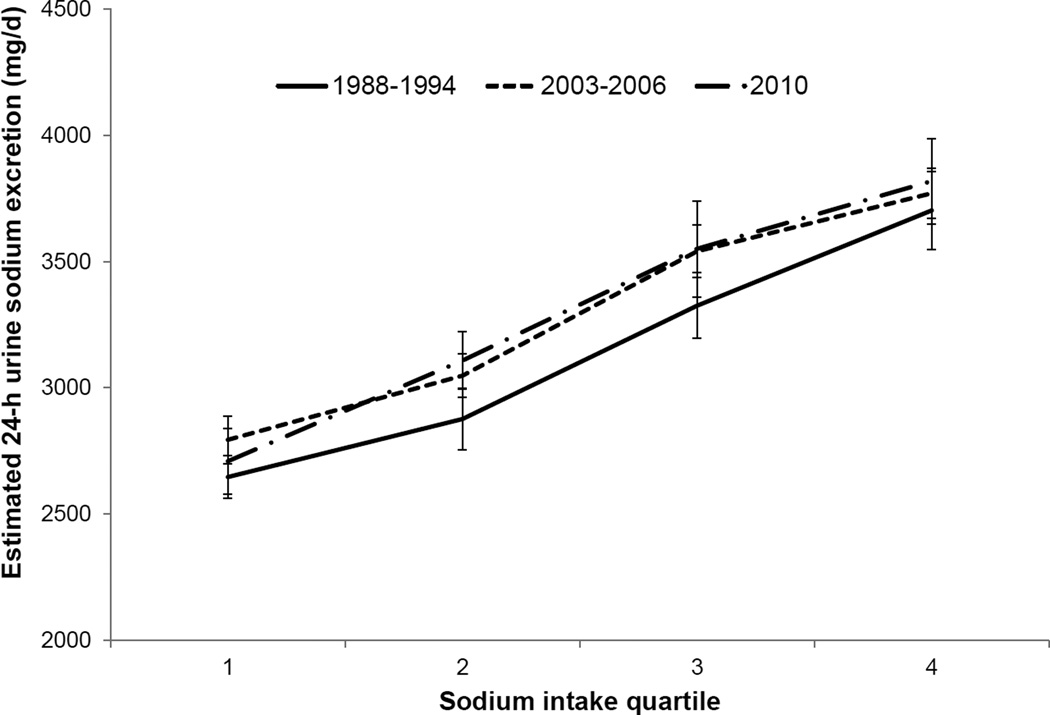
Description:Little information is available on temporal trends in sodium intake in the U.S. population using urine sodium excretion as a biomarker. Our aim was to assess 1988-2010 trends in estimated 24-h urine sodium (24hUNa) excretion among U.S. adults (age 20-59 y) participating in the cross-sectional NHANES. We used subsamples from a 1988-1994 convenience sample, a 2003-2006 one-third random sample, and a 2010 one-third random sample to comply with resource constraints. We estimated 24hUNa excretion from measured sodium concentrations in spot urine samples by use of calibration equations (for men and women) derived from the International Cooperative Study on Salt, Other Factors, and Blood Pressure study. Estimated 24hUNa excretion increased over the 20-y period [1988-1994, 2003-2006, and 2010; means ± SEMs (n): 3160 ± 38.4 mg/d (1249), 3290 ± 29.4 mg/d (1235), and 3290 ± 44.4 mg/d (525), respectively; P-trend = 0.022]. We observed significantly higher mean estimated 24hUNa excretion in each survey period (P < 0.001) for men compared with women (31-33%) and for persons with a higher body mass index (BMI; 32-35% for obese vs. normal weight) or blood pressure (17-26% for hypertensive vs. normal blood pressure). After adjusting for age, sex, and race-ethnicity, temporal trends in mean estimated 24hUNa excretion remained significant (P-trend = 0.004). We observed no temporal trends in mean estimated 24hUNa excretion among BMI subgroups, nor after adjusting for BMI. Although several limitations apply to this analysis (the use of a convenience sample in 1988-1994 and using estimated 24hUNa excretion as a biomarker of sodium intake), these first NHANES data suggest that mean estimated 24hUNa excretion increased slightly in U.S. adults over the past 2 decades, and this increase may be explained by a shift in the distribution of BMI.
-
Subjects:
-
Source:J Nutr. 144(5):698-705
-
Pubmed ID:24623847
-
Pubmed Central ID:PMC4806532
-
Document Type:
-
Funding:
-
Volume:144
-
Issue:5
-
Collection(s):
-
Main Document Checksum:urn:sha256:794674480a3202c8195b96456bcf142facf841560905c93bba10649368e119cf
-
Download URL:
-
File Type:
 [PDF
- 1000.86 KB
]
[PDF
- 1000.86 KB
]
Supporting Files


File Language:
English
ON THIS PAGE



CDC STACKS serves as an archival repository of CDC-published products including
scientific findings,
journal articles, guidelines, recommendations, or other public health information authored or
co-authored by CDC or funded partners.
As a repository, CDC STACKS retains documents in their original published format to ensure public access to scientific information.
As a repository, CDC STACKS retains documents in their original published format to ensure public access to scientific information.
You May Also Like
COLLECTION
CDC Public Access