


Urinary Concentrations of Phthalate Metabolites and Bisphenol A and Associations with Follicular-Phase Length, Luteal-Phase Length, Fecundability, and Early Pregnancy Loss
Supporting Files
Public Domain

-
Jul 10 2015
-
Details
-
Alternative Title:Environ Health Perspect
-
Personal Author:Jukic, Anne Marie ; Calafat, Antonia M. ; McConnaughey, D. Robert ; Longnecker, Matthew P. ; Hoppin, Jane A. ; Weinberg, Clarice R. ; Wilcox, Allen J. ; Baird, Donna D. ; Calafat, Antonia M. ; McConnaughey, D. Robert ; Longnecker, Matthew P. ; Hoppin, Jane A. ; Weinberg, Clarice R. ; Wilcox, Allen J. ; Baird, Donna D.
-
Description:Background
Certain phthalates and bisphenol A (BPA) show reproductive effects in animal studies and potentially affect human ovulation, conception, and pregnancy loss.
Objectives
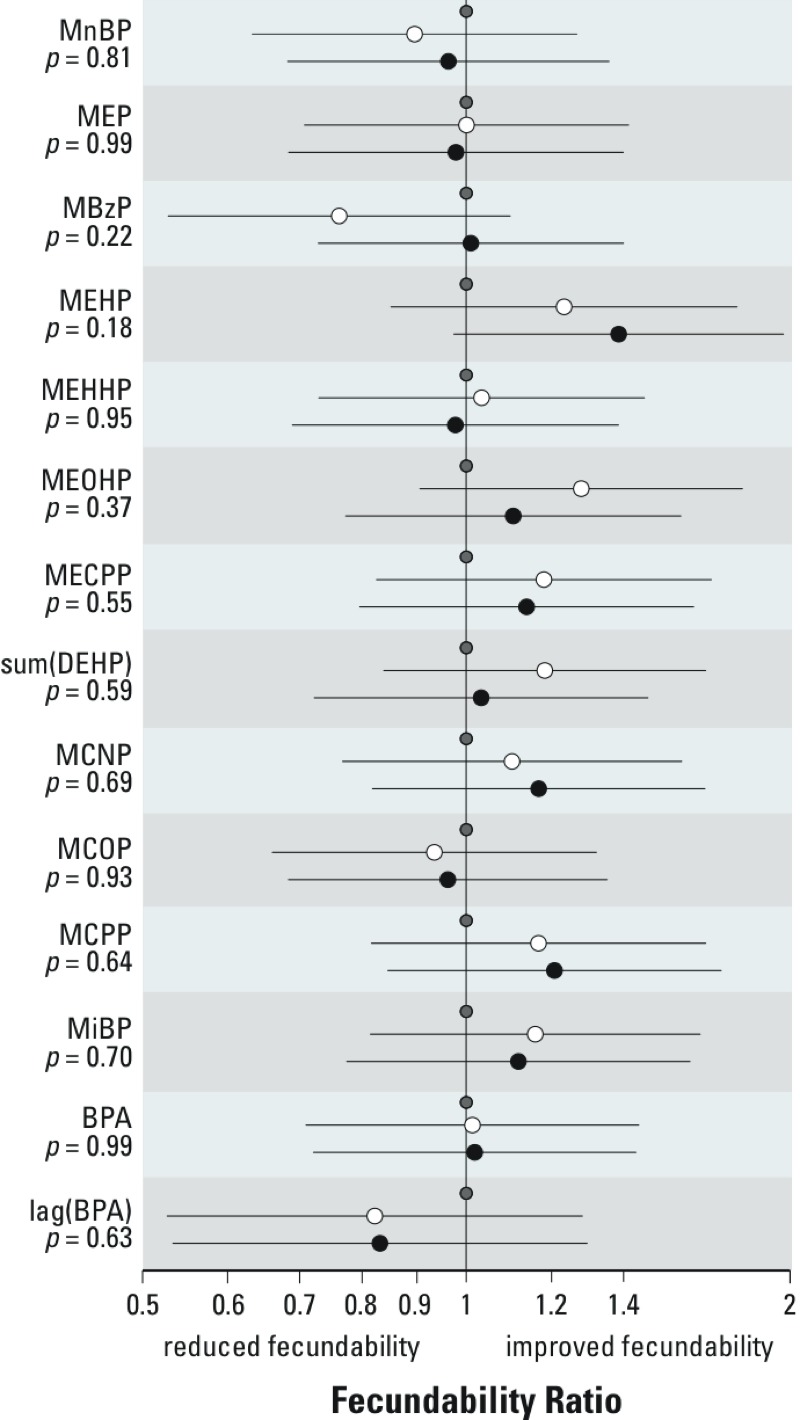
We investigated these chemicals in relation to follicular- and luteal-phase lengths, time to pregnancy, and early pregnancy loss (within 6 weeks of the last menstrual period) among women attempting pregnancy.
Methods
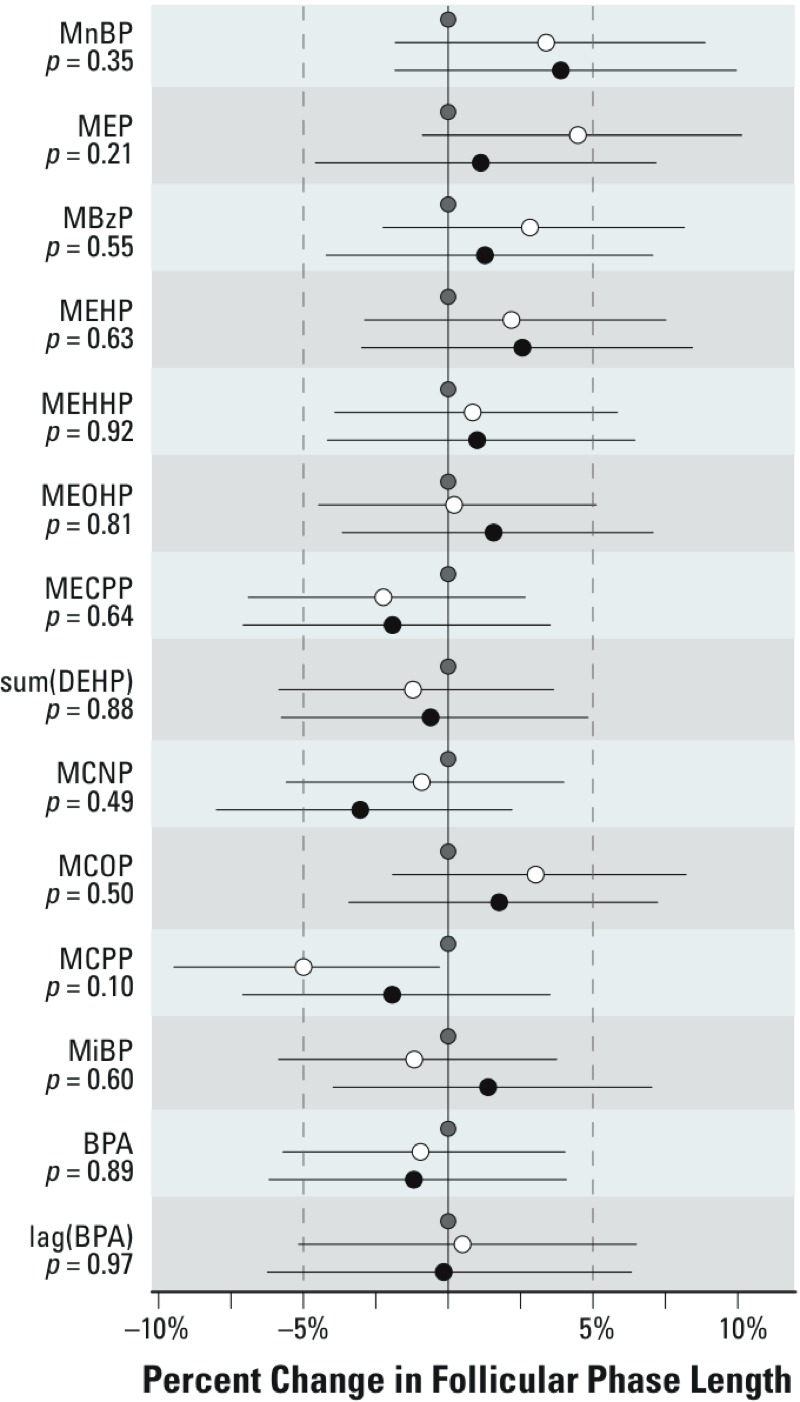
Women discontinuing contraception provided daily first-morning urine specimens and recorded days with vaginal bleeding for up to 6 months. Specimens had previously been analyzed for estrogen and progesterone metabolites and human chorionic gonadotropin. A total of 221 participants contributed 706 menstrual cycles. We measured 11 phthalate metabolites and BPA in pooled urine from three specimens spaced throughout each menstrual cycle. We analyzed associations between chemical concentrations and outcomes using linear mixed models for follicular- and luteal-phase lengths, discrete-time fecundability models for time to pregnancy, and logistic regression for early pregnancy loss.
Results
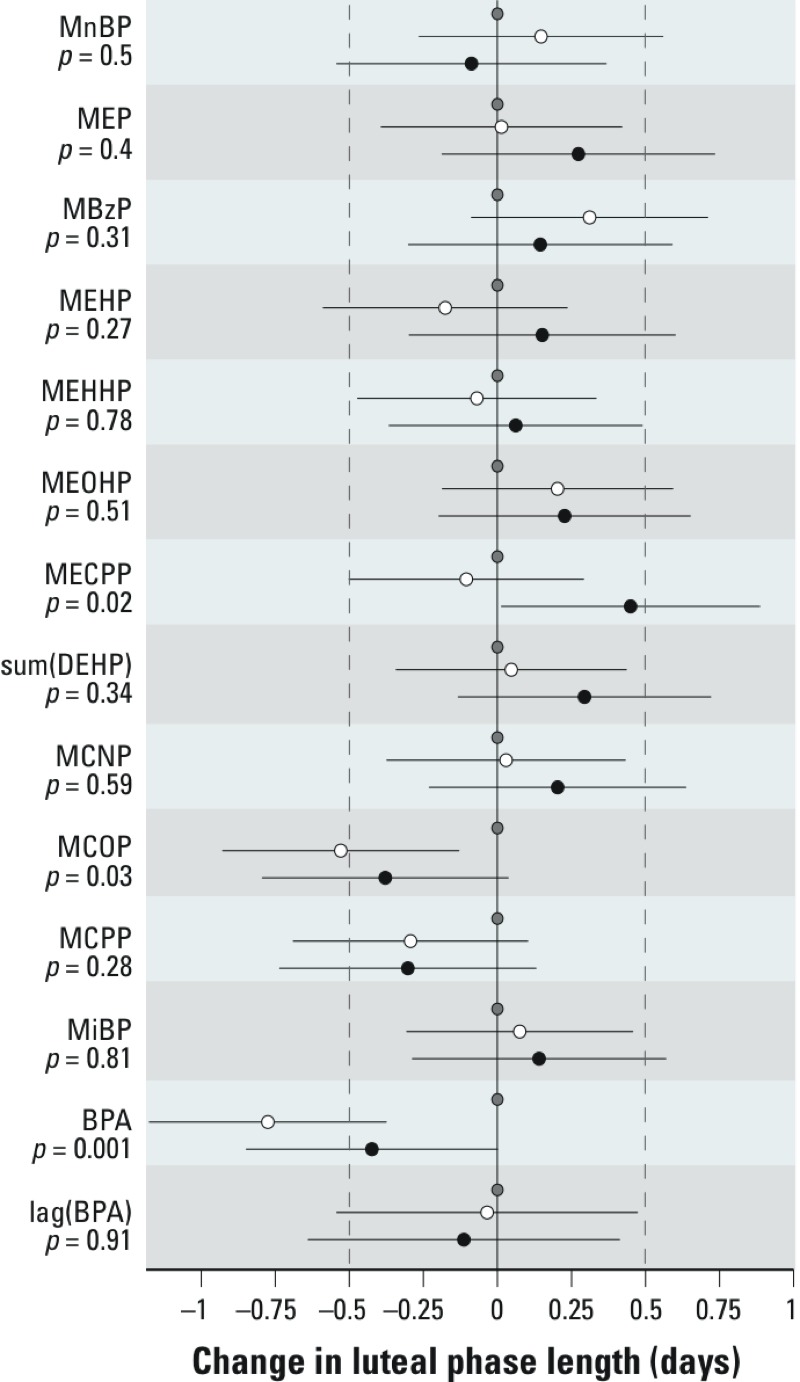
Higher concentrations of monocarboxyoctyl phthalate (MCOP) were associated with shorter luteal phase [2nd tertile vs. 1st tertile: –0.5 days (95% CI: –0.9, –0.1), 3rd vs. 1st: –0.4 days (95% CI: –0.8, 0.01), p = 0.04]. BPA was also associated with shorter luteal phase [2nd vs. 1st: –0.8 days (95% CI: –1.2, –0.4), 3rd vs. 1st: –0.4 days (95% CI: –0.8, 0.02), p = 0.001].
Conclusions
BPA and MCOP (or its precursors) were associated with shorter luteal phase. Menstrual cycle–specific estimates of urinary BPA and phthalate metabolites were not associated with detrimental alterations in follicular-phase length, time to pregnancy, or early pregnancy loss, and in fact, DEHP [di(2-ethylhexyl) phthalate] metabolites {MEOHP [mono(2-ethyl-5-oxohexyl) phthalate] and ΣDEHP} were associated with reduced early loss. These findings should be confirmed in future human studies.
Citation
Jukic AM, Calafat AM, McConnaughey DR, Longnecker MP, Hoppin JA, Weinberg CR, Wilcox AJ, Baird DD. 2016. Urinary concentrations of phthalate metabolites and bisphenol A and associations with follicular-phase length, luteal-phase length, fecundability, and early pregnancy loss. Environ Health Perspect 124:321–328; http://dx.doi.org/10.1289/ehp.1408164
-
Subjects:
-
Source:Environ Health Perspect. 124(3):321-328.
-
Pubmed ID:26161573
-
Pubmed Central ID:PMC4786975
-
Document Type:
-
Volume:124
-
Issue:3
-
Collection(s):
-
Main Document Checksum:urn:sha256:d730601b0a4864ca2e169d6caf304f5a92637757555abc76ac71545aec144550
-
Download URL:
-
File Type:
 [PDF
- 636.64 KB
]
[PDF
- 636.64 KB
]
Supporting Files


ON THIS PAGE




CDC STACKS serves as an archival repository of CDC-published products including
scientific findings,
journal articles, guidelines, recommendations, or other public health information authored or
co-authored by CDC or funded partners.
As a repository, CDC STACKS retains documents in their original published format to ensure public access to scientific information.
As a repository, CDC STACKS retains documents in their original published format to ensure public access to scientific information.
You May Also Like
COLLECTION
CDC Public Access