


Bacteria associated with Amblyomma cajennense tick eggs
Supporting Files
Public Domain

-
Nov 03 2015
Details
-
Alternative Title:Genet Mol Biol
-
Personal Author:
-
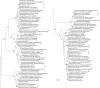
Description:Ticks represent a large group of pathogen vectors that blood feed on a diversity of hosts. In the Americas, the Ixodidae ticks Amblyomma cajennense are responsible for severe impact on livestock and public health. In the present work, we present the isolation and molecular identification of a group of culturable bacteria associated with A. cajennense eggs from females sampled in distinct geographical sites in southeastern Brazil. Additional comparative analysis of the culturable bacteria from Anocentor nitens, Rhipicephalus sanguineus and Ixodes scapularis tick eggs were also performed. 16S rRNA gene sequence analyses identified 17 different bacterial types identified as Serratia marcescens, Stenotrophomonas maltophilia, Pseudomonas fluorescens, Enterobacter spp., Micrococcus luteus, Ochrobactrum anthropi, Bacillus cereus and Staphylococcus spp., distributed in 12 phylogroups. Staphylococcus spp., especially S. sciuri, was the most prevalent bacteria associated with A. cajennense eggs, occurring in 65% of the samples and also frequently observed infecting A. nitens eggs. S. maltophilia, S. marcescens and B. cereus occurred infecting eggs derived from specific sampling sites, but in all cases rising almost as pure cultures from infected A. cajennense eggs. The potential role of these bacterial associations is discussed and they possibly represent new targets for biological control strategies of ticks and tick borne diseases.
-
Subjects:
-
Source:Genet Mol Biol. 2015; 38(4):477-483.
-
Pubmed ID:26537602
-
Pubmed Central ID:PMC4763323
-
Document Type:
-
Volume:38
-
Issue:4
-
Collection(s):
-
Main Document Checksum:urn:sha256:1379e2c520bc288deec71fb1e673ccf51eade9f0d851ed517a7a1e68a422b8c8
-
Download URL:
-
File Type:
 [PDF
- 939.34 KB
]
[PDF
- 939.34 KB
]


ON THIS PAGE


CDC STACKS serves as an archival repository of CDC-published products including
scientific findings,
journal articles, guidelines, recommendations, or other public health information authored or
co-authored by CDC or funded partners.
As a repository, CDC STACKS retains documents in their original published format to ensure public access to scientific information.
As a repository, CDC STACKS retains documents in their original published format to ensure public access to scientific information.
You May Also Like
COLLECTION
CDC Public Access